Lesson 03 — Orders of Magnitude: Thinking in Powers of Ten
Learners reason about large systems by thinking in orders of magnitude — powers of ten — and by estimating (Fermi problems). They round populations, energy, and carbon to the nearest power of ten, place real quantities on a ladder of tenfold jumps, and meet the decimal place-value system as a shared human invention with roots in India and record- keeping traditions like the Inka quipu.
Objectives
Objectives
- D05.S1.12.02 Reason quantitatively about large systems such as populations, energy use, or carbon, using orders of magnitude and estimation, and critique the numbers used in public claims.
Essential question
How do I use orders of magnitude and estimation to reason about populations, energy, and carbon?
Key vocabulary
Materials
Standard materials
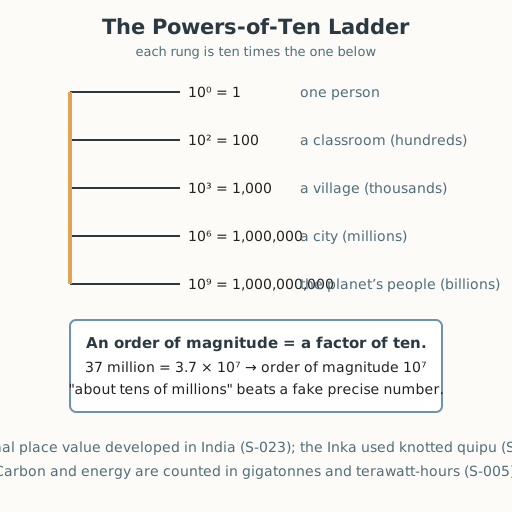
- Powers-of-ten ladder sheet · 1 per learner A ladder from 10^0 to 10^9 with real-world anchors to place a quantity on
- Math journal · 1 per learner
Low-tech / no-cost
- Counters, grains, or seeds Pile and group by tens to *feel* how 10, 100, 1000 grow — a decimal system in your hands
- Blank paper folded into a decimal grid A hand-drawn place-value chart to anchor powers of ten
Enriched / lab & device
- A live data page (Our World in Data or similar) · 1 per pair Real population, energy, and carbon figures to place on the ladder and round
Works in different contexts
- large-group Build the ladder whole-class, then pairs place given quantities and argue the nearest power of ten
- multi-age Younger learners group seeds by tens; older learners round large figures to their order of magnitude
- self-directed A learner builds the ladder, places real quantities, and answers two Fermi problems
- level-grouped A ready group also distinguishes "3×10^7" from "10^8" by a factor-of-3 check and debates which matters
- outdoor-only Estimate the number of leaves on a bush, grains in a handful, or people in a square, then round to a power of ten
Lesson 3 — Orders of Magnitude: Thinking in Powers of Ten
Summary
Learners reason about large systems by thinking in orders of magnitude — powers of ten — and by estimating (Fermi problems). They round populations, energy, and carbon to the nearest power of ten, place real quantities on a ladder of tenfold jumps, and meet the decimal place-value system as a shared human invention with roots in India and in record-keeping traditions like the Inka quipu.
Objectives
- Reason quantitatively about large systems using orders of magnitude and estimation. (D05.S1.12.02)
Connection
“One billion” sounds like “one million” until you feel the jump: a million seconds is about 11.6 days; a billion seconds is about 31.7 years. Thinking in powers of ten — one, ten, a hundred, a thousand, a million — lets you hold enormous systems (a city’s population, a nation’s energy, the planet’s carbon) in your head and check whether a number is even in the right ballpark. Every person can do this with a place-value chart and a little practice.
Materials
- Powers-of-ten ladder sheet
- Math journal
- Low-tech: counters or seeds, paper folded into a decimal grid
Preparation
- Copy or draw the ladder; prepare a seed/counter tray for the ten-grouping demo.
- Retrieval: from Grade 11, exponents and scientific notation (D05.S1.11.01); from Grade 9, large and small numbers. Today we use powers of ten to estimate and place.
- Prepare two Fermi problems to model first (S-011).
Facilitator note
This lesson is written to the learner (“you”). The idea to land: an order of magnitude is a factor of ten; reasoning about large systems means rounding a quantity to its nearest power of ten and checking whether that is even plausible. Teach the ladder and one Fermi problem explicitly, then let learners estimate freely and compare (S-011). Estimation is a skill with a right answer range, not a guess — feedback comes from comparing to a known anchor.
The ethics lens: an order-of-magnitude check is an honesty tool — it catches claims that are ten or a hundred times off before they spread. The egalitarianism lens: powers of ten need only a place-value chart; they put a billion and a hundred on the same ladder for anyone to compare. The global lens: the decimal place-value system with ten symbols and a zero was developed in India and carried through the Arabic-speaking world to Europe (S-023, S-272, S-295); the Inka recorded decimal quantities on knotted cords, the quipu (S-473); the Maya wrote a place-value system with zero of their own (S-378). No single tradition owns “ten.” The technology lens: computing is built on powers of two that we still speak of in powers of ten — kilobytes, megabytes, giga-, tera-. The environment lens: carbon and energy are talked about in gigatonnes and terawatt-hours — orders of magnitude are the natural units of the living Earth (S-005, S-006). Preview: Lesson 4 uses these tools to critique a public claim.
Procedure
- Recall (5 min). From Grade 11: 10^3 = 1000, 10^6 = a million, 10^9 = a billion. Each rung is ten times the one below.
- Feel the jump (8 min). Group seeds: a pile of 10, then 100, then 1000. Notice the pile feels the same until you see it is ten times bigger. A million seconds ≈ 11.6 days; a billion seconds ≈ 31.7 years. One rung up is a different world.
- Build the ladder (10 min). Write 10^0 (one) up to 10^9 (one billion). Anchor each rung with something real: one person (10^0); a classroom (10^1); a village (10^3); a city (10^6); the planet’s people (10^9). This ladder is your measuring stick.
- Worked example — place a quantity (10 min). A country has about 37 million people. Is that closer to 10^7 (10 million) or 10^8 (100 million)? 37 million = 3.7×10^7, so its order of magnitude is 10^7 (a factor of 10 below 10^8). Say it — aloud or in writing, sign, gesture, or AAC: “about tens of millions.” Placing it lets you compare countries without memorizing digits.
- Fermi problem — estimate by steps (12 min). Worked example first: about how many breaths do you take in a day? Estimate breaths per minute (~15), minutes per hour (60), hours per day (24): 15 × 60 × 24 ≈ 21,600 ≈ 2×10^4 breaths a day. Then, with a partner, estimate how many people could stand in your school field (estimate area, then people per square meter). Compare ranges and say — or write, sign, gesture, or use AAC to show — your order of magnitude.
- Place real data (8 min). With a partner, place on the ladder: your country’s population; world population (~8 billion); a nation’s annual energy use; the planet’s yearly carbon emissions (tens of gigatonnes). Round each to its nearest power of ten.
- Close (2 min). Say — or write, sign, gesture, or use AAC to express — why “tens of millions” is often a better answer than a precise fake number.
Differentiation
- Support: Work only on the ladder from 10^0 to 10^4 with seeds, placing familiar quantities before tackling billions.
- Extension: For two quantities of different orders of magnitude, compute the ratio and say “this is about ten (or a hundred, or a thousand) times that.”
- Number access (dyscalculia): Provide the step-3 powers-of-ten ladder pre-printed with the anchor words (one person, a classroom, a village, a city, a billion people) already on the rungs, so placing a quantity is matching rather than counting zeros; offload the Fermi arithmetic (15 × 60 × 24) to a calculator or a pre-computed anchors table; and take the verbal route — count the rungs between two quantities and say “this is ten times that,” concluding “tens of millions” aloud without multiplying.
- Communication access: Every spoken step — saying, naming, reading aloud, discussing, or closing — can be done in writing, sign, gesture, or AAC instead. Learners who are non-speaking, d/Deaf, hard-of-hearing, or who use AAC complete every task in their preferred mode; no step requires producing or hearing sound.
Assessment
- Formative (peer + self): Can the learner build the ladder, round a quantity to its nearest power of ten, and complete a Fermi estimate with a defensible range?
- Portfolio artifact (unit): The completed ladder with three real quantities placed, plus one Fermi estimate with its steps, in the math journal.
Home connection
Estimate something large at home — grains of rice in a bag, people in a market, cars on a road in a day. Write the estimate as a power of ten and one sentence on what anchor you used.
Resources
- On worked examples and guided practice: Kirschner, Sweller & Clark (2006) (S-011).
- On the decimal place-value system’s Indian origin and spread: Ifrah, The Universal History of Numbers (S-023); Joseph, The Crest of the Peacock (S-272); MacTutor — Indian numerals (S-295). On the Inka quipu: Britannica — quipu (S-473). On Maya numeration: Britannica — Maya (S-378).
- On global energy and carbon figures: IPCC (S-005); Our World in Data (S-006).