Lesson 04 — Critiquing the Numbers in Public Claims
Learners put orders of magnitude to work on real public claims about populations, energy, and carbon: they estimate what the number *should* be, compare it to the claim, and write a verdict of plausible or not. They learn the back-of-the-envelope check as an everyday honesty tool, and distinguish evidence (what the numbers say) from values (what we should do about them).
Objectives
Objectives
- D05.S1.12.02 Reason quantitatively about large systems such as populations, energy use, or carbon, using orders of magnitude and estimation, and critique the numbers used in public claims.
Essential question
How do I use orders of magnitude and estimation to critique the numbers used in public claims?
Key vocabulary
Materials
Standard materials
- Claim-critique sheet · 1 per learner A claim, a box for the estimate, a box for the comparison, and a verdict line
- Math journal · 1 per learner
Low-tech / no-cost
- A printed or hand-copied news headline with a number Any public claim with a number works — the bigger the number, the better the exercise
- Scratch paper For back-of-the-envelope arithmetic
Enriched / lab & device
- A live data page (Our World in Data, IPCC summary) · 1 per pair To check an estimate against an authoritative figure and see how far off the claim is
Works in different contexts
- large-group Critique one claim whole-class, then pairs each take a different claim and report their verdicts
- multi-age Younger learners check "is this number bigger than a city or bigger than a country?"; older learners compute per capita and verdicts
- self-directed A learner runs the four-step critique on a real claim and writes the verdict with evidence
- level-grouped A ready group also computes per capita figures and explains why "total" can hide "per person"
- outdoor-only Estimate something claimable outdoors — water used by a field, people in a market — and check the number claimed
Lesson 4 — Critiquing the Numbers in Public Claims
Summary
Learners put orders of magnitude to work on real public claims about populations, energy, and carbon: they estimate what the number should be, compare it to the claim, and write a verdict of plausible or not. They learn the back-of-the-envelope check as an everyday honesty tool, and distinguish evidence (what the numbers say) from values (what we should do about them).
Objectives
- Reason quantitatively about large systems and critique the numbers used in public claims. (D05.S1.12.02)
Connection
A headline says a country will “use one hundred times more energy by 2050,” or that a new project will “power a million homes.” Before you repeat it, you can check it: does a million homes match the order of magnitude of the country’s population? Is “one hundred times” even possible in one generation? A quick estimate turns you from someone who receives numbers into someone who checks them — a skill that matters wherever public decisions are made, from a village meeting to a national energy plan.
Materials
- Claim-critique sheet
- Math journal
- Low-tech: a headline with a number, scratch paper
Preparation
- Gather two or three real, recent claims with large numbers (energy, population, carbon).
- Retrieval: from Lesson 3, the powers-of-ten ladder and Fermi estimation. Today we aim them at a claim.
- Prepare the four-step critique as a worked example to model first (S-011).
Facilitator note
This lesson is written to the learner (“you”). The idea to land: a four-step check — read the claim, estimate what the number should be, compare, and write a verdict — turns orders of magnitude into a working honesty tool. Teach the worked example explicitly, then let learners run the loop on fresh claims (S-011). Keep two things distinct: the factual question (is the number even plausible?) and the value question (what should be done?), because conflating them is exactly what misleading claims exploit.
The ethics lens: checking a number before repeating it is a small act of honesty that compounds in public life. The egalitarianism lens: the skill is free and universal — it puts a citizen and a headline on the same footing, and it protects the people a false number would harm (a mis-stated risk, an inflated benefit). The global lens: the same check applies in every place; a per-capita reading (“per person,” not just “total”) keeps big countries from dwarfing small ones by raw size (S-006). The technology lens: the numbers we check increasingly arrive through feeds and dashboards, so the skill scales to screens as much as to print. The environment lens: energy and carbon claims are where this matters most — gigatonnes, terawatt-hours, and “homes powered” are checkable against authoritative climate data (S-005, S-006). Preview: Lesson 5 begins modeling systems with equations.
Procedure
- Recall (5 min). From Lesson 3, name the rungs of the ladder and one Fermi problem you solved. Today the ladder becomes a lie-detector.
- Read the claim (6 min). “A new power plant will supply electricity to 10 million homes.” Read it aloud and underline the number and the thing it counts.
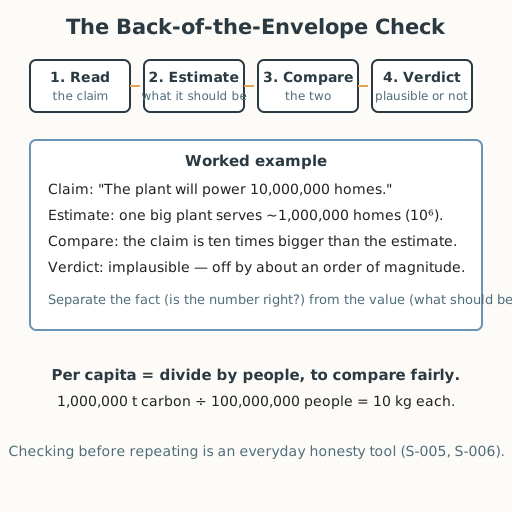
- Worked example — the four-step check (15 min). (1) Estimate: how many homes does one power plant roughly serve? A big plant is on the order of 1 GW; a home draws on the order of a few kW, so roughly 10^5 to 10^6 homes — a million at most. (2) Compare: the claim says 10 million, ten times more. (3) Verdict: implausible — off by about an order of magnitude. (4) Say — or write, sign, gesture, or use AAC to show — what you’d need to believe it: a plant ten times bigger than any built. Write all four steps.
- Per capita (6 min). A raw total can hide the per-person story: 1 million tonnes of carbon sounds enormous, but across 100 million people it is 10 kg each. Compute per capita to compare fairly.
- Critique a fresh claim (15 min). With a partner, run the four-step check on a different claim (energy, population, or carbon). Estimate, compare, and write a verdict with the reasoning visible. Be ready to say — or write, sign, gesture, or use AAC to show — whether the number is wrong or whether you simply disagree with the values behind it — those are different.
- Share and check (6 min). Pairs exchange verdicts and check each other’s estimate — does the order of magnitude hold up? Give one specific improvement.
- Close (2 min). Say — or write, sign, gesture, or use AAC to express — what a “plausibility check” is and why “I don’t know the exact number” is not an excuse to skip it.
Differentiation
- Support: Check only whether the claim is “bigger than a city or bigger than a country,” using the ladder, before computing anything.
- Extension: Write a corrected, honest version of the claim, and state the per-capita figure with the comparison to an authoritative source.
- Number access (dyscalculia): Use the step-3 claim-critique sheet as a pre-printed organizer — boxes for “estimate,” “compare,” and “verdict” already labeled — so the learner fills phrases rather than computations; offload the per-capita division (1 million tonnes ÷ 100 million people) to a partner or calculator; and take the verbal route — ask only “is this number bigger than a city or bigger than a country?” and answer in words, reaching the plausibility verdict without any arithmetic.
- Communication access: Every spoken step — saying, naming, reading aloud, discussing, or closing — can be done in writing, sign, gesture, or AAC instead. Learners who are non-speaking, d/Deaf, hard-of-hearing, or who use AAC complete every task in their preferred mode; no step requires producing or hearing sound.
Assessment
- Formative (peer + self): Can the learner estimate an order of magnitude for a claimed quantity, compare it to the claim, and write a reasoned verdict separating fact from value?
- Portfolio artifact (unit): One completed claim critique with all four steps, added to the math journal.
Home connection
Find one number in a news story or ad at home, estimate what it should be, and write one sentence verdict: plausible or not, and why. Bring the claim and your check to share.
Resources
- On worked examples and guided practice: Kirschner, Sweller & Clark (2006) (S-011).
- On global energy, carbon, and per-capita figures to check against: IPCC (S-005); Our World in Data (S-006).