Lesson 05 — Systems of Relationships as Equations
Learners model a system of relationships — two constraints, two unknowns — as a pair of equations, solve it by substitution or elimination, and interpret the solution in its real context. They meet the Chinese *fangcheng* method for systems of equations as an early example of the same idea, and learn that a solution is a point where every relationship holds at once.
Objectives
Objectives
- D05.S2.12.01 Model systems of relationships with equations or matrices and interpret the meaning of a solution in a real context.
Essential question
How do I model a system of relationships with equations and interpret what the solution means in a real context?
Key vocabulary
Materials
Standard materials
- Systems problem sheet · 1 per learner Two real scenarios to model, solve, and interpret, with a worked example first
- Math journal · 1 per learner
Low-tech / no-cost
- Two kinds of counters or coins Build "two equations, two unknowns" by physically combining two kinds of item into known totals
- Grid paper Draw the two lines and read their intersection as the solution
Enriched / lab & device
- Spreadsheet or graphing tool · 1 per learner or pair Graph both equations at once and zoom to the intersection to confirm the algebraic solution
Works in different contexts
- large-group Model and solve one system whole-class, then pairs model a second and present their interpretation
- multi-age Younger learners solve "two items, two totals" by guess-and-check with counters; older learners use elimination and interpret
- self-directed A learner follows the worked example, models a fresh scenario, and checks the solution in the original context
- level-grouped A ready group also explains what "no solution" and "infinitely many" mean for a real situation (parallel or identical lines)
- outdoor-only Use a market or field scenario — two goods, two constraints — drawn in the dirt or on slate
Lesson 5 — Systems of Relationships as Equations
Summary
Learners model a system of relationships — two constraints, two unknowns — as a pair of equations, solve it by substitution or elimination, and interpret the solution in its real context. They meet the Chinese fangcheng method for systems of equations as an early example of the same idea, and learn that a solution is the point where every relationship holds at once.
Objectives
- Model systems of relationships with equations and interpret the meaning of a solution in a real context. (D05.S2.12.01)
Connection
A stall sells two things — say, rice and beans — and you know two facts: the total number of bags sold and the total money taken. Neither fact alone tells you how much was rice and how much was beans, but together they pin it down to one pair. That pair is the solution of a system of equations: the one combination that satisfies every relationship at once. The same shape shows up wherever two constraints meet — a budget and a goal, supply and demand, two recipes to blend.
Materials
- Systems problem sheet
- Math journal
- Low-tech: two kinds of counters, grid paper
Preparation
- Copy or draw the problem sheet with two model-then-solve scenarios.
- Retrieval: from Grade 9–11, solving one linear equation and graphing a line. Today we solve two equations that must be true together.
- Prepare the worked example (a two-goods market scenario) to model first (S-011).
Facilitator note
This lesson is written to the learner (“you”). The idea to land: a system of equations holds several relationships at once; the solution is the pair that satisfies all of them, and it means something concrete in context — an amount, a price, a time. Teach substitution and elimination as procedures with a worked example and guided practice (S-011), and always close by re-reading the answer in the original situation (the interpretation is the point, not the arithmetic alone).
The ethics lens: modeling forces you to name your assumptions and check the answer against reality — honesty about whether the model fits. The egalitarianism lens: the method is a shared, checkable procedure; anyone who can add and substitute can verify a solution, so no answer has to be taken on authority. The global lens: the Nine Chapters on the Mathematical Art (China, c. 200 BCE) solved systems of linear equations with a method called fangcheng — the ancestor of what we now call elimination — using counting rods and negative numbers (S-289); Brahmagupta in 7th-century India wrote rules for arithmetic with “debts” (negatives) that make the same moves work (S-290). The technology lens: every solver on a phone runs elimination in disguise — the same two moves, done fast. The environment lens: blending fuels, mixing a fertilizer to a specification, or balancing a diet’s cost and nutrition are all systems — and a “solution” that violates a constraint (too much carbon, too little nutrient) is a red flag, not a success. Preview: Lesson 6 scales this up to matrices.
Procedure
- Recall (5 min). From past grades: solve 2x = 8, and graph a line. One equation pins down one number; two equations can pin down two.
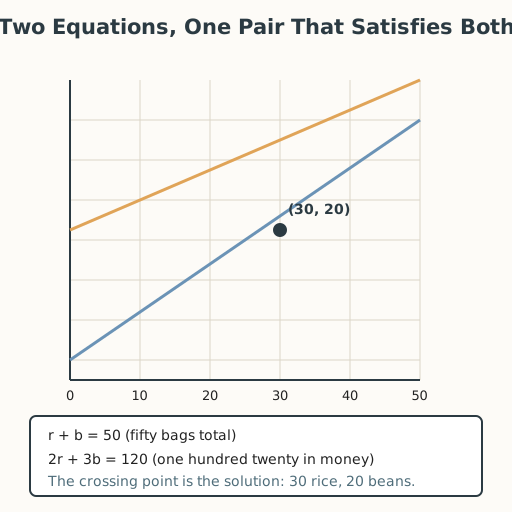
- Two facts, one pair (8 min). A stall sells bags of rice at 2 and beans at 3. You know: 50 bags total (r + b = 50) and 120 in money (2r + 3b = 120). Each equation is a relationship; together they make a system.
- Worked example — solve by substitution (15 min). From r + b = 50, write r = 50 − b. Substitute into 2r + 3b = 120: 2(50 − b) + 3b = 120, so 100 + b = 120, b = 20, and r = 30. Check both facts: 30 + 20 = 50 ✓; 2·30 + 3·20 = 120 ✓. Interpret: 30 bags of rice and 20 of beans.
- Solve by elimination (8 min). Same system, second way: subtract 2×(first equation) from the second to make r vanish, leaving b = 20 directly. Both moves are the same idea — remove one unknown to see the other.
- Read the graph (5 min). Each equation is a line; their intersection is the solution — the one point on both. A system with no meeting point (parallel lines) has no solution; two identical lines have infinitely many.
- Guided practice (12 min). With a partner, model a fresh scenario (two goods, two totals), solve by substitution and elimination, and write one sentence saying what the numbers mean in the situation. Swap and check each other’s interpretation.
- Close (2 min). Say — or write, sign, gesture, or use AAC to express — what a solution to a system means, beyond “the numbers.”
Differentiation
- Support: Solve by guess-and-check with counters first, then translate the winning guess into the equations.
- Extension: Set up a three-variable system (three goods, three totals) and solve it, then explain when a system can have no solution in a real context.
- Number access (dyscalculia): Keep a visible worked-step card for substitution (r = 50 − b, so b = 20, so r = 30) and one for elimination to copy line by line; offload the check arithmetic (30 + 20 = 50 and 2·30 + 3·20 = 120) to a partner or calculator; and build the same pair with two colors of counters, then say in words “twenty bags of beans and thirty of rice makes both facts true” to reach and state the solution without symbol-crunching.
- Communication access: Every spoken step — saying, naming, reading aloud, discussing, or closing — can be done in writing, sign, gesture, or AAC instead. Learners who are non-speaking, d/Deaf, hard-of-hearing, or who use AAC complete every task in their preferred mode; no step requires producing or hearing sound.
Assessment
- Formative (peer + self): Can the learner write a system from a scenario, solve it two ways, and interpret the solution in context (in speech, writing, sign, or AAC) with a check?
- Portfolio artifact (unit): One modeled system with both solution methods and a written interpretation, in the math journal.
Home connection
Find two facts about the same two things at home (prices and totals, distances and times) and write them as a system. Solve it and write one sentence on what the answer means.
Resources
- On worked examples and guided practice: Kirschner, Sweller & Clark (2006) (S-011).
- On the Chinese fangcheng method for systems of equations: MacTutor — Nine Chapters on the Mathematical Art (S-289); on Brahmagupta’s rules for negatives: MacTutor — Brahmagupta (S-290).