Lesson 06 — Matrices as Many Equations at Once
Learners rewrite a system of equations as an augmented matrix and solve it by row reduction — the same elimination moves from Lesson 5, performed on a grid — then interpret the solution in context. They connect the grid to the ancient Chinese *fangcheng* array and the Lo Shu square as early array-like objects, and see the matrix as the form a computer actually solves.
Objectives
Objectives
- D05.S2.12.01 Model systems of relationships with equations or matrices and interpret the meaning of a solution in a real context.
Essential question
How does a matrix hold a whole system of equations, and what does its solution mean in a real context?
Key vocabulary
Materials
Standard materials
- Matrix-system sheet · 1 per learner A system written three ways (equations, matrix, graph) and a row-reduction worked example
- Math journal · 1 per learner
Low-tech / no-cost
- Grid paper and counters Lay the coefficients in a grid and move counters to "eliminate" one unknown at a time
- A real table (price list, resource grid) Read the table as the coefficient matrix of a system
Enriched / lab & device
- Spreadsheet or a matrix-capable calculator · 1 per learner or pair Enter the matrix and reduce it, then confirm the solution matches the hand work
Works in different contexts
- large-group Reduce one system whole-class on the board, then pairs reduce a second and interpret it
- multi-age Younger learners add and scale matrix rows by counting; older learners reduce and interpret the solution
- self-directed A learner follows the worked example, reduces a fresh matrix, and checks the answer in the original scenario
- level-grouped A ready group reduces a 3×3 system and explains what a row of zeros means (dependent or inconsistent)
- outdoor-only Draw the augmented matrix in a grid in the dirt or on slate and reduce it row by row with chalk
Lesson 6 — Matrices as Many Equations at Once
Summary
Learners rewrite a system of equations as an augmented matrix and solve it by row reduction — the same elimination moves from Lesson 5, performed on a grid — then interpret the solution in context. They connect the grid to the ancient Chinese fangcheng array and the Lo Shu square as early array-like objects, and see the matrix as the form a computer actually solves.
Objectives
- Model systems of relationships with matrices and interpret the meaning of a solution in a real context. (D05.S2.12.01)
Connection
When there are many equations and many unknowns, writing them all out becomes a wall of symbols. A matrix squeezes the whole system into one grid — the numbers in rows and columns — so that a few clean moves solve it. The same grid sits under every spreadsheet, every supply plan, and every recommendation system you touch: a table of numbers that represents many relationships at once, and can be reduced to see the answer.
Materials
- Matrix-system sheet
- Math journal
- Low-tech: grid paper and counters
Preparation
- Copy or draw the sheet with a system written three ways.
- Retrieval: from Lesson 5, elimination; from Grade 11 (D05.S1.11.02), matrix rows, columns, and addition. Today a matrix is the system.
- Prepare the row-reduction worked example to model first (S-011).
Facilitator note
This lesson is written to the learner (“you”). The idea to land: an augmented matrix holds the coefficients and the answers side by side; row operations (swap, scale, add a multiple) preserve the solution while clearing one unknown at a time, and the reduced matrix reads out the solution. Teach the moves explicitly with a worked example and guided practice (S-011). The interpretation — what the numbers mean in the original situation — is the goal, not the row operations alone.
The ethics lens: row operations are a public, checkable record — the same answer anyone else can verify, which is what makes a computed result trustworthy rather than opaque. The egalitarianism lens: the matrix puts every unknown in the same grid, so no quantity is privileged; the method is a shared skill, not an arcane one. The global lens: the fangcheng array of the Nine Chapters (China, c. 200 BCE) arranged systems in rows and columns and eliminated unknowns — an ancestor of Gaussian elimination (S-289, S-429); the Lo Shu square is an early Chinese array-like object whose rows, columns, and diagonals sum to 15 (S-496). The technology lens: computers solve enormous systems by exactly these row operations — the matrix is the working form of numerical computation. The environment lens: resource and energy balances (supply meeting demand across many nodes of a grid) are matrices; a solution that needs negative or impossible amounts signals a mismatch between plan and planet (S-005). Preview: Lesson 7 turns from solving to algorithms.
Procedure
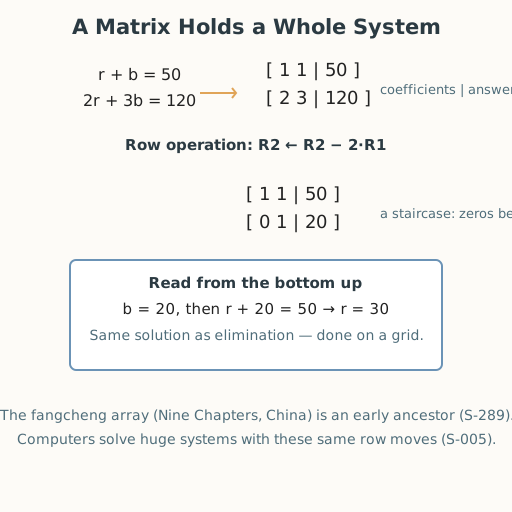
- Recall (5 min). From Lesson 5, the system r + b = 50 and 2r + 3b = 120. Today we pack it into one grid.
- Write the matrix (10 min). The augmented matrix holds coefficients on the left
and the answers on the right:
Each row is one equation; each column is one unknown (then the answer column). The system is this grid.[ 1 1 | 50 ] [ 2 3 | 120 ] - Worked example — row reduction (15 min). Use row operations that keep the
solution the same: scale a row, swap rows, or add a multiple of one row to another.
Subtract 2×(row 1) from row 2 to clear the 2:
Now read from the bottom up: b = 20; then r + 20 = 50, so r = 30. Same answer as Lesson 5, done on a grid.[ 1 1 | 50 ] [ 1 1 | 50 ] [ 2 3 | 120 ] R2-2R1 [ 0 1 | 20 ] - Name the goal (6 min). Row reduction aims for a staircase — a leading 1 in each row, zeros below — so each row reveals one unknown. A full row of zeros on the left with a nonzero answer means no solution; a zero row with a zero answer means infinitely many.
- Guided practice (12 min). With a partner, write a 2×2 system as an augmented matrix, reduce it to the staircase, and read off the solution. Interpret the answer in the original context, and check it by substitution. Swap and verify.
- Retrieve and connect (5 min). Write one sentence on how the matrix and the equations say the same thing in two forms, and one on why the grid is what a computer prefers.
- Close (2 min). Say — or write, sign, gesture, or use AAC to express — what the reduced matrix tells you that the original does not make obvious.
Differentiation
- Support: Reduce only to “clear one coefficient” and finish by substitution, using counters to see the move.
- Extension: Reduce a 3×3 system and explain, for each kind of zero row, whether the system is dependent, inconsistent, or uniquely solved.
- Number access (dyscalculia): Provide the step-2 augmented-matrix grid pre-printed with empty cells and the step-3 row-reduction worked example partially completed (the R2 − 2R1 move already applied) to copy; offload the row arithmetic (2×1, 3 − 2, 120 − 100) to a partner or calculator; and take the verbal route — read each row aloud as a sentence (“one rice plus one bean is fifty”) and say “after clearing the 2, the bottom row reads b = 20” to reach the solution without hand-computing.
- Communication access: Every spoken step — saying, naming, reading aloud, discussing, or closing — can be done in writing, sign, gesture, or AAC instead. Learners who are non-speaking, d/Deaf, hard-of-hearing, or who use AAC complete every task in their preferred mode; no step requires producing or hearing sound.
Assessment
- Formative (peer + self): Can the learner write an augmented matrix, reduce it to a staircase, read off the solution, and interpret it in context (in speech, writing, sign, or AAC) with a check?
- Portfolio artifact (unit): The matrix written, reduced, and interpreted, added to the math journal.
Home connection
Find a two-column table at home (prices, distances, a schedule) and write the rows as a matrix. Add or scale a row and write one sentence on what the changed numbers would mean.
Resources
- On worked examples and guided practice: Kirschner, Sweller & Clark (2006) (S-011).
- On the fangcheng array and the history of systems: MacTutor — Nine Chapters (S-289); Boyer & Merzbach, A History of Mathematics (S-429). On the Lo Shu square: Wikipedia — Luoshu Square (S-496).