Lesson 07 — Algorithms: Step-by-Step Procedures
Learners describe an algorithm as a precise step-by-step procedure for a real problem — sorting a pile, splitting a bill fairly, finding the largest value — and analyze it for the two things that make an algorithm *work*: it must always finish (termination) and produce the right result (correctness). They meet the very word's origin in the Persian scholar al-Khwarizmi and see the procedure as something anyone can write and check.
Objectives
Objectives
- D05.S2.12.02 Describe an algorithm as a step-by-step procedure for a real problem and analyze whether it works correctly and fairly.
Essential question
How do I describe an algorithm precisely and analyze whether it works correctly?
Key vocabulary
Materials
Standard materials
- Algorithm sheet · 1 per learner Two procedures to describe precisely, trace by hand, and test for correctness
- Math journal · 1 per learner
Low-tech / no-cost
- Cards, stones, or slips to sort Physically sort a small pile step by step to *be* the algorithm before writing it
- A recipe or instruction list Any everyday procedure, read for what happens if a step is missing or out of order
Enriched / lab & device
- A simple programming environment or spreadsheet · 1 per pair Encode the algorithm as a few lines so the machine runs the exact steps you wrote
Works in different contexts
- large-group Build one algorithm whole-class on the board, then pairs design and trace their own
- multi-age Younger learners sort objects by one rule; older learners write the steps and argue about termination and correctness
- self-directed A learner writes the steps, traces them by hand, and tests them on a tricky input
- level-grouped A ready group also finds a counterexample where a flawed algorithm fails, and patches it
- outdoor-only Line up and act out a sorting or "who is tallest" procedure, testing whether it always finishes
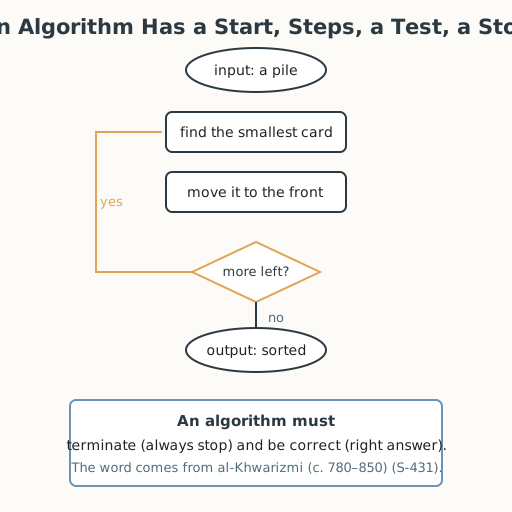
Lesson 7 — Algorithms: Step-by-Step Procedures
Summary
Learners describe an algorithm as a precise step-by-step procedure for a real problem — sorting a pile, splitting a bill fairly, finding the largest value — and analyze it for the two things that make an algorithm work: it must always finish (termination) and produce the right result (correctness). They meet the very word’s origin in the Persian scholar al-Khwarizmi, and see the procedure as something anyone can write and check.
Objectives
- Describe an algorithm as a step-by-step procedure for a real problem and analyze whether it works correctly. (D05.S2.12.02)
Connection
A recipe, a bus route, a rule for sharing a harvest fairly, the steps of long division — each is an algorithm: a precise list of steps that a person (or machine) can follow without judgment, and that ends with a result. The power and the risk are the same: because an algorithm runs exactly the steps you write, a missing step or a wrong order does real damage — so learning to read and test one is a survival skill in a world run by them.
Materials
- Algorithm sheet
- Math journal
- Low-tech: cards or stones to sort, a recipe or instruction list
Preparation
- Prepare two procedures (a sort and a fair split) and a deliberately flawed one to debug.
- Retrieval: from Lesson 6, row reduction was itself an algorithm (ordered row operations). Today we study procedures themselves.
- Prepare the worked example (trace a sort by hand) to model first (S-011).
Facilitator note
This lesson is written to the learner (“you”). The idea to land: an algorithm is a finite, ordered, unambiguous set of steps that turns an input into an output; we analyze it for termination (it always stops) and correctness (it stops on the right answer). Teach tracing by hand as the skill — read each step, write the state, repeat — with a worked example and guided practice (S-011). Debugging a flawed algorithm is the deepest learning; let learners find the flaw rather than only receiving it.
The ethics lens: an algorithm that is correct is a promise kept — but correctness is only one virtue, and a procedure can be correct yet cruel; naming that distinction prepares Lesson 8. The egalitarianism lens: because an algorithm is written in steps anyone can follow and check, it can be inspected and questioned by anyone — transparency is the egalitarian heart of procedure. The global lens: the word algorithm comes from the name of Muhammad ibn Musa al-Khwarizmi (c. 780–850, Baghdad), whose book on calculation by completion and balancing also gave us the word algebra (S-431, S-293) — a reminder that the idea of explicit procedure has deep, multi-rooted history. The technology lens: algorithms are what runs — every recommendation, every search, every payment. The environment lens: resource-sharing and allocation algorithms (who gets water, how a harvest is divided) decide real environmental outcomes, so their correctness is a matter of survival, not just arithmetic. Preview: Lesson 8 asks whether an algorithm is fair.
Procedure
- Recall (5 min). From Lesson 6, row reduction was a set of ordered steps. Name other procedures you follow without thinking: a recipe, a route, a game’s rules.
- Define it (8 min). An algorithm is a finite, ordered, unambiguous list of steps that takes an input and produces an output. It must terminate (always stop) and be correct (stop on the right answer).
- Worked example — sort by hand (15 min). Trace this algorithm on the pile [3, 1, 2]: repeat — find the smallest remaining card and move it to the front — until the pile is empty. Show each pass: [1, 3, 2], then [1, 2, 3]. Check both properties: it always finishes (the pile shrinks each pass) and it is correct (each pass places the next smallest). This is selection sort.
- Test it (8 min). Run the same algorithm on [2, 1] and on an empty pile. Does it still terminate? Is it correct? A good algorithm handles edge cases — the empty pile, the one-item pile.
- Find the flaw (12 min). Debug a flawed fair-split algorithm: “give each person one item in turn, repeating until nothing is left, but never check who has had a turn.” Trace it on 5 items and 2 people. Where does it break? Rewrite the step so it is unambiguous and always finishes. With a partner, swap fixes and test each other’s.
- Write your own (10 min). Choose a real problem (finding the tallest in a line, splitting a bill evenly, sharing water fairly) and write a precise algorithm. Trade with a partner and trace theirs by hand; report whether it terminates and is correct.
- Close (2 min). Say — or write, sign, gesture, or use AAC to express — in one sentence each, what termination and correctness mean, and why a missing step matters.
Differentiation
- Support: Sort a physical pile following a given set of steps, then describe the steps you used in one sentence each.
- Extension: Write the algorithm so it also counts how many steps it takes, and compare the count on a sorted vs a reversed pile (a first taste of efficiency).
- Number access (dyscalculia): Provide a pre-printed trace table for step 3 with a “pile” box and a “next smallest” box, so the learner records each pass ([3, 1, 2] → [1, 3, 2] → [1, 2, 3]) by copying rather than comparing numerals; offload the counting (“find the smallest remaining”) to a partner; and take the physical route — sort real cards or stones by the rule and describe each pass aloud, checking termination and correctness in words without number work.
- Communication access: Every spoken step — saying, naming, reading aloud, discussing, or closing — can be done in writing, sign, gesture, or AAC instead. Learners who are non-speaking, d/Deaf, hard-of-hearing, or who use AAC complete every task in their preferred mode; no step requires producing or hearing sound.
Assessment
- Formative (peer + self): Can the learner describe an algorithm precisely (in speech, writing, sign, or AAC), trace it by hand, and judge termination and correctness — including finding a flaw?
- Portfolio artifact (unit): One written algorithm with a hand trace and a correctness check, in the math journal.
Home connection
Describe one procedure from home (cooking, packing, a game) as a numbered list, then test it by having someone follow it exactly. Write one sentence on what they did that you did not intend.
Resources
- On worked examples and guided practice: Kirschner, Sweller & Clark (2006) (S-011).
- On the origin of the word algorithm and of algebra in al-Khwarizmi’s work: Wikipedia — al-Khwarizmi (S-431); MacTutor — al-Khwarizmi (S-293).