Lesson 08 — Are Algorithms Fair?
Learners analyze a decision algorithm not only for correctness but for fairness: they trace the same rule on two different inputs, see how a biased input or a biased rule produces a skewed output, and distinguish input bias from a biased rule from a biased proxy. They connect this to the recommendation and ranking systems that shape what people see and get, and to the principle that a fair procedure must be checkable by those it affects.
Objectives
Objectives
- D05.S2.12.02 Describe an algorithm as a step-by-step procedure for a real problem and analyze whether it works correctly and fairly.
Essential question
How do I analyze an algorithm not only for whether it works, but for whether it works fairly?
Key vocabulary
Materials
Standard materials
- Fairness-analysis sheet · 1 per learner A decision algorithm (who gets a scarce resource) to trace on two different inputs and compare
- Math journal · 1 per learner
Low-tech / no-cost
- Slips of paper as "applicants" with differing attributes Run the same decision rule by hand on each slip and watch who the rule favors
- Two different lists (one skewed, one not) Feed the same rule two inputs and compare the outputs side by side
Enriched / lab & device
- A documented case study of an algorithm with disputed fairness · 1 per pair A real screening, ranking, or allocation algorithm to read and critique
Works in different contexts
- large-group Run one rule on several slips whole-class, then pairs design a fairer rule and defend it
- multi-age Younger learners notice "the rule picks more of one kind"; older learners trace the mechanism and propose a fix
- self-directed A learner traces a rule on two inputs, names the bias, and writes a fairer version with reasons
- level-grouped A ready group also distinguishes input bias, a biased rule, and a biased proxy, and debates which is operating
- outdoor-only Stand in two lines representing two groups and physically run a selection rule, then notice who is left out
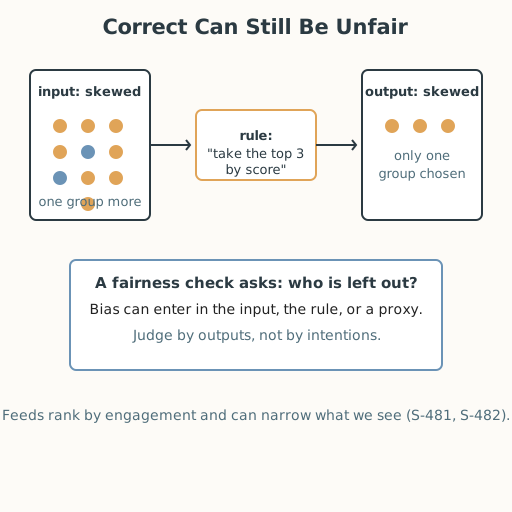
Lesson 8 — Are Algorithms Fair?
Summary
Learners analyze a decision algorithm not only for correctness but for fairness: they trace the same rule on two different inputs, see how a biased input or a biased rule produces a skewed output, and distinguish input bias from a biased rule from a biased proxy. They connect this to the recommendation and ranking systems that shape what people see and get, and to the principle that a fair procedure must be checkable by those it affects.
Objectives
- Describe an algorithm for a real problem and analyze whether it works correctly and fairly. (D05.S2.12.02)
Connection
An algorithm can be perfectly correct — it always stops, and it follows its rule exactly — and still be unfair. If a loan or admission or hiring screen is trained on past decisions that favored one group, a “correct” algorithm will copy that pattern; if a feed ranks by what keeps you clicking, it may hide what challenges you. Correctness is about the rule doing what it says; fairness is about who it helps and leaves out. Both are checkable, but only if we look.
Materials
- Fairness-analysis sheet
- Math journal
- Low-tech: slips of paper as “applicants”
Preparation
- Prepare a decision rule (e.g., “admit the top 3 by past score”) and two inputs: one where past scores are balanced across groups, one where they are skewed.
- Retrieval: from Lesson 7, an algorithm’s correctness. Today we add a second question: fairness.
- Prepare the worked example (trace one rule on two inputs) to model first (S-011).
Facilitator note
This lesson is written to the learner (“you”). The idea to land: an algorithm can be correct yet unfair; bias can enter through the input, through the rule itself, or through a proxy that stands in for a protected attribute — and we can see all three by tracing the same rule on different inputs. Teach the trace explicitly (S-011), then let learners argue about fairness — that argument is the learning, so hold it open rather than closing it with one verdict. Keep the descriptive question (does the output differ by group?) apart from the value question (is that difference acceptable?), per philosophy §5.
The ethics lens: a rule that is correct but harmful still carries moral weight; naming that is the whole point of the lesson. The egalitarianism lens: fairness is judged by who is left out — a rule is not fair just because its author intended it to be; check the outputs, not the intentions. The global lens: the same mechanism appears everywhere algorithms gate scarce things — credit, housing, jobs, migration, school places — across many legal and cultural contexts, none of which is the default. The technology lens: recommendation and ranking systems shape what we see and get; personalization can wrap a person in a “filter bubble” of what confirms their existing views (S-482, S-481). The environment lens: allocation algorithms decide who gets water, land, or disaster relief, so a biased rule can mean real ecological and bodily harm to one group (S-483). The critical-thinking lens: distinguishing input bias, a biased rule, and a biased proxy is careful analysis, not slogan. Preview: Lesson 9 turns to coordinates and vectors.
Procedure
- Recall (5 min). From Lesson 7, name the two properties of a correct algorithm. Today a third question: is it fair?
- Correct but unfair (8 min). An admission rule: “rank everyone by past score and take the top 3.” The rule is correct — it always stops and follows its own rule. But if past scores were themselves skewed (some groups had worse access to schooling), the “correct” rule copies the old unfairness forward. Correctness ≠ fairness.
- Worked example — trace on two inputs (15 min). Take slips for 6 applicants in two groups; give the rule “top 3 by score.” Trace it. Now make the input skewed — one group’s scores sit higher because they had better preparation — and trace again. Compare the two outputs: the same rule picks more from the advantaged group. Name where the bias lives: the input, not the rule.
- Three places bias enters (8 min). Bias can be (a) input bias — the data already skews; (b) a biased rule — the rule itself uses a group attribute directly; or (c) a biased proxy — the rule uses a “neutral” stand-in (like a postal code) that secretly tracks a group attribute. Sort each case into one of the three.
- Fix it (12 min). With a partner, rewrite the rule to reduce the skew — e.g., reserve places, or use a measure that predicts future performance without the proxy. Test your new rule on both inputs and report what changed. Discuss — aloud or in writing, sign, gesture, or AAC: does your fix trade one unfairness for another? (There is no perfect answer — argue it honestly.)
- Connect to feeds (5 min). A feed that ranks by “what keeps you clicking” is a correct algorithm whose output can narrow what you see into a filter bubble (S-482). Write one sentence on what that means for you as the input to the algorithm.
- Close (2 min). Say — or write, sign, gesture, or use AAC to express — why checking outputs, not just intentions, is how we judge fairness.
Differentiation
- Support: Sort the slips by the rule and count “how many from each group” without the vocabulary; then attach the three labels to what you saw.
- Extension: Find and analyze a documented real-world algorithm (screening, ranking, or allocation), name where the bias enters, and defend a fairer design in writing.
- Number access (dyscalculia): Provide a pre-printed two-input trace organizer for step 3 — one column per group with tally boxes for “who the rule picked” — so the learner tallies slips rather than comparing scores; offload the counting (“how many from each group”) to a partner; and take the verbal route — run the rule by hand on the slips and name in words which group the rule favors and who is left out, reaching the bias conclusion without numeric comparison.
- Communication access: Every spoken step — saying, naming, reading aloud, discussing, or closing — can be done in writing, sign, gesture, or AAC instead. Learners who are non-speaking, d/Deaf, hard-of-hearing, or who use AAC complete every task in their preferred mode; no step requires producing or hearing sound.
Assessment
- Formative (peer + self): Can the learner trace one rule on two inputs, name where the bias enters (input, rule, or proxy) — in speech, writing, sign, or AAC — and propose and test a fairer rule?
- Portfolio artifact (unit): The two-input trace with the bias named and a fairer rule argued, in the math journal.
Home connection
Notice one algorithm you met today — a search result, a recommended video, a “best price.” Write one sentence on what it seems to rank by and one on who might be left out.
Resources
- On worked examples and guided practice: Kirschner, Sweller & Clark (2006) (S-011).
- On recommendation systems, engagement-ranking, and the filter bubble: Britannica — Social media (S-481); Pariser, The Filter Bubble (S-482).
- On environmental-justice framing for who bears the harms of biased allocation: U.S. EPA — Environmental Justice (S-483).