Lesson 03 — Who Asks the Questions? Who Benefits?
Learners turn the lens of science ethics on the *framing* of research itself: who asks the questions, who is studied and who is left out, who benefits and who bears the cost. They trace real cases — historical exclusion from medical studies, environmental racism, and the cobalt that powers devices — and learn to read any finding for the question that shaped it.
Objectives
Objectives
- D06.S1.12.02 Reflect on the ethics of scientific practice — who asks the questions, who benefits, and how knowledge is used — and propose a more just practice.
Essential question
Who gets to ask the questions of science, who benefits from the answers, and who has been left out — and what does that do to the knowledge we have?
Key vocabulary
Materials
Standard materials
- "Who asks / who benefits" worksheet · 1 per learner A table for tracing a research question to its funder, its subjects, and its beneficiaries
- Science journal · 1 per learner
Low-tech / no-cost
- A real product label, news item, or study abstract Anything that names a research finding — the learner traces who asked and who benefits
- Scratch paper For the who-asks/who-benefits table
Enriched / lab & device
- A short case study (e.g., a supply-chain or health-equity report) · 1 per pair To trace a real research question from funding through subjects to beneficiaries
Works in different contexts
- large-group Trace one case whole-class, then pairs each take a different case and report who benefits
- multi-age Younger learners answer "who was asked, and who was left out?"; older learners also name the structural reason
- self-directed A learner traces a real question through its funder, subjects, and beneficiaries and writes the reflection
- level-grouped A ready group also proposes one question that was *never asked* because of who held the pen
- outdoor-only Trace who benefits from a land-use or resource decision visible outdoors, and whose knowledge was consulted
Lesson 3 — Who Asks the Questions? Who Benefits?
Summary
Learners turn the lens of science ethics on the framing of research itself: who asks the questions, who is studied and who is left out, who benefits and who bears the cost. They trace real cases and learn to read any finding for the question that shaped it — because the questions science does not ask shape the knowledge we have as much as the ones it does.
Objectives
- Reflect on the ethics of scientific practice — who asks the questions, who benefits, and how knowledge is used. (D06.S1.12.02)
Connection
A medicine is tested only on young men, and later it works differently — or not at all — for women and older people. A factory’s pollution is studied only after the people living beside it have been sick for years. A study asks “how do we extract more ore faster?” and never asks “who drinks the water downstream?” The answers science gives depend on the questions it was allowed to ask — and every question has a someone who asked it and a someone who benefits.
Materials
- “Who asks / who benefits” worksheet
- Science journal
- Low-tech: a product label, news item, or study abstract; scratch paper
Preparation
- Gather two or three real case snippets (a medical-exclusion history note, a pollution-justice note, a supply-chain note).
- Retrieval: from Lesson 2, evidence vs values. Today we ask a value-laden but checkable question: who is in the room when the questions are written?
- Prepare the worked example (tracing one question) to model first (S-011).
Facilitator note
This lesson is written to the learner (“you”). The idea to land: science is done by people in societies, so its questions are framed by who has power — and we can read any finding for who asked, who was studied, who was left out, who benefits, and who bears the cost. Teach the trace explicitly, then let learners run it (S-011). Hold two things distinct: factual claims (women were historically excluded from many clinical trials; the cobalt in batteries is often mined under harmful conditions) are checkable and cited; the value judgment (exclusion and harm are unjust) is a stance we name openly, not a fact we pretend is settled by the data alone.
The ethics lens: beneficence — doing good and not harm — is not automatic; it has to be designed in, and its absence is visible in who is excluded. The egalitarianism lens: the distribution of who-asks and who-benefits is the egalitarian question at its most concrete — whose bodies are the “normal” default, whose knowledge counts, whose neighborhood is the sacrifice zone (S-484, S-483). The global lens: the pattern recurs worldwide — the cobalt that powers devices is mined in the Democratic Republic of the Congo under conditions Amnesty International has documented as harmful, while the benefit accrues largely elsewhere (S-398); and Semmelweis’s life-saving evidence was resisted partly because it humiliated the powerful men it corrected (S-357). The technology lens: a device in your hand has a geography and a supply chain — the question “who benefits?” runs from the mine to the screen (S-398, S-281). The environment lens: environmental justice names the finding that polluting sites and their harms are not distributed evenly across people (S-483, S-484). Preview: Lesson 4 turns critique into a proposal for a more just practice.
Procedure
- Recall (5 min). From Lesson 2, name the difference between a fact and a value. Today we ask whose questions produced the facts we have.
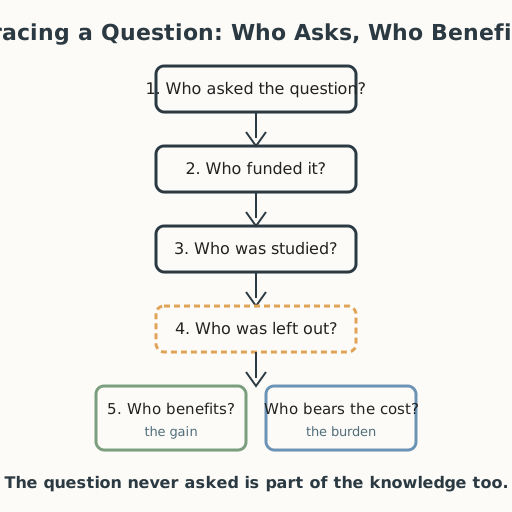
- Meet the trace (8 min). Any finding can be traced through five stations: (1) who asked the question, (2) who funded it, (3) who was studied, (4) who was left out, and (5) who benefits and who bears the cost. Write the five stations as a chain.
- Worked example — the medicine tested on some (12 min). Trace a medicine tested only on young adult men: who asked (researchers with a standard subject pool), who was studied (young men), who was left out (women, older people, children), who benefits (those whose bodies match the test), who bears the cost (everyone else, who may get a dose or effect not studied in them). The question “is this safe for people?” was answered as if one kind of body stood for all.
- Trace a second case (12 min). With a partner, trace the cobalt in a rechargeable battery: who benefits (users of devices, companies, and the demand for energy), who bears the cost (mining communities and workers, where conditions and hazards are concentrated, S-398), and whose question — “cheaper batteries” versus “safe, fair mining” — was asked first. Say — or write, sign, gesture, or use AAC to show — which question was not asked.
- Read a finding for its question (12 min). Take a product label, news item, or study abstract. Run the five-station trace. Note the question that is missing — the one that, if asked, might change the answer.
- Close (2 min). Say — or write, sign, gesture, or use AAC to express — why “who asks the questions” matters as much as the answers themselves.
Differentiation
- Support: Trace only two stations — “who was studied” and “who was left out” — before adding the others.
- Extension: Identify one never-asked question in a real case, and write one sentence on how the answer might change who benefits.
- Number access (dyscalculia): The trace is qualitative — no arithmetic is required; provide the five-station chain as a pre-printed diagram to fill with names and roles rather than numbers, and allow every station to be completed in words or by pointing to a card.
- Communication access: Every spoken step — saying, naming, reading aloud, discussing, or closing — can be done in writing, sign, gesture, or AAC instead. Learners who are non-speaking, d/Deaf, hard-of-hearing, or who use AAC complete every task in their preferred mode; no step requires producing or hearing sound.
Assessment
- Formative (peer + self): Can the learner trace a research question through its five stations, name who is left out, and state the missing question that a fuller science would ask?
- Portfolio artifact (unit): One completed who-asks/who-benefits trace with a written reflection naming the missing question, opened in the science journal.
Home connection
Pick one product you use. Trace it back as far as you can — who made it, under what conditions, and who benefits. Write two sentences: one fact you found, and one question you now wish someone had asked.
Resources
- On worked examples and guided practice: Kirschner, Sweller & Clark (2006) (S-011).
- On environmental justice: Bullard, Dumping in Dixie (S-484); U.S. EPA — Environmental Justice (S-483).
- On the cobalt supply chain: Amnesty International (2016) (S-398); on the digital divide: World Bank — Digital Dividends (S-281).
- On a historical example of whose evidence was resisted: Encyclopaedia Britannica — Ignaz Semmelweis (S-357).