Lesson 04 — Proposing a More Just Science
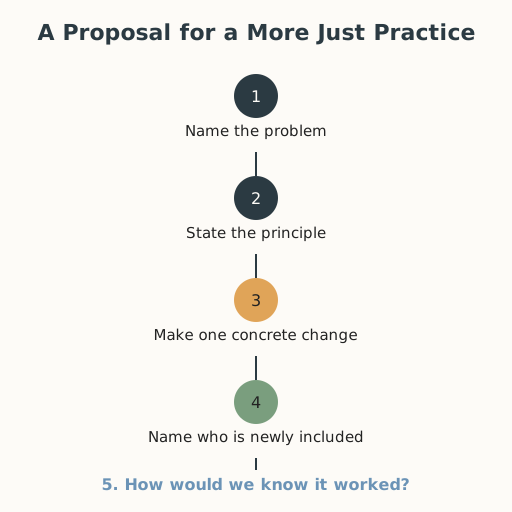
Learners turn the critique of Lesson 3 into a constructive proposal: a more just scientific practice. They learn concrete levers — open sharing, peer review and replication, informed consent, community-based and participatory research, and data sovereignty — and write a one-page proposal that names a problem, a principle, a change, who is newly included, and how we would know it worked.
Objectives
Objectives
- D06.S1.12.02 Reflect on the ethics of scientific practice — who asks the questions, who benefits, and how knowledge is used — and propose a more just practice.
Essential question
Given who asks and who benefits today, what would a more just scientific practice look like — and how do I propose it concretely?
Key vocabulary
Materials
Standard materials
- "More-just practice" proposal frame · 1 per learner A one-page scaffold — problem, principle, concrete change, who it includes, how we would know it worked
- Science journal · 1 per learner
Low-tech / no-cost
- The five-station trace from Lesson 3 Reused as the problem statement for the proposal
- Scratch paper For drafting the proposal
Enriched / lab & device
- One short example of participatory or open research in action · 1 per class To see a more-just practice already being tried
Works in different contexts
- large-group Build one model proposal whole-class, then small groups each draft a change for a different case
- multi-age Younger learners propose one inclusion ("invite the community to help write the question"); older learners write the full proposal
- self-directed A learner writes the proposal alone, using the scaffold and self-check
- level-grouped A ready group also writes the measure — how we would know the practice became more just
- outdoor-only Propose a more just way to study or manage a shared outdoor resource, naming who is newly included
Lesson 4 — Proposing a More Just Science
Summary
Learners turn critique into construction: they learn concrete levers for a more just practice — open sharing, peer review and replication, informed consent, community-based and participatory research, and data sovereignty — and write a one-page proposal that names a problem, a principle, a change, who is newly included, and how we would know it worked.
Objectives
- Reflect on the ethics of scientific practice — who asks the questions, who benefits, and how knowledge is used — and propose a more just practice. (D06.S1.12.02)
Connection
You have named a problem — the questions are asked by some and the benefits go to others. Now the harder, better work: what would you actually change? A medicine could be tested on the people who will take it; a community could help write the question before the study begins; the data a community gives could remain theirs to govern. Justice in science is not a feeling — it is a set of specific, checkable practices anyone can propose.
Materials
- “More-just practice” proposal frame
- Science journal
- Low-tech: the Lesson 3 trace, scratch paper
Preparation
- Copy or draw the proposal frame.
- Retrieval: from Lesson 3, the five-station trace and the missing question. Today we answer that missing question with a change.
- Prepare one model proposal to model first (S-011).
Facilitator note
This lesson is written to the learner (“you”). The idea to land: a more just science is not an abstraction — it is named practices (open sharing, replication, consent, participation, data sovereignty) that can be proposed, tried, and checked. Teach the proposal structure explicitly, then let learners write (S-011). Keep the distinction live: each lever is factually documented as a real practice (peer review and replication make knowledge more trustworthy, S-489; exclusion is historically documented, S-357, S-484); that these practices are better is a value commitment we state openly.
The ethics lens: the proposal is ethics made operational — consent, participation, and shared benefit written as steps, not slogans. The egalitarianism lens: the question “who is newly included?” is the egalitarian test of any reform — if the same people still hold the pen, nothing has moved. The global lens: data sovereignty and community-based research are movements with roots in Indigenous and formerly excluded communities worldwide, asserting that a community’s knowledge and data are theirs to govern (S-427, S-085); the levers are not one nation’s property. The technology lens: open science is made possible — and contested — by technology; open publication and open data are tools, but so is the digital divide that can keep them closed to the least resourced (S-281, S-489). The environment lens: a more just science of the environment is one where the people living with a river or a forest help set the questions, not merely answer them (S-483). Preview: Lesson 5 leaves the ethics of inquiry and enters coupled living systems.
Procedure
- Recall (5 min). From Lesson 3, name the missing question in your traced case. Today you propose the change that would let that question be asked.
- Meet the levers (10 min). Write each and one line on how it helps: open sharing (findings published so others can read and check), peer review and replication (others re-run and re-check before trust, S-489), informed consent (people choose, knowing what will happen to their data and bodies), community-based research (the people affected help write the question and do the work), and data sovereignty (a community governs its own knowledge and data, S-427, S-085).
- Worked example — a model proposal (12 min). Build one together: Problem — a medicine was tested on people unlike those who will take it. Principle — the people studied should be the people served. Change — recruit the full range of people who will use it, and let a community board review the question first. Who is newly included — the people previously left out now help set the question. How we would know — the study reports who was included and on what terms. Write all five parts.
- Write your own proposal (20 min). Using the scaffold, write a one-page proposal for your traced case from Lesson 3. Say — or write, sign, gesture, or use AAC to show — each of the five parts, especially who is newly included.
- Peer-check (6 min). Exchange proposals. Check one thing: does the change actually include someone new, or does it just describe the problem again? Give one specific improvement.
- Close (2 min). Say — or write, sign, gesture, or use AAC to express — one concrete practice that would make science more just, and who it would newly include.
Differentiation
- Support: Complete only three of the five parts — problem, change, who is included — and use the model proposal as a template to adapt.
- Extension: Add the “how we would know” measure with a falsifiable indicator, and name one obstacle and who would need to help remove it.
- Number access (dyscalculia): The proposal is prose, not arithmetic; provide the five-part frame as a pre-printed scaffold with sentence starters, and allow every part to be completed in words, gesture, or recorded voice with no numbers required.
- Communication access: Every spoken step — saying, naming, reading aloud, discussing, or closing — can be done in writing, sign, gesture, or AAC instead. Learners who are non-speaking, d/Deaf, hard-of-hearing, or who use AAC complete every task in their preferred mode; no step requires producing or hearing sound.
Assessment
- Formative (peer + self): Can the learner name at least three levers of a more just practice and write a proposal that names a problem, a principle, a change, who is newly included, and how we would know it worked?
- Portfolio artifact (unit): The one-page proposal, opened in the science journal — a capstone artifact for the science-ethics strand.
Home connection
Show your proposal to someone at home and ask: who else is still left out? Add their answer as one sentence and one adjustment to your change.
Resources
- On worked examples and guided practice: Kirschner, Sweller & Clark (2006) (S-011).
- On peer review and replication making knowledge trustworthy: Understanding Science — peer review & replication (S-489).
- On Indigenous knowledge and data governance: Kimmerer, Braiding Sweetgrass (S-427); AIATSIS (S-085).
- On the digital divide in who can participate: World Bank — Digital Dividends (S-281); on environmental justice: EPA (S-483).