Lesson 05 — Coupled Systems: Ecosystems, Economies, and Health
Learners map how ecosystems, economies, and human health are one coupled system: what each gives and takes from the others, and how a change in one loops back. They trace a trophic cascade (wolves returning to Yellowstone) and a food-system coupling, and learn the idea of ecosystem services and feedback loops that make the parts impossible to treat in isolation.
Objectives
Objectives
- D06.S2.12.01 Explain how ecosystems, economies, and human health are coupled, and weigh trade-offs in sustaining living systems.
Essential question
How are ecosystems, economies, and human health coupled, so that a change in one ripples through the others?
Key vocabulary
Materials
Standard materials
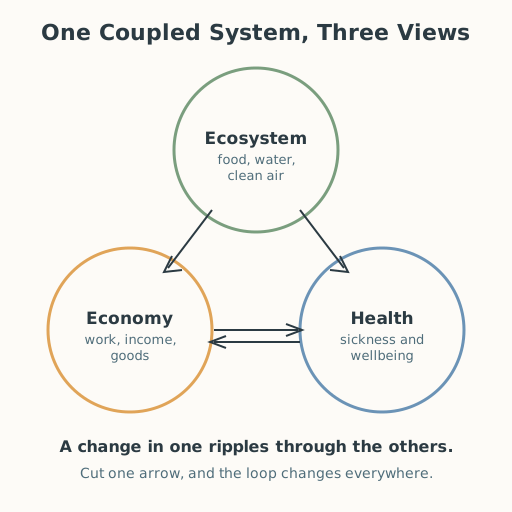
- Coupling diagram sheet · 1 per learner Three circles — Ecosystem, Economy, Health — with arrows to be labeled with what flows between them
- Science journal · 1 per learner
Low-tech / no-cost
- Three circles drawn on paper or in sand Label them Ecosystem, Economy, Health and draw arrows of what each gives the others
- A local food or water example Any real coupling the learner can name — a crop, a fishery, a well, a river
Enriched / lab & device
- A short film or article on a trophic cascade or a One Health case · 1 per class To see a coupled system change end to end
Works in different contexts
- large-group Map one coupling whole-class, then pairs each map a different local system and report
- multi-age Younger learners draw "what does the forest give us?"; older learners trace feedback loops and name ecosystem services
- self-directed A learner maps a local coupling with labeled arrows and writes one feedback loop
- level-grouped A ready group also identifies a feedback loop that amplifies or damps a change
- outdoor-only Map a real coupling in view — a stream, a field, a market — and trace what flows each way
Lesson 5 — Coupled Systems: Ecosystems, Economies, and Health
Summary
Learners map how ecosystems, economies, and human health are one coupled system: what each gives and takes from the others, and how a change in one loops back. They trace a trophic cascade and a food-system coupling, and learn ecosystem services and feedback loops — the reasons the parts cannot be treated in isolation.
Objectives
- Explain how ecosystems, economies, and human health are coupled. (D06.S2.12.01)
Connection
The price of bread rises when a drought hits a faraway wheat region; a river’s fish decline and the fishers who sold them lose their income and their food; a forest is cleared and the people downstream drink dirtier water and fall sick. Ecosystem, economy, and health are not three separate subjects — they are three views of one connected system, and you live inside that connection every time you eat, drink, work, or breathe.
Materials
- Coupling diagram sheet
- Science journal
- Low-tech: three drawn circles, a local food or water example
Preparation
- Copy or draw the coupling diagram sheet.
- Retrieval: from Grade 11 (D06.S2.11.02), ethics of human relationships with species and ecosystems; from D06.S4.11.02, coupled Earth systems. Today we add economy and health to the coupling.
- Prepare the worked example (the Yellowstone cascade) to model first (S-011).
Facilitator note
This lesson is written to the learner (“you”). The idea to land: ecosystem, economy, and health are coupled — a change in one moves through the others, often through feedback loops — so they must be understood together. Teach the cascade explicitly, then let learners map a local coupling (S-011). Keep evidence and values distinct: that ecosystems provide services and are coupled is a factual, cited claim (S-310, S-437); how much we should weigh a forest against a road is a value question to be argued, not assumed.
The ethics lens: seeing the coupling makes the consequences of a choice visible on other people and other species — an ethical demand, because hidden consequences are the ones we cannot consent to. The egalitarianism lens: the costs of a broken coupling are rarely borne evenly — the people downstream of pollution, or dependent on a declining fishery, are often the least able to buy their way out (S-483, S-006). The global lens: coupled systems look different everywhere but are everywhere — a potato field in the Andes, a fishery in the Pacific, a market garden in a city (S-054); the One Health idea, that human, animal, and environmental health are one, is now a global framework (S-003). The technology lens: technology both tightens couplings (a global supply chain) and reveals them (satellite and data tools that show the loop, S-006). The environment lens: the trophic cascade — wolves returning to Yellowstone changed elk browsing, and streamside willows and aspens recovered — is a vivid, documented coupling (S-310). Preview: Lesson 6 turns the coupling into a structured weighing of trade-offs.
Procedure
- Recall (5 min). From Grade 11, name one way a disruption in an ecosystem affects its species. Today we widen the frame to include people’s livelihoods and health.
- Draw the three circles (8 min). Label them Ecosystem, Economy, Health. Draw arrows of what flows each way: the ecosystem gives food, water, materials, and clean air; the economy gives work, income, and goods; health depends on both. Say — or write, sign, gesture, or use AAC to show — one arrow you drew and why.
- Worked example — the cascade (15 min). Wolves returned to Yellowstone; elk changed where they browsed; streamside willows and aspens grew back; more beavers and birds followed (S-310). Trace the chain from one species through ecosystem, then economy (tourism, ranching tensions), then health (cleaner water). Notice the feedback loop: each step changes the next, and some loop back to the first.
- Name the ideas (7 min). An ecosystem service is a benefit people get from ecosystems — food, water, pollination, flood control (S-437). A feedback loop is when an effect returns to change its own cause. A keystone species is one whose presence shapes the whole system (S-176).
- Map a local coupling (15 min). With a partner, map a real system you know — a crop, a fishery, a river, a market garden. Draw the three circles and label what flows. Find one feedback loop. Say — or write, sign, gesture, or use AAC to show — what happens when one arrow is cut.
- Close (2 min). Say — or write, sign, gesture, or use AAC to express — why an ecosystem, an economy, and a population’s health cannot be managed one at a time.
Differentiation
- Support: Map only two circles (ecosystem → health) with one labeled arrow before adding the third.
- Extension: Identify whether a feedback loop amplifies a change (positive) or damps it (negative), and trace it one full turn.
- Number access (dyscalculia): The lesson is diagram-based; provide the three-circle sheet pre-drawn so the learner labels arrows rather than measuring or counting, and allow every relationship to be stated in words (“when the fish go, the fishers lose their work”) with no numeric work required.
- Communication access: Every spoken step — saying, naming, reading aloud, discussing, or closing — can be done in writing, sign, gesture, or AAC instead. Learners who are non-speaking, d/Deaf, hard-of-hearing, or who use AAC complete every task in their preferred mode; no step requires producing or hearing sound.
Assessment
- Formative (peer + self): Can the learner draw the three coupled circles, label what flows each way, trace a cascade, and name one feedback loop?
- Portfolio artifact (unit): The labeled coupling diagram with one written feedback loop and one sentence on why the parts must be managed together, opened in the science journal.
Home connection
Name one thing you eat or drink and trace its chain back: where did it come from, whose work moved it, and what does its production cost the land and the people who depend on it? Write two sentences.
Resources
- On worked examples and guided practice: Kirschner, Sweller & Clark (2006) (S-011).
- On the Yellowstone trophic cascade: Ripple & Beschta (2012) (S-310); on keystone species: National Geographic Education (S-176).
- On ecosystem services and biodiversity: IPBES Global Assessment (S-437).
- On the One Health framing: WHO (S-003); on who bears environmental costs: EPA Environmental Justice (S-483); Our World in Data (S-006); on Andean agroecology: CIP Potato (S-054).