Lesson 06 — Trade-offs in Sustaining Living Systems
Learners learn to weigh trade-offs in sustaining living systems without pretending there is a free choice: for any option they ask who gains, who loses, over what time, and whether it can be reversed. They apply the matrix to real decisions — food versus forest, fishing versus livelihoods, fire suppression versus cultural burning — and learn that sustainability is a conversation about who bears which costs, not a single correct answer.
Objectives
Objectives
- D06.S2.12.01 Explain how ecosystems, economies, and human health are coupled, and weigh trade-offs in sustaining living systems.
Essential question
When sustaining a living system means choosing between competing goods, how do I weigh the trade-offs honestly?
Key vocabulary
Materials
Standard materials
- Trade-off matrix · 1 per learner Rows of options, columns of who gains / who loses / over what time / reversible? — plus a verdict
- Science journal · 1 per learner
Low-tech / no-cost
- A real local decision under debate Land use, a fishery, a dam, a plantation — anything with competing goods
- Scratch paper For the trade-off matrix
Enriched / lab & device
- A short case study of a sustainability decision (forest, fishery, or fire management) · 1 per pair To weigh a real trade-off with documented stakes
Works in different contexts
- large-group Weigh one decision whole-class, then pairs each weigh a different option and report
- multi-age Younger learners answer "who gains and who loses?"; older learners also score reversibility and time horizon
- self-directed A learner fills the matrix for a real decision and writes the verdict with reasons
- level-grouped A ready group also proposes a design that reduces the trade-off rather than merely choosing a side
- outdoor-only Weigh a visible trade-off — a cleared field, a fenced pasture, a diverted stream — and name who gains and who loses
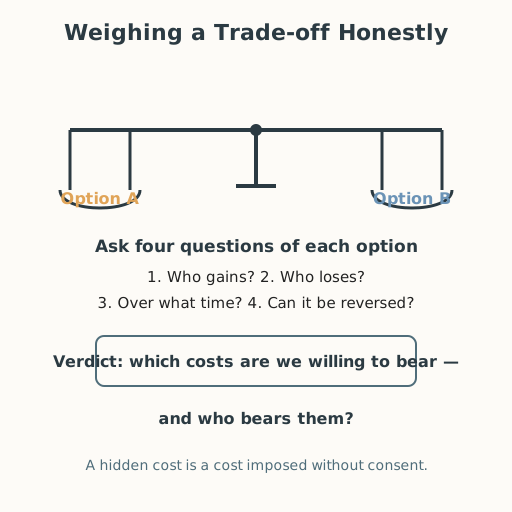
Lesson 6 — Trade-offs in Sustaining Living Systems
Summary
Learners learn to weigh trade-offs in sustaining living systems without pretending there is a free choice: for any option they ask who gains, who loses, over what time, and whether it can be reversed. They apply the matrix to real decisions and learn that sustainability is a conversation about who bears which costs, not a single correct answer.
Objectives
- Explain how ecosystems, economies, and human health are coupled, and weigh trade-offs in sustaining living systems. (D06.S2.12.01)
Connection
Protect the forest and a family loses the land it farms; clear the land and the river downstream silts up and the fish die; ban the fishing and the fishers have no income today; keep fishing and there are no fish next year. Almost every real choice about a living system is a trade-off between goods we all want. The skill is not avoiding the trade-off — it is seeing it clearly and asking who pays for it.
Materials
- Trade-off matrix
- Science journal
- Low-tech: a real local decision, scratch paper
Preparation
- Copy or draw the trade-off matrix.
- Retrieval: from Lesson 5, the coupled system and feedback loops. Today we decide within the coupling.
- Prepare the worked example (a forest/farm decision) to model first (S-011).
Facilitator note
This lesson is written to the learner (“you”). The idea to land: sustaining a living system is a weighing of trade-offs — who gains, who loses, over what time, and whether the change is reversible — and honest weighing names all four rather than hiding any. Teach the matrix explicitly, then let learners run it (S-011). Keep two things distinct: factual claims (fire suppression changed forests; Indigenous cultural burning sustains them, S-320, S-321) are cited; value claims (which trade-off is worth accepting) are argued openly and never disguised as science.
The ethics lens: a trade-off hidden is a cost imposed without consent — naming who loses is the ethical minimum of any decision about shared living systems. The egalitarianism lens: the matrix’s first question, “who gains, who loses?”, is the egalitarian question — and it often reveals that the same people gain while the same people lose, generation after generation (S-483). The global lens: stewardship traditions differ and overlap — many Indigenous fire practices sustain landscapes rather than merely suppressing fire, a practice documented in Australia and beyond (S-320, S-321); the Convention on Biological Diversity frames sustaining biodiversity as a shared global responsibility (S-279). The technology lens: technology can widen or narrow a trade-off — a better tool may need less land, but its materials have their own costs (S-397). The environment lens: reversibility is the deepest environmental question — a forest cut may regrow in decades; a species lost does not come back, which is why extinction weighs differently from a temporary cost (S-437). Preview: Lesson 7 turns from managing systems to the accounts we give of how life began.
Procedure
- Recall (5 min). From Lesson 5, name one feedback loop in a coupled system. Today we decide inside that loop.
- Meet the four questions (8 min). For any option, ask: (1) who gains, (2) who loses, (3) over what time, and (4) can it be reversed? Write the four as columns.
- Worked example — forest or farm (15 min). Weigh two options for a hillside: clear for crops or keep forest. Fill the matrix. Clear: farmers gain food and income now, downstream people lose clean water and fish, the soil erodes over years, and regrowth is slow — partly reversible. Keep forest: everyone gains clean water and habitat, farmers lose immediate land, the benefit lasts, and cutting later is possible — reversible. Say — or write, sign, gesture, or use AAC to show — which cost is the harder one to bear and who bears it.
- Meet a real trade-off (8 min). Fire: suppressing every fire seemed to protect forests but let fuel build until fires became catastrophic; many Indigenous peoples instead used careful, small, seasonal burns that sustain the landscape (S-320, S-321). This is a trade-off between two ways of managing the same system, with different who-gains and who-loses.
- Weigh a real decision (15 min). With a partner, choose a local decision — a fishery, a dam, a plantation, a new road. Fill the four columns for at least two options. Say — or write, sign, gesture, or use AAC to show — your verdict and which of the four questions mattered most.
- Peer-check (4 min). Exchange matrices. Check one thing: did the other pair name a real loser, or did they leave that cell empty? Give one specific improvement.
- Close (2 min). Say — or write, sign, gesture, or use AAC to express — why a sustainability decision is never free, and what it means to weigh it honestly.
Differentiation
- Support: Fill only “who gains / who loses” for one option before adding time and reversibility.
- Extension: Propose a third option that reduces the trade-off — one that lets more people gain and fewer lose — and test it against the four questions.
- Number access (dyscalculia): The matrix is qualitative; provide it pre-printed with the four columns labeled so the learner fills names and time words (“now,” “years later”) rather than quantities, and allow the verdict to be reached in words with no arithmetic.
- Communication access: Every spoken step — saying, naming, reading aloud, discussing, or closing — can be done in writing, sign, gesture, or AAC instead. Learners who are non-speaking, d/Deaf, hard-of-hearing, or who use AAC complete every task in their preferred mode; no step requires producing or hearing sound.
Assessment
- Formative (peer + self): Can the learner fill the four trade-off questions for two options, name a real loser and a real gainer, and write a reasoned verdict that does not hide any cost?
- Portfolio artifact (unit): One completed trade-off matrix with a written verdict, opened in the science journal — a capstone artifact for the coupled-systems strand.
Home connection
Choose a decision your household or community faces that touches a living thing — a garden, a pet, a tree, a water source. Fill the four questions and write one sentence on who gains and who loses.
Resources
- On worked examples and guided practice: Kirschner, Sweller & Clark (2006) (S-011).
- On Indigenous cultural burning: CSIRO (S-320); Firesticks Alliance / Living Knowledge Network (S-321).
- On biodiversity and why loss can be irreversible: IPBES Global Assessment (S-437); Convention on Biological Diversity (S-279).
- On environmental justice in who bears costs: EPA (S-483); on materials costs: WHO e-waste (S-397).