Lesson 07 — Accounts of Life's Origin and Diversity
Learners get the scientific account of life's origin and diversity straight: evolution by natural selection and common ancestry are strongly evidenced (Darwin's finches, the peppered moth, deep time in the rocks), while life's very first origin from non-living chemistry remains an open area of research. They learn to hold "what the evidence shows" and "what is still open" in the same frame — and to treat the account as evidence-grounded, not creed.
Objectives
Objectives
- D06.S2.12.02 Hold scientific accounts of life's origin and diversity alongside cultural and spiritual accounts, and articulate how they relate.
Essential question
What does the evidence-grounded scientific account of life's origin and diversity actually say — and where does it remain an open question?
Key vocabulary
Materials
Standard materials
- Origin-and-diversity timeline sheet · 1 per learner A deep-time line with milestones (Earth forms, first life, complex life, today) and a column for "what the evidence shows" vs "still open"
- Science journal · 1 per learner
Low-tech / no-cost
- A long strip of paper or string marked into deep time A meter or a hallway scaled to 4.5 billion years, so the learner can feel deep time
- Scratch paper For the evidence-vs-open-question two-column list
Enriched / lab & device
- A short video on the evidence for evolution or the origin-of-life question · 1 per class To see the evidence and the open questions side by side
Works in different contexts
- large-group Build the deep-time line whole-class, then pairs fill the evidence-vs-open-question columns
- multi-age Younger learners retell the deep-time story in order; older learners also distinguish settled evidence from open questions
- self-directed A learner builds the two-column list alone and writes where the account remains open
- level-grouped A ready group also names one line of evidence for common ancestry and one for an open origin question
- outdoor-only Find a living thing and a rock, and locate each on the deep-time line by its evidence
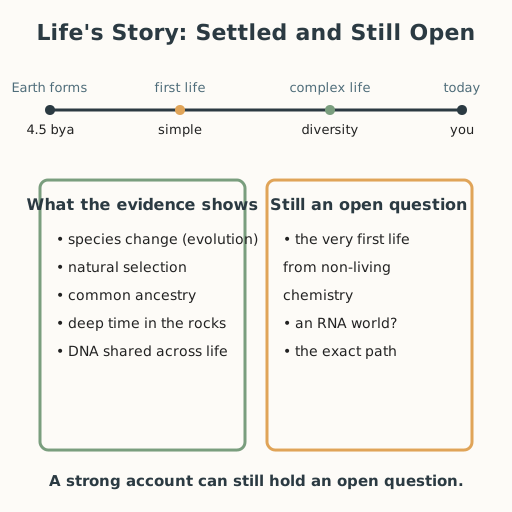
Lesson 7 — Accounts of Life’s Origin and Diversity
Summary
Learners get the scientific account of life’s origin and diversity straight: evolution by natural selection and common ancestry are strongly evidenced, while life’s very first origin from non-living chemistry remains an open area of research. They learn to hold “what the evidence shows” and “what is still open” in the same frame — and to treat the account as evidence-grounded, never creed.
Objectives
- Hold scientific accounts of life’s origin and diversity alongside cultural and spiritual accounts, and articulate how they relate. (D06.S2.12.02)
Connection
Every living thing you have ever met — the dog, the mosquito, the wheat, the fungus on the bread — shares a family story written in its body and in the rocks. Some parts of that story are as well-evidenced as anything we know; other parts, especially the very first step, are still open questions scientists are working on. Knowing which is which is what it means to hold the account honestly, as evidence rather than as a story you must simply accept.
Materials
- Origin-and-diversity timeline sheet
- Science journal
- Low-tech: a deep-time strip, scratch paper
Preparation
- Copy or draw the timeline sheet; prepare a deep-time strip scaled so 4.5 billion years fits a meter (1 cm ≈ 45 million years).
- Retrieval: from Grade 11 (D06.S2.11.01), evidence for evolution and common ancestry. Today we separate the diversity account (well evidenced) from the first origin question (still open).
- Prepare the worked example (one line of evolution evidence) to model first (S-011).
Facilitator note
This lesson is written to the learner (“you”). The idea to land: the scientific account of life has two parts with different status — diversity by evolution and common ancestry is strongly evidenced; the first origin of life from non-living chemistry is an open research question — and we name both honestly. Teach the evidence explicitly, then let learners sort settled from open (S-011). Be precise about scope: Darwin’s On the Origin of Species is about the origin of diversity, not the origin of the first life (S-303); the first origin remains unresolved, with hypotheses such as an RNA world and with life’s building blocks found in meteorites (S-499). Origins are held as evidence-grounded accounts among many — never as dogma (philosophy §11).
The ethics lens: honesty about what is open and what is settled is an ethical discipline — overclaiming certainty about the first origin, or denying the well-evidenced diversity account, are both failures of the same honesty. The egalitarianism lens: the evidence is public — anyone can examine a fossil, a finch beak, or a genome; it does not require a title to be weighed (S-305, S-304). The global lens: the evidence was gathered worldwide — the Galápagos finches, English moths, and rocks of every continent — and the account is offered alongside, not above, the many cultural accounts people hold (S-303, S-308). The technology lens: DNA sequencing and radiometric dating are the instruments that made common ancestry and deep time checkable in ways earlier centuries could not (S-308). The environment lens: the account is environmental at its root — organisms are shaped by their surroundings, which is why a changing climate reshapes the tree of life (S-303). Preview: Lesson 8 places this account beside cultural and spiritual accounts and works out how they relate.
Procedure
- Recall (5 min). From Grade 11, name one piece of evidence for evolution. Today we separate what is settled from what is still open.
- Build deep time (10 min). Mark a line from Earth’s formation, about 4.5 billion years ago, to today (S-308). Place milestones: first simple life, then complex life, then the diversity we see now. Feel how long the line is before any life appears — deep time is the scale the story needs.
- Worked example — the diversity account (15 min). Darwin proposed that species change by natural selection: individuals vary, some variations survive and reproduce more, and the population shifts (S-303). Evidence: the beaks of Darwin’s finches changed shape from season to season as food changed (S-305); the peppered moth shifted from light to dark as industrial soot darkened trees (S-304); and shared features and DNA point to common ancestry. Write this as “what the evidence shows.”
- Name the open part (8 min). The first origin — how non-living chemistry became the first living thing (abiogenesis) — is not yet settled. Building blocks of life (amino acids, nucleobases) are found in meteorites and comets, and hypotheses like an RNA world are tested, but the exact path remains unknown (S-499). Write this under “still an open question.”
- Sort the account (12 min). With a partner, make a two-column list: what the evidence shows versus still open. Say — or write, sign, gesture, or use AAC to show — one entry in each column and why it belongs there.
- Close (2 min). Say — or write, sign, gesture, or use AAC to express — why a strong account can still contain an open question, and why naming both is honesty.
Differentiation
- Support: Sort pre-written cards into the two columns rather than generating entries from scratch.
- Extension: State one prediction the common-ancestry account makes (e.g., where a transitional fossil or a shared gene should be found) and how it could be tested.
- Number access (dyscalculia): Deep time is felt, not computed — use the paper strip and relative positions (“long before,” “later”) rather than years; provide the two-column list as a pre-printed organizer, and allow every entry to be placed and explained in words or by pointing, with any dates read aloud or offloaded to a partner.
- Communication access: Every spoken step — saying, naming, reading aloud, discussing, or closing — can be done in writing, sign, gesture, or AAC instead. Learners who are non-speaking, d/Deaf, hard-of-hearing, or who use AAC complete every task in their preferred mode; no step requires producing or hearing sound.
Assessment
- Formative (peer + self): Can the learner place the diversity account and the first- origin question correctly on the settled-versus-open columns, and explain one line of evidence for each?
- Portfolio artifact (unit): The two-column list with the deep-time milestones, opened in the science journal.
Home connection
Look at two living things at home — a pet, a plant, an insect. Write one sentence on what they share that hints at a common story, and one sentence naming something about life’s beginning that is still unknown.
Resources
- On worked examples and guided practice: Kirschner, Sweller & Clark (2006) (S-011).
- On evolution and common ancestry: Darwin, On the Origin of Species (S-303); Grant & Grant on Darwin’s finches (S-305); Kettlewell on the peppered moth (S-304).
- On deep time: USGS — Age of the Earth (S-308).
- On the open first-origin question and astrobiology: NASA Astrobiology — History of Astrobiology (S-499).