Lesson 08 — Science and Culture, Side by Side
Learners practice holding a scientific account of life and a cultural or spiritual account side by side without ranking one above the other. They meet the idea of "two-eyed seeing," chart what each account asks and offers, and articulate how the two relate — complementary in some ways, genuinely different in others — with dignity for both. Origins and meaning are held as questions, never as creed.
Objectives
Objectives
- D06.S2.12.02 Hold scientific accounts of life's origin and diversity alongside cultural and spiritual accounts, and articulate how they relate.
Essential question
How do I hold a scientific account of life and a cultural or spiritual account side by side, honoring both, without ranking one above the other?
Key vocabulary
Materials
Standard materials
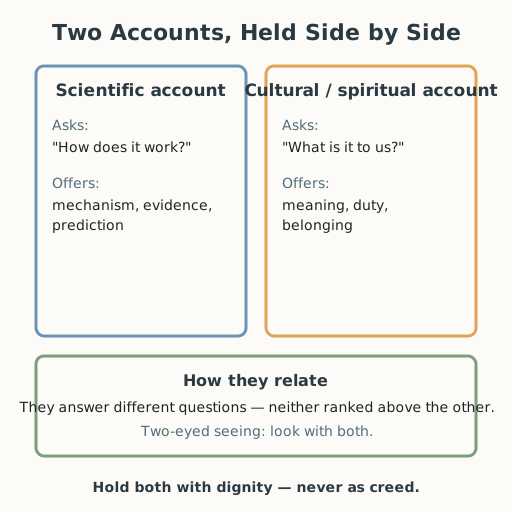
- Side-by-side chart · 1 per learner Two columns — "what this account asks" and "what this account offers" — with a shared row for how they relate
- Science journal · 1 per learner
Low-tech / no-cost
- Two short written accounts (one scientific, one cultural or spiritual) Hand-copied or printed; any local or known pair works
- Scratch paper For the side-by-side chart
Enriched / lab & device
- A reading from Kimmerer's Braiding Sweetgrass or a local elder's account · 1 per class To see two ways of knowing held together in one person's voice
Works in different contexts
- large-group Hold one pair of accounts whole-class, then pairs each chart a different pair and report
- multi-age Younger learners answer "what does each story teach?"; older learners also name the question each account is answering
- self-directed A learner charts a pair of accounts and writes how they relate without ranking
- level-grouped A ready group also names a point where the two accounts genuinely differ and one where they complement
- outdoor-only Name a living thing and tell two accounts of it — how it works, and what it means to your people — and hold both
Lesson 8 — Science and Culture, Side by Side
Summary
Learners practice holding a scientific account of life and a cultural or spiritual account side by side without ranking one above the other. They meet two-eyed seeing, chart what each account asks and offers, and articulate how the two relate — complementary in some ways, genuinely different in others — with dignity for both.
Objectives
- Hold scientific accounts of life’s origin and diversity alongside cultural and spiritual accounts, and articulate how they relate. (D06.S2.12.02)
Connection
The same living thing can be two things at once. A cedar is a photosynthesizing organism, and it is also a relative, a teacher, a gift, in a people’s story of who they are. Neither description is false; they answer different questions. The mature skill is not choosing one and discarding the other, but learning to hold both — and to say, clearly, how they stand beside each other.
Materials
- Side-by-side chart
- Science journal
- Low-tech: two written accounts, scratch paper
Preparation
- Copy or draw the side-by-side chart; gather a pair of accounts (one scientific, one cultural or spiritual) from a tradition learners can respect at a distance or know up close.
- Retrieval: from Lesson 7, the scientific account and its open questions. Today we place it beside another account.
- Prepare the worked example (charting one pair) to model first (S-011).
Facilitator note
This lesson is written to the learner (“you”). The idea to land: scientific and cultural or spiritual accounts of life answer different questions, and the skill is to hold them side by side without ranking — seeing where they complement and where they differ, with dignity for both. Teach the chart explicitly, then let learners work a pair (S-011). This is the inquiry-over-creed commitment made concrete (philosophy §11): no account is imposed, and no account is mocked. Frame as wondering together, and use written or anonymous questions if speaking up is not safe for some learners (contexts, cultural power dynamics).
The ethics lens: ranking one people’s account above another’s has been used to justify harm; refusing the ranking is an ethical stance, not a relativism that says nothing can be checked. The egalitarianism lens: every people’s account of life carries dignity — the Māori tell of Ranginui and Papatūānuku, sky and earth, whose separation made room for life (S-202); the Haudenosaunee tell of Sky Woman and a world made on a turtle’s back (S-203); the Yoruba tell of Olorun, the supreme creator who works through the orisha to shape the world (S-500); the Inca tell of Viracocha, who rose from Lake Titicaca to call the world into being (S-501); the Rig Veda’s Hymn of Creation wonders openly whether anyone knows how it all began (S-502); and the Qur’an tells of one God who made the heavens and the earth and shaped the first human from clay (S-503) — and none is a lesser way of knowing for being a story. The global lens: “two-eyed seeing,” seeing with both Indigenous and Western-scientific eyes together, is itself a teaching from Mi’kmaq Elder Albert Marshall, carried into science by Indigenous scholars such as Robin Wall Kimmerer (S-427) and documented worldwide through living heritage (S-056). The technology lens: science’s instruments answer “how” with unmatched power, but they are silent on “what it means” and “how we should live with it” — questions the cultural accounts take up. The environment lens: many cultural accounts carry ecological knowledge refined over generations — when to burn, when to plant, how to read a landscape — that complements rather than contradicts scientific ecology (S-320, S-321, S-427). Preview: Lesson 9 moves to the physical world’s fundamental forces.
Procedure
- Recall (5 min). From Lesson 7, name what the scientific account shows and what it leaves open. Today we set it beside another account.
- Meet two-eyed seeing (8 min). “Two-eyed seeing” means looking with one eye through Indigenous knowledge and the other through Western science, and using both (S-427). It is not blending into mush — it is seeing more, with two strengths at once.
- Worked example — chart a pair (15 min). Take two accounts of a cedar: the scientific one (a conifer that photosynthesizes, part of a forest ecosystem) and a cultural one (a relative and teacher in a people’s story). Chart each: what does it ask? (how does it work? vs what is it to us?) and what does it offer? (mechanism vs meaning and duty). Then write the relation: they do not contradict; they answer different questions.
- Chart your own pair (18 min). With a partner, choose a living thing and two accounts — one scientific, one cultural or spiritual you can name respectfully (or from the examples, S-202, S-203). Fill the chart. Say — or write, sign, gesture, or use AAC to show — one place they complement and one place they genuinely differ.
- Name the relation (7 min). Write one sentence of relation: do they answer different questions? Does one carry facts and the other carry meaning and duty? Be precise — no ranking, but no pretending they are identical either.
- Close (2 min). Say — or write, sign, gesture, or use AAC to express — what it means to hold two accounts side by side with dignity for both.
Differentiation
- Support: Chart only “what each account offers” before adding “what each asks.”
- Extension: Name a case where the two accounts appear to conflict (e.g., about a species’ origin or a landscape’s history) and write how you would hold both honestly without pretending the difference away.
- Number access (dyscalculia): The chart is qualitative — no arithmetic; provide it pre-printed with the two columns labeled so the learner fills phrases and single words, and allow the relation sentence to be spoken or recorded rather than written.
- Communication access: Every spoken step — saying, naming, reading aloud, discussing, or closing — can be done in writing, sign, gesture, or AAC instead. Learners who are non-speaking, d/Deaf, hard-of-hearing, or who use AAC complete every task in their preferred mode; no step requires producing or hearing sound.
Assessment
- Formative (peer + self): Can the learner chart two accounts — naming what each asks and offers — and write one precise sentence of relation that neither ranks them nor erases their difference?
- Portfolio artifact (unit): The completed side-by-side chart with the relation sentence, opened in the science journal — a capstone artifact for the science-and-culture strand.
Home connection
Ask someone at home for an account of a living thing — a story, a saying, a belief. Write it beside the scientific account you know, and one sentence on how the two stand together.
Resources
- On worked examples and guided practice: Kirschner, Sweller & Clark (2006) (S-011).
- On two-eyed seeing and Indigenous and scientific knowledge together: Kimmerer, Braiding Sweetgrass (S-427).
- On creation accounts held with dignity: Te Ara — Ranginui and Papatūānuku (S-202); Smithsonian NMAI — Haudenosaunee creation (S-203); Encyclopaedia Britannica — Olorun, Yoruba creator deity (S-500); Viracocha, Inca creator deity (S-501); Rigveda (S-502); Allah (S-503).
- On living heritage and intergenerational knowledge: UNESCO Intangible Cultural Heritage (S-056); on Indigenous ecological practice: CSIRO cultural burning (S-320), Firesticks Alliance (S-321).