Lesson 09 — Fundamental Forces
Learners meet the four fundamental forces — gravity, electromagnetism, the strong force, and the weak force — and see that everything they touch is governed by these four. They compare each force's range and relative strength, match each to an everyday effect, and glimpse the deep idea that all of physics is built from a very few interactions.
Objectives
Objectives
- D06.S3.12.01 Explain the fundamental forces and particles that make up matter, and how they unify physical explanations.
Essential question
What are the four fundamental forces of nature, and how does each one shape the world I touch every day?
Key vocabulary
Materials
Standard materials
- Four-forces card sort · 1 set per pair Four cards (gravity, electromagnetism, strong, weak) with range, strength, and an everyday example to match
- Science journal · 1 per learner
Low-tech / no-cost
- A dropped object, two magnets (or a comb and paper), and the sky Gravity (the drop), electromagnetism (the magnet), the strong force (why a nucleus holds), the weak force (why the Sun shines)
- Scratch paper For the four-forces table
Enriched / lab & device
- A short video or simulation of the four forces · 1 per class To see relative strength and range at work
Works in different contexts
- large-group Introduce the four forces whole-class, then pairs sort examples to each force and report
- multi-age Younger learners match each force to one everyday effect; older learners also compare range and relative strength
- self-directed A learner builds the four-forces table and writes one everyday effect of each
- level-grouped A ready group also explains why gravity, though weakest, dominates at large scales
- outdoor-only Find each force outdoors — gravity in a fall, electromagnetism in sunlight, the strong force in any solid, the weak force in the Sun's light
Lesson 9 — Fundamental Forces
Summary
Learners meet the four fundamental forces — gravity, electromagnetism, the strong force, and the weak force — and see that everything they touch is governed by these four. They compare each force’s range and relative strength, match each to an everyday effect, and glimpse the deep idea that all of physics is built from a very few interactions.
Objectives
- Explain the fundamental forces that make up matter, and how they unify physical explanations. (D06.S3.12.01)
Connection
Drop a stone and it falls; a magnet snaps to a fridge; a solid table holds your hand up without collapsing; and the Sun — ninety-three million miles away — still warms your skin. Four forces, and only four, run all of it. Gravity, electromagnetism, the strong force, and the weak force are the handful of rules behind every machine, every mountain, and every living body you have ever met.
Materials
- Four-forces card sort
- Science journal
- Low-tech: a dropped object, magnets or a comb, scratch paper
Preparation
- Copy or draw the four-forces cards.
- Retrieval: from Grade 11 (D06.S3.11.01), matter and energy at atomic and quantum scales. Today we name the four interactions that govern them.
- Prepare the worked example (the four-forces table) to model first (S-011).
Facilitator note
This lesson is written to the learner (“you”). The idea to land: there are four fundamental forces — gravity, electromagnetism, the strong force, and the weak force — with different ranges and strengths, and they account for everything from falling stones to shining stars. Teach the table explicitly, then let learners sort examples (S-011). Keep the physics precise but honest about limits: the Standard Model describes three forces well, while gravity is not yet fitted into that quantum frame — an open frontier, not a finished book (S-498, S-435).
The ethics lens: a tiny set of forces with universal reach is a humbling reminder that no person or nation owns the laws — they are everyone’s inheritance and no one’s property. The egalitarianism lens: the same gravity that holds a king holds a beggar; the forces are indifferent to status, which is a quiet argument for the equal standing of every body. The global lens: the modern picture was built by people of many nations — from Newton’s gravity (S-302) to a Standard Model assembled by physicists worldwide at CERN (S-498) — a shared, international achievement. The technology lens: every technology is a conversation with these forces — a bridge works with gravity, a motor with electromagnetism, a reactor with the strong and weak forces (S-360, S-498). The environment lens: the Sun shines by the weak force driving fusion, and its electromagnetic light powers nearly every food chain on Earth — the forces are the environment’s engine (S-047, S-361). Preview: Lesson 10 turns from the forces to the particles they act on, and to unification.
Procedure
- Recall (5 min). From Grade 11, name one thing that puzzled you about the quantum world. Today we name the four interactions that run it.
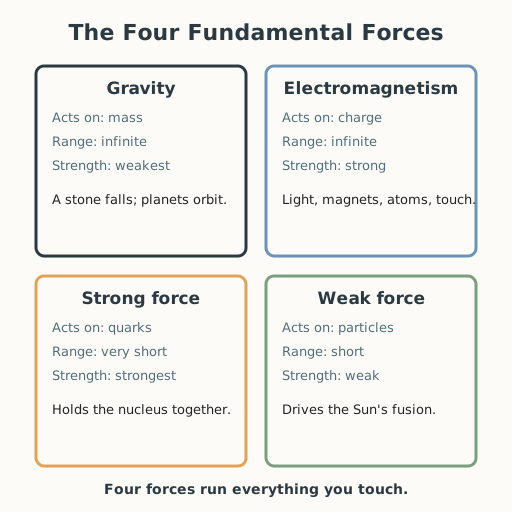
- Meet the four (10 min). Write each force and one line: gravity (attracts mass, infinite range, weakest); electromagnetism (acts on charge, infinite range, holds atoms and makes light); the strong force (binds quarks into protons and neutrons, very short range, strongest); the weak force (drives certain radioactive decays and fusion, short range) (S-498, S-435).
- Worked example — the table (12 min). Build a table: force, what it acts on, range, relative strength, everyday effect. Fill gravity first: acts on mass, infinite range, weakest, “makes the stone fall and the planets orbit.” Then fill the rest together.
- Sort examples (12 min). With a partner, sort each to its force: a dropped apple (gravity); light and a fridge magnet (electromagnetism); a nucleus staying together (strong); the Sun shining (weak, S-361, S-047). Say — or write, sign, gesture, or use AAC to show — one match and why.
- A puzzle worth noticing (8 min). Gravity is the weakest force, yet it shapes planets and galaxies. Why? Because it is always attractive and has infinite range, it adds up across huge masses, while the strong force, though strongest, barely reaches past a nucleus (S-498). Say — or write, sign, gesture, or use AAC to express — this in your own words.
- Close (2 min). Say — or write, sign, gesture, or use AAC to express — the four forces and one everyday effect of each.
Differentiation
- Support: Match each force to one picture (a fall, a magnet, a nucleus, the Sun) before writing any definitions.
- Extension: Explain the “inverse-square” idea informally — why doubling distance weakens gravity and electromagnetism — and predict what it means for a satellite’s orbit.
- Number access (dyscalculia): The comparison of strengths and ranges is relative, not arithmetic — use “strongest/weakest,” “long/short,” and “reaches far/doesn’t” rather than exponents; provide the four-forces table pre-printed so the learner fills words and examples, and allow every match to be made by pointing to a card with no numeric work.
- Communication access: Every spoken step — saying, naming, reading aloud, discussing, or closing — can be done in writing, sign, gesture, or AAC instead. Learners who are non-speaking, d/Deaf, hard-of-hearing, or who use AAC complete every task in their preferred mode; no step requires producing or hearing sound.
Assessment
- Formative (peer + self): Can the learner name the four forces, match each to an everyday effect, and explain in words why the weakest force shapes the largest structures?
- Portfolio artifact (unit): The completed four-forces table with one everyday effect per force, opened in the science journal.
Home connection
Find the four forces in one room: gravity in anything resting or falling, electromagnetism in a light or a switch, the strong force in every solid object, the weak force in anything warm from the Sun. Write one line naming where you found each.
Resources
- On the four fundamental forces and the Standard Model: CERN — The Standard Model (S-498); OpenStax College Physics (S-435).
- On gravity: NASA Space Place — What Is Gravity? (S-180); on Newton’s gravity: Principia (S-302).
- On electromagnetism: BBC Bitesize (KS3) — Electromagnetism (S-360); on the Sun and stellar fusion: NASA Space Place — All About the Sun (S-047); NASA — Star Lifecycle (S-361).