Lesson 10 — Particles and the Unification of Matter
Learners discover that the astonishing variety of matter is built from a very few fundamental particles — quarks, leptons, and force-carrying bosons — organized by the Standard Model. They "build" a proton and an atom from quarks and electrons, and see how unification works: the electromagnetic and weak forces unify into one, the strong force gets its own theory, and gravity alone still resists joining — an unfinished project, not a closed book.
Objectives
Objectives
- D06.S3.12.01 Explain the fundamental forces and particles that make up matter, and how they unify physical explanations.
Essential question
What are the fundamental particles of matter, and how do they unify our explanation of what everything is made of?
Key vocabulary
Materials
Standard materials
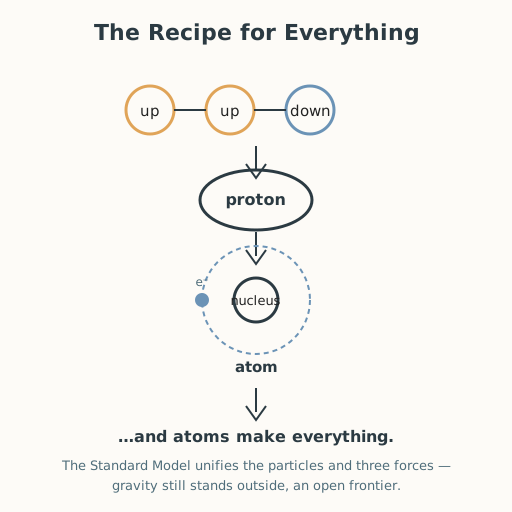
- Particle-build sheet · 1 per learner A "recipe" diagram — proton = two up quarks + one down quark; atom = protons, neutrons, electrons — to assemble ordinary matter
- Science journal · 1 per learner
Low-tech / no-cost
- Small tokens or counters in three kinds Use counters to stand for up quarks, down quarks, and electrons, and "build" an atom by recipe
- Scratch paper For the recipe diagram
Enriched / lab & device
- A particle-physics chart or simulation (e.g., CERN's Standard Model poster) · 1 per class To see the full particle family and the unification story
Works in different contexts
- large-group Build ordinary matter whole-class, then pairs assemble different atoms by recipe and report
- multi-age Younger learners build a proton and an atom with tokens; older learners also name the families and the Higgs's role
- self-directed A learner builds the recipe and writes how a few particles unify the many substances
- level-grouped A ready group also explains which force unifies with which, and where gravity resists unification
- outdoor-only Point to any solid object and "read" it down to quarks and electrons — a recipe for everything in view
Lesson 10 — Particles and the Unification of Matter
Summary
Learners discover that the astonishing variety of matter is built from a very few fundamental particles — quarks, leptons, and force-carrying bosons — organized by the Standard Model. They “build” a proton and an atom from quarks and electrons, and see how unification works: electromagnetism and the weak force unify into one, the strong force gets its own theory, and gravity alone still resists joining — an unfinished project, not a closed book.
Objectives
- Explain the fundamental particles that make up matter, and how they unify physical explanations. (D06.S3.12.01)
Connection
A diamond, a leaf, a drop of water, a bone — nothing alike, and yet all of them are built from the same three ingredients: up quarks, down quarks, and electrons, arranged differently. The dazzling variety of the world is a matter of arrangement, not of many building blocks. A few particles, and a few forces, account for nearly everything you have ever touched — and that is the deep idea of unification.
Materials
- Particle-build sheet
- Science journal
- Low-tech: counters in three kinds, scratch paper
Preparation
- Copy or draw the particle-build sheet.
- Retrieval: from Lesson 9, the four forces. Today we build the matter they act on.
- Prepare the worked example (the proton recipe) to model first (S-011).
Facilitator note
This lesson is written to the learner (“you”). The idea to land: matter is built from a few fundamental particles — quarks and leptons — bound by force-carrying bosons, and this small cast unifies our explanation of what everything is made of; the Standard Model unifies three forces, while gravity remains outside it, an open frontier. Teach the recipe explicitly, then let learners build (S-011). Be honest about limits: the model is tremendously successful but incomplete — it does not yet include gravity or explain dark matter (S-498).
The ethics lens: the unfinished unification — gravity outside the frame — models intellectual honesty: scientists say plainly what the theory does not yet do, rather than claiming completion (S-498). The egalitarianism lens: the claim “we are all made of the same few particles” is literally, materially true — every person is the same handful of quarks and electrons, a scientific statement of deep equality. The global lens: the Standard Model is a collaborative, international construction, assembled by physicists from many nations at CERN and elsewhere, not one country’s triumph (S-498); and the elements of our bodies were forged in stars across the universe (S-361). The technology lens: this “useless” knowledge is the foundation of technologies from medical imaging to semiconductors — particle physics made the devices that run the modern world (S-498). The environment lens: “we are made of star-stuff” — the carbon, oxygen, and iron in our bodies were made in stars and scattered by their deaths — ties our matter to the cosmos and its cycles (S-361). Preview: Lesson 11 weighs the technologies this physics enables.
Procedure
- Recall (5 min). From Lesson 9, name the four forces. Today we meet what they act on.
- Meet the particle families (10 min). Matter particles come in two families: quarks (which feel the strong force) and leptons (like the electron, which do not). Forces are carried by bosons — the photon for electromagnetism, gluons for the strong force, W and Z for the weak force (S-498). Write the three families.
- Worked example — the proton recipe (12 min). A proton is two up quarks + one down quark, held by the strong force; a neutron is one up + two down. An atom is protons and neutrons (a nucleus) with electrons around it (S-498, S-435). “Build” a carbon atom by recipe: 6 protons, 6 neutrons, 6 electrons. Notice: a few particles, arranged, make every element.
- The Higgs (6 min). Particles get mass through the Higgs mechanism; the Higgs boson, predicted by the model, was found at CERN in 2012 — a unification of prediction and discovery (S-498).
- Unification (10 min). Unification means showing that what looked like different forces are one force seen differently: electricity and magnetism unified into electromagnetism; electromagnetism and the weak force unify into the electroweak force; the strong force has its own theory. Gravity — the most familiar force — still resists joining the quantum frame (S-498). Say — or write, sign, gesture, or use AAC to show — why the model is a triumph and a work in progress.
- Build and read (10 min). With a partner, build a proton, then an atom, with counters. Then “read” any solid object in the room down to quarks and electrons. Say — or write, sign, gesture, or use AAC to show — the recipe for something ordinary.
- Close (2 min). Say — or write, sign, gesture, or use AAC to express — what it means that everything is made of the same few particles.
Differentiation
- Support: Build only the proton with tokens before attempting a full atom, and use the pre-drawn recipe diagram as a copy card.
- Extension: Explain why the electron is a lepton (no strong force) while quarks are not, and name one open question the Standard Model does not answer.
- Number access (dyscalculia): Building is counting-free if tokens are used — match by shape or color, not number; provide the recipe diagram pre-printed so the learner follows “two up + one down” as a picture, and allow every explanation in words with any counting offloaded to a partner or done with grouped tokens.
- Communication access: Every spoken step — saying, naming, reading aloud, discussing, or closing — can be done in writing, sign, gesture, or AAC instead. Learners who are non-speaking, d/Deaf, hard-of-hearing, or who use AAC complete every task in their preferred mode; no step requires producing or hearing sound.
Assessment
- Formative (peer + self): Can the learner build a proton and an atom by recipe, name the three particle families, and explain in words what unification means and where it remains unfinished?
- Portfolio artifact (unit): The particle-build sheet with a written sentence on unification, opened in the science journal — a capstone artifact for the physical-systems strand.
Home connection
Choose one object at home and “read” it down: what element is it mostly made of, and what are that element’s atoms made of? Write the recipe in two or three lines.
Resources
- On the Standard Model, particle families, the Higgs, and gravity’s exclusion: CERN — The Standard Model (S-498); OpenStax College Physics (S-435).
- On the elements being forged in stars: NASA — Star Lifecycle (S-361).