Lesson 11 — Energy, Materials, and Computing: Promise and Risk
Learners weigh the promise and risk of the three physical technologies that define our era — energy, materials, and computing. They trace a device from the energy that runs it, through the materials mined for it, to the waste it becomes, and they learn to ask the same two questions of any technology: what does it promise, and what does it risk — and for whom?
Objectives
Objectives
- D06.S3.12.02 Weigh the promise and risk of physical technologies (energy, materials, and computing) for a just and sustainable future.
Essential question
What do physical technologies — energy, materials, and computing — promise, and what do they risk, for people and for the Earth?
Key vocabulary
Materials
Standard materials
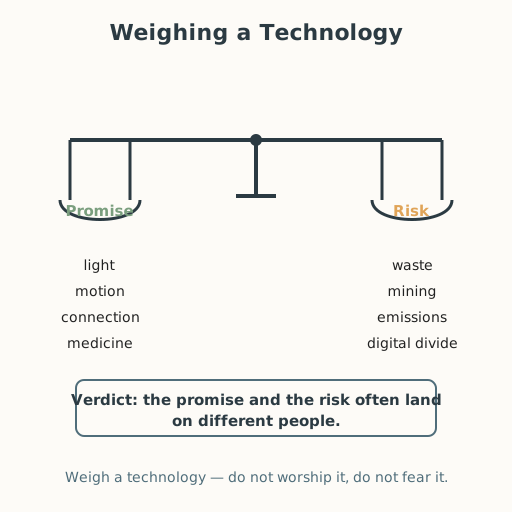
- Promise-and-risk sheet · 1 per learner A two-column scale for one technology — what it promises and what it risks — with a verdict line
- Science journal · 1 per learner
Low-tech / no-cost
- A real device or its label A phone, a light, a battery — trace its energy and material story
- Scratch paper For the promise-and-risk scale
Enriched / lab & device
- A data page on energy mix or e-waste (Our World in Data, WHO) · 1 per pair To check a promise or a risk against an authoritative figure
Works in different contexts
- large-group Weigh one technology whole-class, then pairs each weigh a different technology and report
- multi-age Younger learners answer "what does it give us, and what does it cost?"; older learners also name who bears the cost
- self-directed A learner weighs a technology's promise and risk and writes the verdict with evidence
- level-grouped A ready group also distinguishes a risk that is inherent from one that is a design choice
- outdoor-only Weigh a technology visible outdoors — a pump, a panel, a vehicle — for what it gives and what it takes
Lesson 11 — Energy, Materials, and Computing: Promise and Risk
Summary
Learners weigh the promise and risk of the three physical technologies that define our era — energy, materials, and computing. They trace a device from the energy that runs it, through the materials mined for it, to the waste it becomes, and learn to ask the same two questions of any technology: what does it promise, and what does it risk — and for whom?
Objectives
- Weigh the promise and risk of physical technologies (energy, materials, and computing) for a just and sustainable future. (D06.S3.12.02)
Connection
Your phone is a promise: it connects you to people and knowledge across the world. It is also a risk: the cobalt in its battery was mined, often under conditions that harm the people who dig it; the energy that powers its network burns fuel that warms the climate; and one day it becomes e-waste. Every technology is both of these at once — the mature stance is not to worship it or to fear it, but to weigh it.
Materials
- Promise-and-risk sheet
- Science journal
- Low-tech: a device or its label, scratch paper
Preparation
- Copy or draw the promise-and-risk sheet.
- Retrieval: from Grade 10 (D06.S3.10.02), renewable and nonrenewable energy and their trade-offs. Today we add materials and computing and weigh them together.
- Prepare the worked example (tracing one device) to model first (S-011).
Facilitator note
This lesson is written to the learner (“you”). The idea to land: energy, materials, and computing each carry real promise and real risk, and honest weighing names both — including who bears the risk — rather than praising or damning a technology wholesale. Teach the trace explicitly, then let learners weigh (S-011). Keep evidence and values distinct: that renewable and nonrenewable sources differ, that cobalt mining harms communities, and that e-waste is a growing hazard are factual, cited claims (S-095, S-398, S-397); how much risk we accept is a value choice to be argued, not hidden inside the physics.
The ethics lens: a technology’s benefits and harms rarely land on the same people — the ethical question is whether the bargain is a fair one or a hidden transfer of cost (S-398). The egalitarianism lens: the digital divide means computing’s promise is not equally distributed — the same device that empowers one person is unaffordable or unreachable for another (S-281). The global lens: supply chains are planetary — the cobalt in a battery, the lithium, the rare earths — so the risk of one country’s convenience is another country’s extraction (S-398); and renewable energy is now a global, rapidly growing share of power (S-095, S-006). The technology lens: this is the lens’s home territory — computing’s promise (modeling, medicine, connection) and its material underside (energy-hungry data centers, short-lived devices, e-waste) are the same technology seen whole (S-397, S-481). The environment lens: energy choices drive the climate (S-005), and the life cycle of a device — mine, make, use, discard — is an environmental story from start to finish (S-397). Preview: Lesson 12 turns weighing into a proposal for a just and sustainable physics.
Procedure
- Recall (5 min). From Grade 10, name one renewable and one nonrenewable energy source. Today we weigh energy with materials with computing.
- Trace a device (12 min). Pick a device. Trace its life: energy (what powers it and its network), materials (what it is made of and where that came from), waste (what it becomes when discarded). Note that nonrenewable energy releases carbon that warms the climate (S-005, S-095), and that devices become e-waste — a fast-growing and hazardous stream (S-397).
- Worked example — the battery (12 min). Weigh a rechargeable battery. Promise: it stores energy from renewable sources and powers devices and vehicles. Risk: its cobalt is mined under documented harmful conditions in the Democratic Republic of the Congo (S-398), and at end of life it can become hazardous waste (S-397). Fill the two columns and note: the promise and the risk land on different people.
- Computing’s double face (8 min). Computing promises modeling, medicine, and connection; it also costs energy and concentrates power and access unevenly — the digital divide (S-281, S-481). Say — or write, sign, gesture, or use AAC to show — one promise and one risk of computing.
- Weigh a technology (15 min). With a partner, choose a technology — a solar panel, a data center, a plastic, a device. Fill the promise-and-risk sheet, and name who bears each side. Say — or write, sign, gesture, or use AAC to show — your verdict and whether the bargain is fair.
- Close (2 min). Say — or write, sign, gesture, or use AAC to express — why a technology must be weighed, not worshiped and not feared.
Differentiation
- Support: Fill only “what it promises” and “what it risks” for one device, without the who-bears-it column yet.
- Extension: Distinguish a risk that is inherent to a technology from one that is a design or policy choice, and write one change that removes the avoidable risk.
- Number access (dyscalculia): The weighing is qualitative — use “more/less,” “renewable/nonrenewable,” and “here/elsewhere” rather than quantities; provide the promise-and-risk sheet pre-printed with the two columns labeled so the learner fills phrases, and allow the verdict in words with any figures offloaded to a partner or read aloud.
- Communication access: Every spoken step — saying, naming, reading aloud, discussing, or closing — can be done in writing, sign, gesture, or AAC instead. Learners who are non-speaking, d/Deaf, hard-of-hearing, or who use AAC complete every task in their preferred mode; no step requires producing or hearing sound.
Assessment
- Formative (peer + self): Can the learner trace a device’s energy, material, and waste story, and weigh its promise against its risk while naming who bears each side?
- Portfolio artifact (unit): One completed promise-and-risk sheet with a verdict, opened in the science journal.
Home connection
Choose one device at home and trace one material in it back to its source. Write two sentences: what it promises, and who you now know bears a cost for it.
Resources
- On worked examples and guided practice: Kirschner, Sweller & Clark (2006) (S-011).
- On renewable and nonrenewable energy: EIA Energy Kids (S-095); on climate: IPCC (S-005); Our World in Data (S-006).
- On e-waste: WHO — e-waste fact sheet (S-397); on the cobalt supply chain: Amnesty International (2016) (S-398).
- On the digital divide: World Bank — Digital Dividends (S-281); on social media/computing: Encyclopaedia Britannica — Social media (S-481).