Lesson 12 — Toward a Just and Sustainable Physics
Learners turn the weighing of Lesson 11 into a constructive proposal for a just and sustainable physics. They learn the physical constraints that honesty requires — the second law means no process is perfectly efficient, and every material carries an embodied cost — then propose concrete changes: efficiency and renewables, a circular economy, and a just transition that names who is newly included and how we would know it worked.
Objectives
Objectives
- D06.S3.12.02 Weigh the promise and risk of physical technologies (energy, materials, and computing) for a just and sustainable future.
Essential question
Given the laws of physics and the reality of who bears the costs, what would a just and sustainable use of energy, materials, and computing look like?
Key vocabulary
Materials
Standard materials
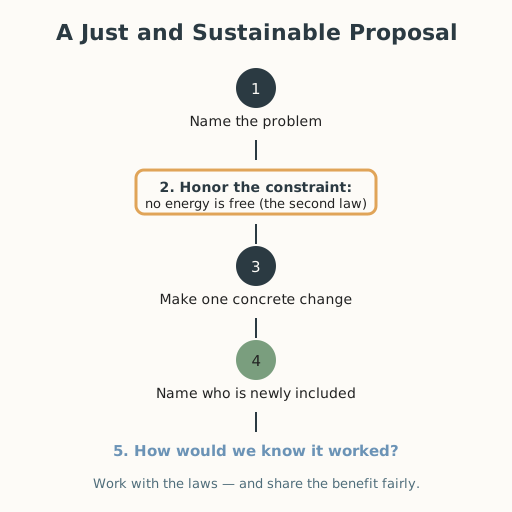
- "Just and sustainable" proposal frame · 1 per learner A one-page scaffold — problem, physical constraint, change, who is newly included, how we would know
- Science journal · 1 per learner
Low-tech / no-cost
- The promise-and-risk sheet from Lesson 11 Reused as the problem statement
- Scratch paper For drafting the proposal
Enriched / lab & device
- A short case study of a just transition or circular-economy practice · 1 per class To see a just-and-sustainable physics already being tried
Works in different contexts
- large-group Build one model proposal whole-class, then small groups each draft a change for a different technology
- multi-age Younger learners propose one inclusion ("who should share the benefit?"); older learners write the full proposal
- self-directed A learner writes the proposal alone using the scaffold and self-check
- level-grouped A ready group also writes the physical constraint (efficiency limit) and the measure of success
- outdoor-only Propose a more just and sustainable use of a local energy or material resource, naming who is newly included
Lesson 12 — Toward a Just and Sustainable Physics
Summary
Learners turn weighing into construction: they learn the physical constraints that honesty requires — the second law means no process is perfectly efficient, and every material carries an embodied cost — then propose concrete changes: efficiency and renewables, a circular economy, and a just transition that names who is newly included and how we would know it worked.
Objectives
- Weigh the promise and risk of physical technologies (energy, materials, and computing) for a just and sustainable future. (D06.S3.12.02)
Connection
You have weighed a technology and seen that its promise and its cost land on different people. Now the constructive question: what would we build instead? Physics sets honest limits — energy is never perfectly converted, nothing is made from nothing — but within those limits there is enormous room to choose who benefits and who pays. A just and sustainable physics is not magic; it is a set of specific choices, and you can propose one.
Materials
- “Just and sustainable” proposal frame
- Science journal
- Low-tech: the Lesson 11 sheet, scratch paper
Preparation
- Copy or draw the proposal frame.
- Retrieval: from Lesson 11, the promise-and-risk weighing. Today we answer the risk with a change.
- Prepare one model proposal to model first (S-011).
Facilitator note
This lesson is written to the learner (“you”). The idea to land: a just and sustainable physics is honest about physical limits — the second law means no free energy, and every material has an embodied cost — and then makes concrete, checkable choices: efficiency and renewables, a circular economy, and a just transition. Teach the proposal structure explicitly, then let learners write (S-011). Keep the distinction live: that no process is perfectly efficient and that extraction harms communities are factual, cited claims (S-256, S-398); that we should share the benefits fairly is a value we state openly, not a conclusion physics can reach by itself.
The ethics lens: the proposal is ethics made operational — naming the constraint, the change, and the measure is what turns “we should do better” into something checkable. The egalitarianism lens: “who is newly included?” is the egalitarian test — a transition that leaves the same people bearing the cost has not been just, however green it is painted (S-483). The global lens: the just transition is a global conversation — the countries that emitted least often bear the worst climate costs, so justice is not a local afterthought but the design problem (S-006, S-005); the circular economy is a worldwide movement (S-452). The technology lens: technology is the lever — efficiency, renewables, and circular design are physical technologies that reduce the trade-off rather than choosing a side (S-095, S-452). The environment lens: the second law and embodied energy are the environment’s own arithmetic — waste heat and waste material are not sloppiness but the laws of thermodynamics, so the design problem is to work with them (S-256, S-397). Preview: Lesson 13 turns to the cosmos — cosmological models and geological evidence.
Procedure
- Recall (5 min). From Lesson 11, name the risk you weighed. Today you propose the change that answers it.
- Meet the honest limits (10 min). Two physical truths constrain any proposal: the second law — no energy conversion is perfectly efficient, some always becomes waste heat (S-256, S-245); and embodied cost — every material took energy and land to make and will become waste (S-397). A proposal that pretends otherwise is not physics, it is wishing.
- Meet the levers (8 min). Write each and one line: efficiency and renewables (do more with less, and power it with sources that replenish, S-095); circular economy (design materials to be reused, repaired, and remade rather than discarded, S-452); and a just transition (change the system so the people who lose old work gain new work, and the people who bore the cost share the benefit, S-483).
- Worked example — a model proposal (12 min). Build one together: Problem — a device’s cobalt harms mining communities. Constraint — we cannot make a battery from nothing; it has an embodied cost. Change — design for repair and recycling, and source materials under fair, audited conditions. Who is newly included — mining communities and repair workers share the benefit and the say. How we would know — the battery lasts longer, is recycled, and the mine is independently audited. Write all five parts.
- Write your own proposal (18 min). Using the scaffold, write a one-page proposal for the technology you weighed in Lesson 11. Say — or write, sign, gesture, or use AAC to show — each part, especially the physical constraint you honored and who is newly included.
- Close (2 min). Say — or write, sign, gesture, or use AAC to express — what a just and sustainable physics looks like in one sentence.
Differentiation
- Support: Complete only three parts — problem, change, who is included — and adapt the model proposal as a template.
- Extension: Add a falsifiable indicator for “how we would know,” and name the physical limit your proposal cannot escape no matter how good the design.
- Number access (dyscalculia): The proposal is prose, not arithmetic; provide the five-part frame as a pre-printed scaffold with sentence starters, and allow every part to be completed in words, gesture, or recorded voice with no numbers required.
- Communication access: Every spoken step — saying, naming, reading aloud, discussing, or closing — can be done in writing, sign, gesture, or AAC instead. Learners who are non-speaking, d/Deaf, hard-of-hearing, or who use AAC complete every task in their preferred mode; no step requires producing or hearing sound.
Assessment
- Formative (peer + self): Can the learner name two physical constraints, two levers of a just transition, and write a proposal that honors a constraint and names who is newly included?
- Portfolio artifact (unit): The one-page proposal, opened in the science journal — a capstone artifact for the just-and-sustainable-physics strand.
Home connection
Share your proposal with someone at home and ask what it would cost them, honestly. Add their answer as one sentence and one adjustment to your change.
Resources
- On worked examples and guided practice: Kirschner, Sweller & Clark (2006) (S-011).
- On the laws of energy and efficiency: EIA Energy Kids — Laws of Energy (S-256); BBC Bitesize (KS3) — Energy stores (S-245); EIA — Renewable and Nonrenewable (S-095).
- On the circular economy: Ellen MacArthur Foundation (S-452); on e-waste: WHO (S-397).
- On who bears climate and extraction costs: Our World in Data (S-006); IPCC (S-005); Amnesty International — cobalt (S-398); EPA — Environmental Justice (S-483).