Lesson 01 — Building a Body of Artwork: Skill and Vision
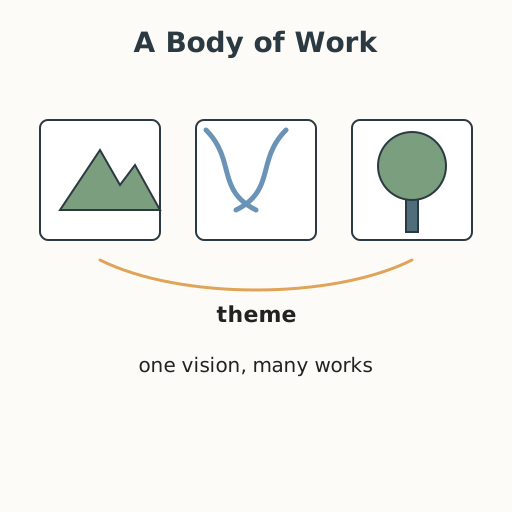
Learners meet the unit's first idea: a *body of work* is not a stack of pictures but a series of pieces held together by one coherent vision and visible, deliberate skill. They study Jacob Lawrence's 60-panel Migration Series as a worked example of a single theme carried across many panels, then choose a theme of their own and make three sketch studies that share a vision.
Objectives
Objectives
- D07.S1.12.01 Produce a sustained body of artwork that demonstrates technical skill and a coherent personal vision, and present it with a written artist statement.
Essential question
What makes several separate artworks into a single body of work — and how do I begin building one that shows both skill and my own vision?
Key vocabulary
Materials
Standard materials
- Capstone art journal · 1 per learner The unit-long notebook for sketch studies, artist statements, critiques, and portfolio artifacts
- Series-planning sheet · 1 per learner A one-page organizer with a theme line, three thumbnail boxes, and a "what stays the same across all pieces" line
Low-tech / no-cost
- Any drawing or mark-making surface Paper, cardboard, smoothed earth, or slate; a stick, charcoal, chalk, or a fingertip works as the tool
- Found images or objects Leaves, cloth scraps, packaging, or printed pictures to sort into a "same vision" group
Enriched / lab & device
- Free digital tools (Krita or Inkscape) · 1 per learner or pair For learners who want to begin the series digitally; both are free and open source (S-440, S-441)
Works in different contexts
- large-group Model the worked example whole-class, then learners plan a three-piece series in pairs, sharing themes aloud
- multi-age Younger learners sort found objects into a "same idea" group; older learners write the line that unifies their three studies
- self-directed A learner follows the worked example, chooses a theme, and completes three sketch studies plus the unifying line alone
- level-grouped A ready group also names the technical skill they are deliberately rehearsing across all three pieces
- outdoor-only Use natural or found materials (leaves, sticks, pressed earth) and the same theme across three outdoor studies
Lesson 1 — Building a Body of Artwork: Skill and Vision
Summary
Learners meet the unit’s first idea: a body of work is not a stack of pictures but a series of pieces held together by one coherent vision and visible, deliberate skill. They study Jacob Lawrence’s 60-panel Migration Series (S-363) as a worked example of a single theme carried across many panels, then choose a theme of their own and make three sketch studies that share a vision.
Objectives
- Produce a sustained body of artwork that demonstrates technical skill and a coherent personal vision, and present it with a written artist statement. (D07.S1.12.01)
Connection
A single song you like, a single dish your family makes, a single photograph of a place — each is one moment. A body of work is what an artist keeps returning to: the potter whose every pot carries the same hand, the weaver whose every cloth repeats a family pattern, the photographer who photographs the same river in every season. It is the difference between saying one thing once and saying it in many ways until it becomes a voice. Wherever you live, you already have themes you return to — a place, a person, a feeling, a question.
Materials
- Capstone art journal
- Series-planning sheet
- Low-tech: any drawing surface and mark-making tool; found images or objects
- Enriched: Krita or Inkscape (free and open source)
Preparation
- Copy or draw the series-planning sheet (theme + three thumbnail boxes + “what stays the same” line).
- Retrieval: from Grade 11 (D07.S1.11.01), art that addresses a social or environmental issue; from Grade 10 (D07.S1.10.01), developing a personal style in a body of work. Today we begin the sustained body that becomes this unit’s capstone portfolio.
- Prepare the worked example (Jacob Lawrence’s Migration Series) to model first (S-011).
Facilitator note
This lesson is written to the learner (“you”). The idea to land: a body of work is a series of pieces united by one coherent vision and rehearsed, visible skill — not just “more than one picture.” Teach the worked example explicitly, then let learners choose a theme and make three studies (S-011). Hold “vision” as something anyone can claim, not a privilege: a vision is simply what you keep returning to and caring about.
The ethics lens: a body of work is a promise — the artist is accountable for the theme they take up, so choose a theme you can stand behind and represent honestly. The egalitarianism lens: Lawrence made his series in tempera on hardboard with simple materials in a small studio; a body of work needs no expensive tools, only sustained attention (S-363). The global lens: series-making is everywhere — Hokusai’s Thirty-six Views of Mount Fuji returns to one mountain in many weathers (S-364), and weavers and potters worldwide repeat a motif until it becomes a signature. Meet every tradition named here as a living practice, never a specimen to copy carelessly. The technology lens: free tools such as Krita and Inkscape mean a learner without paper or paint can still build a series (S-440, S-441); the vision is yours, the tool is optional. The environment lens: returning to one subject across time — a river, a field, a sky — is also how we notice environmental change; a series can be a record. Preview: Lesson 2 turns the body into words with the artist statement.
Procedure
- Recall (5 min). From Grade 11: name one artwork you made (or imagined) that spoke to a social or environmental issue. Today we ask a bigger question: what does it take to make not one piece but a body of work that speaks with one voice?
- Meet the idea (8 min). Write it down: a body of work is a set of pieces held together by a shared theme and a coherent vision — the same eyes, the same concerns, the same developing skill across every piece. A single picture is one sentence; a body of work is a paragraph that says one thing many ways.
- Worked example — Jacob Lawrence’s Migration Series (12 min). Lawrence made sixty small painted panels about one subject: the Great Migration, the movement of African Americans from the rural South to cities in the North in the early 1900s (S-363). Every panel shows the same theme, the same flat, bold shapes, the same colors — a single vision sustained across sixty works. Name what unifies them: theme (migration) and skill (a consistent visual language). Write this on your sheet as the model.
- Name the move (5 min). A series is not “anything I happened to make.” It is a decision: I will return to this. The artist chooses the thread, then keeps pulling it.
- Choose your theme and make three studies (18 min). Pick one thing you keep returning to — a place, a person, a memory, a question, a worry for the Earth. In your journal, make three sketch studies of it, each a little different in subject but the same in feeling and approach. Then write one line: what stays the same across all three.
- Share and check (5 min). With a partner, show your three studies and read your line. Ask: could a viewer tell these three belong together, and how? Give one specific improvement.
- Close (2 min). Say — or write, sign, gesture, or use AAC to express — the difference between “three pictures” and “a body of work.”
Differentiation
- Support: Use the series-planning sheet pre-filled with a suggested theme (“a place I love”); the learner makes three studies of that one place rather than choosing a theme cold.
- Extension: Name the specific technique you are deliberately rehearsing across all three pieces (a line quality, a color family, a way of composing), and note where it improves.
- Number access (dyscalculia): This lesson requires no arithmetic. Any counting (“three studies,” “sixty panels”) is a simple count that can be done with the pre-marked three-box sheet; a learner may make any number of studies and still meet the goal of “several pieces, one vision,” spoken or shown without numerals.
- Communication access: Every spoken step — saying, naming, reading aloud, sharing, or closing — can be done in writing, sign, gesture, or AAC instead. Learners who are non-speaking, d/Deaf, hard-of-hearing, or who use AAC complete every task in their preferred mode; no step requires producing or hearing sound. For learners with low or no vision, the three studies can be made as tactile surfaces (raised lines, textures, pressed forms) and the “what stays the same” line spoken or signed as a description.
Assessment
- Formative (peer + self): Can the learner state the difference between a single work and a body of work, choose a theme, and produce three studies a viewer would recognize as belonging together?
- Portfolio artifact (unit): The three sketch studies with the one-line “what stays the same” statement, opened in the capstone art journal.
Home connection
Ask someone at home about a thing they keep returning to — a recipe, a song, a place, a story. Write one sentence naming their “theme” and one sentence about what you and they share in how you return to things.
Resources
- On worked examples and guided practice for a new concept: Kirschner, Sweller & Clark (2006) (S-011).
- On Jacob Lawrence’s Migration Series as a 60-panel series on one theme: The Phillips Collection (S-363).
- On Hokusai’s Thirty-six Views of Mount Fuji as a non-Western series on one subject: The Metropolitan Museum of Art (S-364).
- On free, open-source art tools: Krita (S-440) and Inkscape (S-441).