Lesson 02 — The Artist Statement
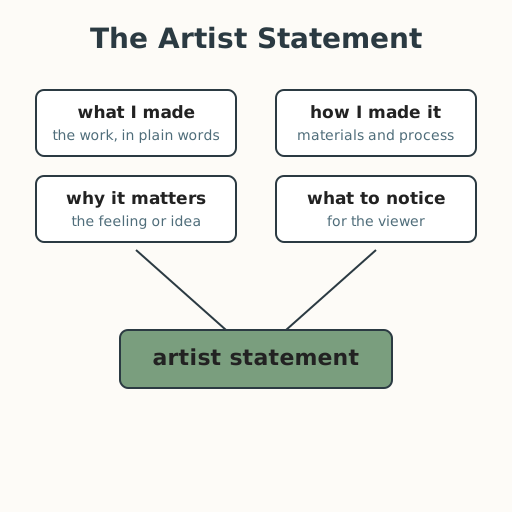
Learners turn the Lesson 1 body of work into words. They learn that an artist statement is not decoration but a short, honest account of *what* they made, *how*, *why it matters*, and *what a viewer should notice*. They draft one for their three studies using a four-prompt frame, then revise it with a partner so the words match the work.
Objectives
Objectives
- D07.S1.12.01 Produce a sustained body of artwork that demonstrates technical skill and a coherent personal vision, and present it with a written artist statement.
Essential question
How do I put my body of work into words, so a viewer meets both the work and the vision behind it?
Key vocabulary
Materials
Standard materials
- Capstone art journal · 1 per learner Contains the three sketch studies from Lesson 1, now to be written about
- Artist-statement frame sheet · 1 per learner Four labeled prompts — what I made, how I made it, why it matters to me, what I want a viewer to notice
Low-tech / no-cost
- The three studies and a scrap of paper The statement can be drafted on any surface with any writing tool
- A partner-listener or voice recorder To speak the statement first, then write down what was said
Enriched / lab & device
- A document app or digital portfolio · 1 per learner To type, lay out, and caption the statement beside images of the work
Works in different contexts
- large-group Model the frame whole-class, then learners draft individually and read statements to a small group for one revision
- multi-age Younger learners answer "what I made" and "why it matters" aloud; older learners write all four prompts
- self-directed A learner fills the four prompts alone, reads them back, and revises one sentence to be more specific
- level-grouped A ready group also revises for the difference between what a viewer can see and what only the artist knows
- outdoor-only Speak the statement about the three outdoor studies to a partner before writing it on any surface
Lesson 2 — The Artist Statement
Summary
Learners turn the Lesson 1 body of work into words. They learn that an artist statement is not decoration but a short, honest account of what they made, how, why it matters, and what a viewer should notice. They draft one for their three studies using a four-prompt frame, then revise it with a partner so the words match the work.
Objectives
- Produce a sustained body of artwork that demonstrates technical skill and a coherent personal vision, and present it with a written artist statement. (D07.S1.12.01)
Connection
When you show someone a thing you care about, you rarely hand it over in silence — you say “look at this, I made it because…” A potter at a market explains the clay; a child explains a drawing to a parent; a musician says what a song is about before playing it. The artist statement is that sentence, written down and made honest, so the work can be met by a stranger who was not there when you made it.
Materials
- Capstone art journal (with the Lesson 1 studies)
- Artist-statement frame sheet
- Low-tech: the studies and any writing surface; a partner-listener or voice recorder
- Enriched: a document app or digital portfolio
Preparation
- Copy or draw the artist-statement frame sheet (four labeled prompts).
- Retrieval: from Grade 11 (D07.S1.11.01), explaining an artwork’s intended effect on an audience; from Grade 10 (D07.S1.10.01), explaining how a body of work reflects ideas and influences. Today we write the statement that presents this unit’s body of work.
- Prepare a model statement (or draft one from your own example) to show first (S-011).
Facilitator note
This lesson is written to the learner (“you”). The idea to land: an artist statement is a short, specific, honest account of what was made, how, why it matters, and what to notice — written so a stranger can meet the work fairly. Teach the four-prompt frame explicitly, then let learners draft and revise (S-011). Guard against two traps: a statement that is all grand abstraction (“I express the human condition”) and one that is all technique with no why. The good statement names both.
The ethics lens: the statement is where the artist takes responsibility — the claim must match what the work actually shows, or the statement is dishonest. The egalitarianism lens: any maker can write a true statement; it needs no degree and no “art-world” vocabulary, only honesty about one’s own process. The global lens: artists worldwide accompany work with words — titles, labels, spoken introductions — and curators and weavers alike explain intention to an audience; the statement is one more living tradition of explaining your making. The technology lens: captions, alt text, and audio description are modern forms of the same move — putting the work into words so more people can meet it, including people who cannot see the image at all. The environment lens: a statement can name where materials came from and where they go — clay dug nearby, paper reused — making the work’s footprint visible. Preview: Lesson 3 turns from making to critique.
Procedure
- Recall (5 min). Look again at your three studies from Lesson 1. In one sentence, say — or write, sign, gesture, or use AAC to show — what they all share. That sentence is the seed of your statement.
- Meet the four prompts (8 min). Write them down: (1) What I made (the work, in plain words); (2) How I made it (materials and process); (3) Why it matters to me (the feeling or idea behind it); (4) What I want a viewer to notice. A statement answers these four, in about a paragraph.
- Worked example (10 min). Hear or read a model statement about a simple body of work — three studies of one place. Notice it names the work, the how, the why, and the notice — no vague claims, no jargon. Mark each prompt in the model as you find it.
- Draft your statement (12 min). Using the frame sheet, write your own statement for your three studies. Answer all four prompts in your own words. Keep it honest: if the work does not show something, do not claim it does.
- Revise with a partner (12 min). Read your draft to a partner (or they read it). Ask one question: does the statement say something the work itself would not tell me, and does it leave out something obvious? Revise one sentence to be more specific.
- Close (3 min). Say — or write, sign, gesture, or use AAC to express — the four questions your statement always answers.
Differentiation
- Support: Use the frame sheet with sentence starters (“I made… using… because… I want a viewer to notice…”); fill in the blanks rather than composing free.
- Extension: Revise for the line between what is visible and what is known only to the maker, and cut every word that claims more than the work shows.
- Number access (dyscalculia): No arithmetic is required; the four prompts are a list, not a computation. The frame sheet is pre-numbered so a learner can work one box at a time in any order without counting.
- Communication access: Every spoken step — reading, drafting aloud, discussing, or closing — can be done in writing, sign, gesture, or AAC instead. Learners who are non-speaking, d/Deaf, hard-of-hearing, or who use AAC complete every task in their preferred mode. A learner who is blind or has low vision can compose the statement as a spoken or recorded description and have it transcribed, or write it in braille.
Assessment
- Formative (peer + self): Does the draft answer all four prompts, and does the revised sentence make the words match the work more closely?
- Portfolio artifact (unit): The written artist statement, paired with the three studies in the capstone art journal.
Home connection
Write a one-sentence “statement” for something at home — a meal, a tool, a kept object — naming what it is, how it was made or kept, and why it matters. Read it to someone and ask whether the words match the thing.
Resources
- On worked examples and guided practice for a new skill: Kirschner, Sweller & Clark (2006) (S-011).
- On the shared vocabulary artists and museums use to describe work (context for “what a viewer notices”): The J. Paul Getty Museum, Understanding Formal Analysis (S-365).