Lesson 03 — Critiquing Artwork Across Cultures and Eras
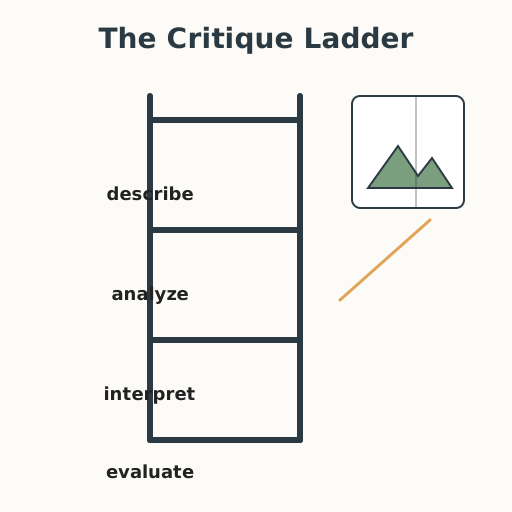
Learners meet critique as a respectful, evidence-based climb: describe what is there, analyze how the elements work, interpret what it might mean in its own context, and evaluate with a reason. They climb the ladder on two artworks from different cultures or eras, learning to honor each as a living tradition and to separate observation from judgment.
Objectives
Objectives
- D07.S1.12.02 Critique artwork across cultures and eras with insight, honoring diverse traditions while forming and defending an independent judgment.
Essential question
How do I look at an artwork from any culture or era and say something true, respectful, and well-evidenced about it?
Key vocabulary
Materials
Standard materials
- Critique-ladder sheet · 1 per learner Four rungs — describe, analyze, interpret, evaluate — each with a prompt and a space to write
- Capstone art journal · 1 per learner For recording the worked example and the learner's own critique
Low-tech / no-cost
- Any two printed or hand-copied artworks from different places or times From a textbook, calendar, family object, or found image; verbal description works if no image is available
- Scratch paper For jotting observations at each rung
Enriched / lab & device
- Museum database or digital image collection · 1 per pair To view high-resolution works from two cultures or eras side by side (e.g., the Met's Heilbrunn Timeline, S-114)
Works in different contexts
- large-group Climb the ladder on one work whole-class, then pairs take a second work from a different tradition
- multi-age Younger learners do "describe" and "interpret" (what do I see, what might it mean); older learners add "evaluate" with a reason
- self-directed A learner climbs all four rungs on a chosen work and writes the critique alone
- level-grouped A ready group also names which observations are facts and which are the viewer's judgments
- outdoor-only Critique a built or natural "artwork" in view — a painted wall, a carved doorway, a decorated cloth — using the same ladder
Lesson 3 — Critiquing Artwork Across Cultures and Eras
Summary
Learners meet critique as a respectful, evidence-based climb: describe what is there, analyze how the elements work, interpret what it might mean in its own context, and evaluate with a reason. They climb the ladder on two artworks from different cultures or eras, learning to honor each as a living tradition and to separate observation from judgment.
Objectives
- Critique artwork across cultures and eras with insight, honoring diverse traditions while forming and defending an independent judgment. (D07.S1.12.02)
Connection
You already read images every day — a painted sign, a screen, a cloth pattern, a family photograph. You notice something, you feel something, you decide whether it works. Critique makes that noticing fair: it slows the glance into four steps so you can say something true about work made by someone far away in place or time, without flattening it into “good” or “bad.”
Materials
- Critique-ladder sheet
- Capstone art journal
- Low-tech: any two artworks from different places or times; scratch paper
- Enriched: a museum database or digital image collection
Preparation
- Copy or draw the critique-ladder sheet (describe / analyze / interpret / evaluate).
- Retrieval: from Grade 8 (D07.S1.08.02), critiquing with evidence and separating observation from judgment; from Grade 10 (D07.S1.10.02), distinguishing appreciation from appropriation. Today we aim those habits at work from any culture or era.
- Choose two artworks from different traditions to model (e.g., Hokusai’s woodblock print and a Māori kōwhaiwhai pattern or an Akan adinkra cloth) (S-364, S-115, S-084).
Facilitator note
This lesson is written to the learner (“you”). The idea to land: critique is a four-step climb — describe, analyze, interpret, evaluate — each step grounded in what is actually in the work, and each tradition met as a living one to honor, not a specimen to grade. Teach the ladder explicitly with a worked example, then let learners climb it on a second work (S-011). Name the danger plainly: a critique that ranks another culture’s art by one’s own standards is not critique, it is flattening.
The ethics lens: to critique fairly is to describe before judging and to ask respectful questions rather than pronounce. The egalitarianism lens: the ladder needs no special training — only careful looking and honest wording, open to anyone. The global lens: the same four moves work on a Japanese woodblock print (S-364), a Māori painted rafter pattern (S-115), and an Akan adinkra cloth stamped with proverbs (S-084) — each met as a living tradition carried by real people now. The technology lens: digital collections and image search put works from many cultures on one screen, but the screen is not the work — name that you are seeing a reproduction, and that the living context (place, people, occasion) matters. The environment lens: many traditions make art from local materials and respond to a local landscape, so “what is it made of and where is it from” is part of faithful description. Preview: Lesson 4 sharpens the final rung into a defended judgment.
Procedure
- Recall (5 min). From Grade 8: what is the difference between an observation (“the figure is in the center”) and a judgment (“the composition is strong”)? Today we put that difference to work across cultures and eras.
- Meet the ladder (8 min). Write the four rungs: describe (what is literally there — subject, materials, colors, shapes); analyze (how the elements work together); interpret (what it may mean in its own context — and what I do not know); evaluate (a judgment with a reason). Climb in order; do not skip from “look” to “verdict.”
- Worked example — climb on one work (15 min). Take Hokusai’s South Wind, Clear Sky (Red Fuji), a woodblock print from the series Thirty-six Views of Mount Fuji (S-364). Describe: a red mountain, a blue sky with cloud streaks, trees below. Analyze: the strong diagonal of the slope, the repetition of the mountain’s triangle. Interpret: a single sacred mountain seen in a particular weather — and I do not know the artist’s full meaning without asking. Evaluate: the repetition of the mountain’s shape across the series gives it force — a reason, not just “I like it.” Write each rung on your sheet.
- Name the move (5 min). You did not rank; you read. Critique honors the work by paying it careful attention and by knowing the limits of what you can claim about a tradition that is not your own.
- Climb on a second work (15 min). With a partner, choose a work from a different place or era — a Māori kōwhaiwhai rafter pattern (S-115) or an Akan adinkra cloth (S-084) or one from your own home. Climb all four rungs in writing. At “interpret,” write at least one respectful question you would ask a living keeper of that tradition.
- Close (2 min). Say — or write, sign, gesture, or use AAC to express — the four rungs and why you must not skip from describe to evaluate.
Differentiation
- Support: Use the ladder pre-filled for one work; the learner adds one observation to each rung rather than building the critique from scratch.
- Extension: For each rung, separate what is factual observation from what is the viewer’s inference, and mark the claim you would need to verify by asking a living keeper.
- Number access (dyscalculia): No arithmetic is required; the four rungs are a sequence, not a computation. The ladder sheet is pre-numbered so a learner can work top-down or bottom-up in any order without counting.
- Communication access: Every spoken step — reading, discussing, sharing, or closing — can be done in writing, sign, gesture, or AAC instead. Learners who are non-speaking, d/Deaf, hard-of-hearing, or who use AAC complete every task in their preferred mode. For a learner who is blind or has low vision, provide a verbal or tactile description of the work (or a raised-line or textured reproduction) so “describe” and “analyze” are possible through touch and description rather than sight alone.
Assessment
- Formative (peer + self): Can the learner climb all four rungs in order, grounding each in the work, and write one respectful question at the “interpret” rung?
- Portfolio artifact (unit): One completed critique-ladder sheet on a work from a culture or era different from the learner’s own, opened in the capstone art journal.
Home connection
Choose an object or image at home that came from somewhere else — a cloth, a cup, a picture. Write the four rungs for it in one sentence each, and one respectful question you would ask the person who knows it best.
Resources
- On the shared vocabulary of the elements of art and principles of design: The J. Paul Getty Museum, Understanding Formal Analysis (S-365).
- On Hokusai’s Thirty-six Views of Mount Fuji: The Metropolitan Museum of Art (S-364).
- On Māori arts as living heritage: Te Papa Tongarewa (S-115).
- On Akan adinkra cloth as a living tradition: Smithsonian National Museum of African Art (S-084); general art-history frame: The Met Heilbrunn Timeline of Art History (S-114).