Lesson 07 — Critiquing Music Across Cultures and Eras
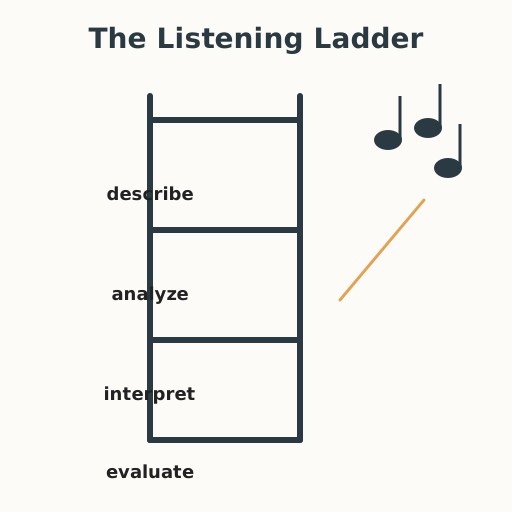
Learners meet musical critique as a respectful, evidence-based climb: describe what is heard, analyze how the elements of music work, interpret what it may mean in its own context, and evaluate with a reason. They climb the ladder on two pieces from different cultures or eras, honoring each as a living tradition and separating observation from judgment.
Objectives
Objectives
- D07.S2.12.02 Critique music across cultures and eras with insight, honoring diverse traditions while forming and defending an independent judgment.
Essential question
How do I listen to music from any culture or era and say something true, respectful, and well-evidenced about it?
Key vocabulary
Materials
Standard materials
- Listening-ladder sheet · 1 per learner Four rungs — describe, analyze, interpret, evaluate — each with a prompt for music
- Music-capstone journal · 1 per learner For recording the worked example and the learner's own listening critique
Low-tech / no-cost
- Any two pieces of music from different places or times, sung or played live A family song, a recorded or remembered tune, a work-song, or a chant — described aloud if no audio is available
- Scratch paper For jotting what is heard at each rung
Enriched / lab & device
- A curated audio playlist spanning two traditions · 1 per class To listen side by side (e.g., a raga and a maqam, a spiritual and reggae) with descriptive notes
Works in different contexts
- large-group Climb the ladder on one piece whole-class, then pairs take a second piece from a different tradition
- multi-age Younger learners do "describe" (what sounds do I hear) and "interpret" (what mood); older learners add "evaluate" with a reason
- self-directed A learner climbs all four rungs on a chosen piece and writes the critique alone
- level-grouped A ready group also names which observations are facts and which are the listener's judgments
- outdoor-only Critique two live or remembered songs — a work-song, a call, a chant — using the same ladder
Lesson 7 — Critiquing Music Across Cultures and Eras
Summary
Learners meet musical critique as a respectful, evidence-based climb: describe what is heard, analyze how the elements of music work, interpret what it may mean in its own context, and evaluate with a reason. They climb the ladder on two pieces from different cultures or eras, honoring each as a living tradition and separating observation from judgment.
Objectives
- Critique music across cultures and eras with insight, honoring diverse traditions while forming and defending an independent judgment. (D07.S2.12.02)
Connection
You already listen with judgment — a song makes you move or cry or remember; a voice is “rough” or “sweet”; a beat is “right.” Musical critique makes that hearing fair: it slows the ear into steps so you can say something true about music from a place or time far from your own, without flattening it into “good” or “bad” by your own habits.
Materials
- Listening-ladder sheet
- Music-capstone journal
- Low-tech: two pieces from different places or times; scratch paper
- Enriched: a curated audio playlist spanning two traditions
Preparation
- Copy or draw the listening-ladder sheet (describe / analyze / interpret / evaluate).
- Retrieval: from Grade 8 (D07.S2.08.02), critiquing music with evidence and separating observation from judgment; from Grade 10 (D07.S2.10.02), distinguishing respectful engagement from appropriation. Today we aim those habits at music from any culture or era.
- Choose two contrasting pieces to model (e.g., a raga and a maqam, or a spiritual and reggae) (S-366, S-367, S-385, S-450).
Facilitator note
This lesson is written to the learner (“you”). The idea to land: musical critique is a four-step climb — describe, analyze, interpret, evaluate — each step grounded in what is actually heard, and each tradition met as a living one to honor, not a specimen to grade. Teach the ladder explicitly with a worked example, then let learners climb it on a second piece (S-011). Name the danger plainly: ranking another culture’s music by one’s own scale or tuning is not critique, it is flattening.
The ethics lens: to critique fairly is to describe before judging and to ask respectful questions rather than pronounce. The egalitarianism lens: the ladder needs no training — only careful listening and honest wording, open to anyone, instrument or none. The global lens: the same four moves work on an Indian raga (S-366), a Middle Eastern maqam (S-367), an African American spiritual (S-385), and Jamaican reggae (S-450) — each met as a living tradition carried by real musicians now. The technology lens: recordings and streaming put many traditions on one device, but a recording is not the occasion — name that you are hearing a reproduction, and that the living context (place, people, event) matters. The environment lens: much music is made from and about a place — work-songs of a harvest, a song of the sea — so “where and when is this sung, and with what” is part of faithful description. Preview: Lesson 8 sharpens the final rung into a defended judgment.
Procedure
- Recall (5 min). From Grade 8: what is the difference between an observation (“the pulse is steady”) and a judgment (“the piece is moving”)? Today we put that difference to work across cultures and eras.
- Meet the ladder (8 min). Write the four rungs, this time for the ear: describe (what is literally heard — instruments, voices, tempo, loudness); analyze (how the elements of music — melody, rhythm, harmony, timbre, texture, form — work together, S-368); interpret (what it may mean in its own context — and what I do not know); evaluate (a judgment with a reason). Climb in order.
- Worked example — climb on one piece (15 min). Take a raga performance: a singer or instrumentalist unfolds a particular scale and its characteristic phrases, building a mood (S-366). Describe: a drone, a voice or instrument, a scale, a slow build. Analyze: the melody stays within one scale and returns to its phrases; the rhythm marks the piece’s structure. Interpret: each raga carries its own mood and even time of day — and I do not know the full meaning without asking a living musician. Evaluate: the return to the characteristic phrases gives the piece unity — a reason, not just “I liked it.” Write each rung on your sheet.
- Name the move (5 min). You did not rank; you listened. Critique honors the music by paying it careful attention and by knowing the limits of what you can claim about a tradition that is not your own.
- Climb on a second piece (15 min). With a partner, choose a piece from a different place or era — a maqam (S-367), a spiritual (S-385), reggae (S-450), or one from your own home. Climb all four rungs in writing. At “interpret,” write at least one respectful question you would ask a living keeper of that tradition.
- Close (2 min). Say — or write, sign, gesture, or use AAC to express — the four rungs and why you must not skip from describe to evaluate.
Differentiation
- Support: Use the ladder pre-filled for one piece; the learner adds one observation to each rung rather than building the critique from scratch.
- Extension: For each rung, separate what is a factual property of the sound from what is the listener’s inference, and mark the claim you would need to verify by asking a living musician.
- Number access (dyscalculia): No arithmetic is required; the four rungs are a sequence, not a computation. The ladder sheet is pre-numbered so a learner can work in any order without counting.
- Communication access: Every spoken step — listening discussion, reading, sharing, or closing — can be done in writing, sign, gesture, or AAC instead. Learners who are d/Deaf, hard-of-hearing, non-speaking, or who use AAC complete every task in their preferred mode; a d/Deaf learner critiques through felt vibration, visual notation, or a written description of the sound, and no step requires hearing. A learner who is blind or has low vision critiques entirely by ear and verbal description.
Assessment
- Formative (peer + self): Can the learner climb all four rungs in order, grounding each in what is heard, and write one respectful question at the “interpret” rung?
- Portfolio artifact (unit): One completed listening-ladder sheet on a piece from a culture or era different from the learner’s own, opened in the music-capstone journal.
Home connection
Choose a song or tune at home that comes from somewhere else. Write the four rungs in one sentence each, and one respectful question you would ask the person who knows it best.
Resources
- On the shared vocabulary of the elements of music: Wikipedia — Elements of music (S-368).
- On the raga: Encyclopaedia Britannica — Raga (S-366); on the maqam: Encyclopaedia Britannica — Maqam (S-367).
- On the spiritual: Encyclopaedia Britannica — Spiritual (S-385); on reggae: UNESCO — Reggae Music of Jamaica (S-450).