Lesson 08 — Independent Judgment in Music
Learners turn musical critique into conviction: a judgment that is their own, supported by evidence in the sound, and defended with a warrant ("because") — while still honoring the musicians and community the music comes from and distinguishing appreciation from appropriation. They write one full claim-evidence-warrant chain and test it against a counter-judgment.
Objectives
Objectives
- D07.S2.12.02 Critique music across cultures and eras with insight, honoring diverse traditions while forming and defending an independent judgment.
Essential question
How do I form a judgment of a piece of music that is truly my own — and defend it with evidence while still honoring the musicians and community it comes from?
Key vocabulary
Materials
Standard materials
- Judgment-with-evidence sheet (music) · 1 per learner A claim line, two evidence lines, and a "because" line, for one defended musical judgment
- Music-capstone journal · 1 per learner For drafting and recording the defended judgment
Low-tech / no-cost
- The Lesson 7 listening-ladder sheet The learner's own rungs become the evidence for the judgment
- Scratch paper For testing a claim against evidence before committing
Enriched / lab & device
- A shared document or discussion board · 1 per class To post judgments and respond to peers' defenses with counter-evidence
Works in different contexts
- large-group Model one defended judgment whole-class, then learners write their own and exchange with two peers for counter-questions
- multi-age Younger learners state "I think… because I hear…"; older learners write the full claim-evidence-warrant chain
- self-directed A learner writes the claim, two pieces of evidence, and the warrant, then tests it against a counter-claim
- level-grouped A ready group also answers the strongest counter-judgment against their own and revises the warrant
- outdoor-only Defend a judgment about a live or remembered piece — a work-song, a chant, a call
Lesson 8 — Independent Judgment in Music
Summary
Learners turn musical critique into conviction: a judgment that is their own, supported by evidence in the sound, and defended with a warrant (“because”) — while still honoring the musicians and community the music comes from and distinguishing appreciation from appropriation. They write one full claim-evidence-warrant chain and test it against a counter-judgment.
Objectives
- Critique music across cultures and eras with insight, honoring diverse traditions while forming and defending an independent judgment. (D07.S2.12.02)
Connection
You already defend musical judgments — you say a song is powerful because of the bass line and the way the voice breaks, a rhythm works because it leaves space, a piece feels old because of the scale it uses. “I like it” is where judging starts; “I think because I hear…” is where it becomes something you can stand behind and someone else can honestly agree or disagree with.
Materials
- Judgment-with-evidence sheet (music)
- Music-capstone journal
- Low-tech: the Lesson 7 listening-ladder sheet; scratch paper
- Enriched: a shared document or discussion board
Preparation
- Copy or draw the judgment-with-evidence sheet (claim + evidence + warrant).
- Retrieval: from Grade 10 (D07.S2.10.02), distinguishing respectful engagement with a tradition from appropriation; from Lesson 7, the four-rung listening ladder. Today we build the final rung into a defended judgment.
- Prepare a model claim-evidence-warrant chain about the Lesson 7 piece to show first (S-011).
Facilitator note
This lesson is written to the learner (“you”). The idea to land: an independent musical judgment is a claim about a piece, backed by evidence in the sound, connected by a warrant — and it is “independent” because the learner formed it, not because it ignores the tradition. Teach the claim-evidence-warrant chain explicitly, then let learners write and test their own (S-011). Keep “independent” from sliding into “isolated”: a defended judgment is more respectful of living musicians, because it rests on careful listening rather than borrowed opinion.
The ethics lens: a judgment I cannot defend with evidence is only a preference wearing a judge’s robe; defending it honestly means naming what the sound does and does not show. The egalitarianism lens: anyone can be a music critic, because the warrant is public — it invites another person to check the evidence and disagree with reasons, not with status. The global lens: judgment across cultures is only fair when it starts from the music’s own context (Lesson 7) and when appreciation — credit, permission, respect for living musicians — replaces appropriation (S-056, S-450). The technology lens: a recorded or streamed piece can be judged without the musician’s context or consent; a defended judgment should say when it is judging a recording, not the lived performance. The environment lens: a judgment can weigh where the sound and its instruments come from — the wood, the hide, the metal, the field — as part of its evidence. Preview: Lesson 9 carries the “body of work” idea into performance.
Procedure
- Recall (5 min). From Lesson 7: what were the four rungs, and why must describe come before evaluate? Today we make the top rung — the judgment — one we can defend.
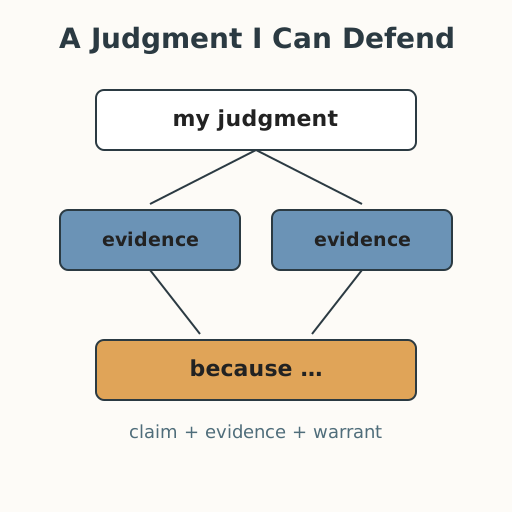
- Meet the chain (8 min). Write it: claim (my judgment), evidence (what I hear in the piece), warrant (the “because” that connects them). A claim without evidence is a preference; evidence without a claim is a list. The three together are a judgment you can stand behind.
- Worked example (12 min). Build a chain about a spiritual — an African American religious song born of the enslaved experience, carrying sorrow, faith, and hope (S-385). Claim: the song sounds sorrowful and hopeful at once. Evidence: the melody is slow and low; the words speak of trouble and of deliverance; the voice carries both. Warrant: because the melody’s weight and the words’ turn toward deliverance sit side by side, the music holds two feelings at once — so the sound, not my mood, creates the effect. The warrant points to the sound, not “I just feel it.”
- Name the distinction (6 min). A defended judgment is independent — it is yours — and accountable — it can be checked. And when the music is from another culture or community, independence means you judged it on its own terms, with appreciation, not appropriation (S-056, S-450): credit the musicians, do not take from them.
- Write your own chain (15 min). Return to the second piece you critiqued in Lesson 7. Write one claim, two pieces of evidence from the sound, and a warrant. Then write the strongest counter-judgment a fair listener might make, and answer it in one sentence.
- Share and check (7 min). Exchange chains with a partner. Check: does the evidence point to the sound (not the musician’s biography or your mood), and does the warrant connect claim to evidence? Give one specific improvement.
- Close (2 min). Say — or write, sign, gesture, or use AAC to express — the three parts of a judgment you can defend.
Differentiation
- Support: Use a pre-written claim and evidence; the learner writes only the warrant (“because…”) to connect them.
- Extension: Write the warrant as a testable statement — “if a listener removed the drone, the mood should shift” — and explain how the evidence could be checked.
- Number access (dyscalculia): No arithmetic is required; “two pieces of evidence” is a simple count the sheet already structures with two labeled boxes. A learner may offer one strong piece of evidence and still meet the goal of a defended judgment.
- Communication access: Every spoken step — reading, discussing, sharing, or closing — can be done in writing, sign, gesture, or AAC instead. Learners who are non-speaking, d/Deaf, hard-of-hearing, or who use AAC complete every task in their preferred mode. A d/Deaf learner defends the judgment from felt vibration, visual notation, or a written description of the sound; a learner who is blind or has low vision defends it by ear.
Assessment
- Formative (peer + self): Does the chain contain a claim, evidence from the sound, and a warrant, and does the learner answer one counter-judgment in their own words?
- Portfolio artifact (unit): One complete judgment-with-evidence sheet (claim, evidence, warrant, counter-answer), opened in the music-capstone journal.
Home connection
Form and defend one judgment about a piece of music you know — why one version or performance works better than another — in a claim, one piece of evidence, and a “because.” Read it to someone and invite them to disagree with a reason.
Resources
- On worked examples and guided practice for a new skill: Kirschner, Sweller & Clark (2006) (S-011).
- On the spiritual: Encyclopaedia Britannica — Spiritual (S-385).
- On honoring living traditions (appreciation vs. appropriation): UNESCO Intangible Cultural Heritage (S-056); UNESCO — Reggae Music of Jamaica (S-450).