Lesson 11 — Critiquing Performance Across Cultures and Eras
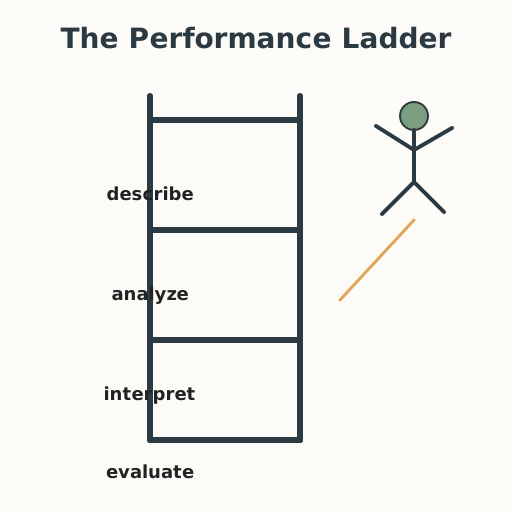
Learners meet performance critique as a respectful, evidence-based climb: describe what is seen or described, analyze how movement and expression work, interpret what it may mean in its own context, and evaluate with a reason. They climb the ladder on two performances from different cultures or eras, honoring each as a living tradition and separating observation from judgment.
Objectives
Objectives
- D07.S3.12.02 Critique performance across cultures and eras with insight, honoring diverse traditions while forming and defending an independent judgment.
Essential question
How do I watch a performance from any culture or era and say something true, respectful, and well-evidenced about it?
Key vocabulary
Materials
Standard materials
- Performance-ladder sheet · 1 per learner Four rungs — describe, analyze, interpret, evaluate — each with a prompt for performance
- Performance-capstone journal · 1 per learner For recording the worked example and the learner's own critique
Low-tech / no-cost
- Any two live, remembered, or described performances from different places or times A family dance, a ritual, a greeting, a work-movement — described aloud if no performance is available
- Scratch paper For jotting what is seen or described at each rung
Enriched / lab & device
- A curated set of performance recordings spanning two traditions · 1 per class To watch or hear described side by side (e.g., capoeira and a ritual dance) with descriptive notes
Works in different contexts
- large-group Climb the ladder on one performance whole-class, then pairs take a second from a different tradition
- multi-age Younger learners do "describe" (what movements do I see) and "interpret" (what might it mean); older learners add "evaluate" with a reason
- self-directed A learner climbs all four rungs on a chosen performance and writes the critique alone
- level-grouped A ready group also names which observations are facts and which are the viewer's judgments
- outdoor-only Critique a live or remembered movement — a work-motion, a game, a greeting — using the same ladder
Lesson 11 — Critiquing Performance Across Cultures and Eras
Summary
Learners meet performance critique as a respectful, evidence-based climb: describe what is seen or described, analyze how movement and expression work, interpret what it may mean in its own context, and evaluate with a reason. They climb the ladder on two performances from different cultures or eras, honoring each as a living tradition and separating observation from judgment.
Objectives
- Critique performance across cultures and eras with insight, honoring diverse traditions while forming and defending an independent judgment. (D07.S3.12.02)
Connection
You already read movement every day — the way someone greets you, the way a crowd moves at a game, a dance at a celebration, the rhythm of a work crew. You notice, you feel, you decide whether it “worked.” Performance critique makes that noticing fair: it slows the glance into steps so you can say something true about a dance or ritual from a place or time far from your own, without flattening it into “good” or “bad” by your own habits.
Materials
- Performance-ladder sheet
- Performance-capstone journal
- Low-tech: two performances from different places or times; scratch paper
- Enriched: a curated set of performance recordings spanning two traditions
Preparation
- Copy or draw the performance-ladder sheet (describe / analyze / interpret / evaluate).
- Retrieval: from Grade 8 (D07.S3.08.02), critiquing performance with evidence and separating observation from judgment; from Grade 10 (D07.S3.10.02), distinguishing respectful engagement from appropriation. Today we aim those habits at performance from any culture or era.
- Choose two contrasting performances to model (e.g., capoeira and a ritual dance such as Mexico’s Day of the Dead festivity) (S-325, S-448).
Facilitator note
This lesson is written to the learner (“you”). The idea to land: performance critique is a four-step climb — describe, analyze, interpret, evaluate — each step grounded in what is actually seen (or faithfully described), and each tradition met as a living one to honor, not a specimen to grade. Teach the ladder explicitly with a worked example, then let learners climb it on a second performance (S-011). Name the danger plainly: ranking another culture’s dance by one’s own standards is not critique, it is flattening.
The ethics lens: to critique fairly is to describe before judging and to ask respectful questions rather than pronounce. The egalitarianism lens: the ladder needs no training — only careful watching and honest wording, open to anyone. The global lens: the same four moves work on capoeira, an Afro-Brazilian art of movement and music (S-325), and on Mexico’s Day of the Dead festivity, a living ritual that links the living to deceased loved ones and the maize harvest (S-448) — each met as a living tradition carried by real people now. The technology lens: recordings let us watch performances from anywhere, but a recording is not the occasion — name that you are seeing a reproduction, and that the living context (place, people, event) matters. The environment lens: performance answers its space and season — a harvest dance, a sea ritual — so “where, when, and for what occasion” is part of faithful description. Preview: Lesson 12 sharpens the final rung into a defended judgment.
Procedure
- Recall (5 min). From Grade 8: what is the difference between an observation (“the dancers move in a circle”) and a judgment (“the dance is joyful”)? Today we put that difference to work across cultures and eras.
- Meet the ladder (8 min). Write the four rungs, this time for the moving body: describe (what is literally seen — movement, gesture, spacing, stillness, posture); analyze (how movement and expression work together — speed, level, direction, repetition); interpret (what it may mean in its own context — and what I do not know); evaluate (a judgment with a reason). Climb in order.
- Worked example — climb on one performance (15 min). Take capoeira: two people move in a circle (roda) around song and instruments, a game of attack and escape that is also dance (S-325). Describe: two bodies facing, low to the ground, stepping and turning; others sing and clap in a ring. Analyze: the movement swings between evasion and attack; the music sets the pace; the circle holds the space. Interpret: a game of bodies in dialogue, born among enslaved Africans and carrying strength and identity — and I do not know its full meaning without asking a living practitioner. Evaluate: the constant give-and-take between the two bodies gives the form its tension — a reason, not just “it is impressive.” Write each rung on your sheet.
- Name the move (5 min). You did not rank; you watched. Critique honors the performance by paying it careful attention and by knowing the limits of what you can claim about a tradition that is not your own.
- Climb on a second performance (15 min). With a partner, choose a performance from a different place or era — the Day of the Dead festivity (S-448), a family dance, or a work-movement from your own home. Climb all four rungs in writing. At “interpret,” write at least one respectful question you would ask a living keeper of that tradition.
- Close (2 min). Say — or write, sign, gesture, or use AAC to express — the four rungs and why you must not skip from describe to evaluate.
Differentiation
- Support: Use the ladder pre-filled for one performance; the learner adds one observation to each rung rather than building the critique from scratch.
- Extension: For each rung, separate what is a factual property of the movement from what is the viewer’s inference, and mark the claim you would need to verify by asking a living practitioner.
- Number access (dyscalculia): No arithmetic is required; the four rungs are a sequence, not a computation. The ladder sheet is pre-numbered so a learner can work in any order without counting.
- Communication access: Every spoken step — discussing, reading, sharing, or closing — can be done in writing, sign, gesture, or AAC instead. Learners who are non-speaking, d/Deaf, hard-of-hearing, or who use AAC complete every task in their preferred mode. A learner who is blind or has low vision critiques through a verbal or tactile description of the movement (or a raised-line diagram of the spacing); no step requires sight.
Assessment
- Formative (peer + self): Can the learner climb all four rungs in order, grounding each in what is seen or described, and write one respectful question at the “interpret” rung?
- Portfolio artifact (unit): One completed performance-ladder sheet on a performance from a culture or era different from the learner’s own, opened in the performance-capstone journal.
Home connection
Watch a movement at home — a dance, a greeting, a way of working — and write the four rungs in one sentence each, plus one respectful question you would ask the person who knows it best.
Resources
- On capoeira as a living art of movement and music: Encyclopaedia Britannica — Capoeira (S-325).
- On the Day of the Dead festivity as a living ritual: UNESCO — Indigenous Festivity Dedicated to the Dead (S-448).
- On performance and ritual as living heritage: UNESCO Intangible Cultural Heritage (S-056).