Lesson 10 — The Performance Artist Statement
Learners turn the Lesson 9 performance into words — a short, honest written statement naming *what* they made, *how*, *why it matters*, and *what an audience should notice*. They draft one for their devised piece using a four-prompt frame and revise it so the words match the movement.
Objectives
Objectives
- D07.S3.12.01 Produce and perform a sustained piece that shows technical skill and a coherent creative vision, with a written artist statement.
Essential question
How do I put my performance into words, so an audience meets both the movement and the vision behind it?
Key vocabulary
Materials
Standard materials
- Performance-capstone journal · 1 per learner Contains the devised piece from Lesson 9, now to be written about
- Performance-statement frame sheet · 1 per learner Four prompts — what I made, how I made it, why it matters, what an audience should notice
Low-tech / no-cost
- The devised piece and a scrap of paper The statement can be drafted on any surface with any writing tool
- A partner-listener or voice recorder To speak the statement first, then write down what was said
Enriched / lab & device
- A document app or digital portfolio with a video or photo embed · 1 per learner To pair the written statement with a recording of the piece
Works in different contexts
- large-group Model the frame whole-class, then learners draft individually and read statements to a small group for one revision
- multi-age Younger learners answer "what I made" and "why it matters" aloud; older learners write all four prompts
- self-directed A learner fills the four prompts alone, reads them back, and revises one sentence to be more specific
- level-grouped A ready group also revises for the line between what an audience can see and what only the performer knows
- outdoor-only Speak the statement about the outdoor piece to a partner before writing it on any surface
Lesson 10 — The Performance Artist Statement
Summary
Learners turn the Lesson 9 performance into words — a short, honest written statement naming what they made, how, why it matters, and what an audience should notice. They draft one for their devised piece using a four-prompt frame and revise it so the words match the movement.
Objectives
- Produce and perform a sustained piece that shows technical skill and a coherent creative vision, with a written artist statement. (D07.S3.12.01)
Connection
Before a dance or a play begins, something tells you what you are about to see — a program note, a spoken introduction, a title. That is the performance statement: the words that let an audience meet the moving body fairly, especially when the performer cannot stand beside them and explain.
Materials
- Performance-capstone journal (with the Lesson 9 piece)
- Performance-statement frame sheet
- Low-tech: the devised piece and any writing surface; a partner-listener or voice recorder
- Enriched: a document app or digital portfolio with a video or photo embed
Preparation
- Copy or draw the performance-statement frame sheet (four prompts).
- Retrieval: from Grade 11 (D07.S3.11.01), explaining a performance’s intended effect; from Grade 10 (D07.S3.10.01), explaining the choices in an original piece. Today we write the statement that presents this unit’s performance.
- Prepare a model statement to show first (S-011).
Facilitator note
This lesson is written to the learner (“you”). The idea to land: a performance statement is a short, specific, honest account of what was made, how, why it matters, and what to watch for — written so a stranger can meet the moving body fairly. Teach the four-prompt frame, then let learners draft and revise (S-011). Guard against two traps: all mood and no craft (“it is about joy”), and all craft and no why (“it uses three levels”). The good statement names both.
The ethics lens: the statement is where the performer takes responsibility — the claim must match what the body actually does, or the statement is dishonest. The egalitarianism lens: any performer can write a true statement; it needs no degree or dance-theory vocabulary, only honesty about one’s own choices. The global lens: spoken introductions, program notes, and titles accompany performance worldwide — from a dancer naming the tradition a step belongs to, to a ritual’s own occasion (S-056) — all living traditions of explaining your movement. The technology lens: statements now travel with recordings as captions and text descriptions, so an audience that cannot see the performance can meet it through words, and one that cannot hear can meet the text through a screen reader. The environment lens: a statement can name where the piece lives — the space, the floor, the weather, the place it answers — making the body’s relationship to its environment visible. Preview: Lesson 11 turns from performing to critiquing performance.
Procedure
- Recall (5 min). Run or recall your Lesson 9 piece. In one sentence, say — or write, sign, gesture, or use AAC to show — the one idea it expresses. That is the seed of your statement.
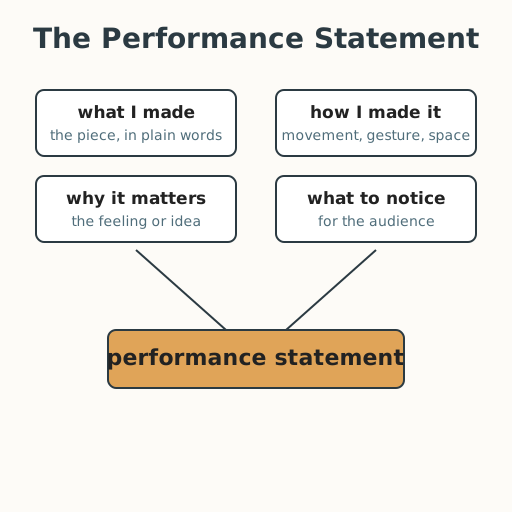
- Meet the four prompts (8 min). Write them down: (1) What I made (the piece, in plain words); (2) How I made it (movement, gesture, space, stillness; the beginning-middle-end); (3) Why it matters to me (the feeling or idea); (4) What I want an audience to notice. A statement answers these four in about a paragraph.
- Worked example (10 min). Hear or read a model statement about a short devised piece. Notice it names the work, the how, the why, and the watch-for — no vague claims, no jargon. Mark each prompt as you find it.
- Draft your statement (12 min). Using the frame sheet, write your own statement for your piece. Answer all four prompts in your own words. Keep it honest: if the body does not do something, do not claim it does.
- Revise with a partner (12 min). Read your draft to a partner (or they read it). Ask: does the statement say something the movement itself would not tell an audience, and does it leave out something obvious? Revise one sentence to be more specific.
- Close (3 min). Say — or write, sign, gesture, or use AAC to express — the four questions your statement always answers.
Differentiation
- Support: Use the frame sheet with sentence starters (“I made… using… because… I want an audience to notice…”); fill in the blanks rather than composing free.
- Extension: Revise for the line between what an audience can see and what only the performer knows, and cut every word that claims more than the body shows.
- Number access (dyscalculia): No arithmetic is required; the four prompts are a list, not a computation. The frame sheet is pre-numbered so a learner can work one box at a time in any order without counting.
- Communication access: Every spoken step — reading, drafting aloud, discussing, or closing — can be done in writing, sign, gesture, or AAC instead. Learners who are non-speaking, d/Deaf, hard-of-hearing, or who use AAC complete every task in their preferred mode. A learner who is blind or has low vision composes the statement as a spoken or recorded description (or in braille); a learner with limited mobility describes the choices their body makes, which are performance.
Assessment
- Formative (peer + self): Does the draft answer all four prompts, and does the revised sentence make the words match the movement more closely?
- Portfolio artifact (unit): The written performance statement, paired with the piece in the performance-capstone journal.
Home connection
Write a one-sentence “statement” for a movement or ritual you know from home — a greeting, a dance, a way of working — naming what it is, how it is done, and why it matters. Read it to someone and ask whether the words match the movement.
Resources
- On worked examples and guided practice for a new skill: Kirschner, Sweller & Clark (2006) (S-011).
- On performance and ritual as living heritage: UNESCO Intangible Cultural Heritage (S-056).