Lesson 13 — Designing and Realizing a Substantial Project
Learners meet the unit's making-and-design strand: a substantial project is one that serves a real need, is shaped by a repeated design cycle, and can be presented with a written rationale naming its purpose and craft. They run one full cycle, build and test a prototype, and write the rationale — designing with access and fairness in mind from the start.
Objectives
Objectives
- D07.S4.12.01 Design and realize a substantial project that demonstrates craft and a coherent purpose, presenting it with a written rationale.
Essential question
How do I take a real need, design for it with craft and a coherent purpose, and realize it as a substantial project I can present with a written rationale?
Key vocabulary
Materials
Standard materials
- Design-capstone journal · 1 per learner For the brief, sketches, iteration notes, rationale, and evaluation — the unit-long record
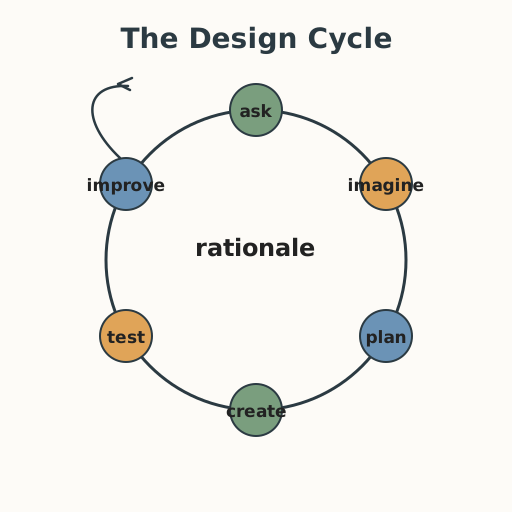
- Design-process sheet · 1 per learner A cycle — ask, imagine, plan, create, test, improve — plus a line for the written rationale
Low-tech / no-cost
- Found or scrap materials Cardboard, cloth, string, wood offcuts, clay, or anything repurposed — to build a working prototype
- A user or partner to test with To try the prototype and give one specific improvement
Enriched / lab & device
- Fabrication or digital-design tools (a Fab Lab, or any CAD tool) · 1 per class or pair Where available, to prototype with digital fabrication; community fab labs make these tools broadly accessible (S-451)
Works in different contexts
- large-group Model the design cycle whole-class, then learners design and prototype individually or in pairs, testing with a partner
- multi-age Younger learners build a simple prototype for a felt need; older learners document the full cycle and write the rationale
- self-directed A learner runs the cycle alone, builds a prototype, tests it, and writes the rationale
- level-grouped A ready group also runs the universal-design checks and names who the design leaves out
- outdoor-only Design for an outdoor need — shade, carrying, storing, seating — with materials found on site
Lesson 13 — Designing and Realizing a Substantial Project
Summary
Learners meet the unit’s making-and-design strand: a substantial project is one that serves a real need, is shaped by a repeated design cycle, and can be presented with a written rationale naming its purpose and craft. They run one full cycle, build and test a prototype, and write the rationale — designing with access and fairness in mind from the start.
Objectives
- Design and realize a substantial project that demonstrates craft and a coherent purpose, presenting it with a written rationale. (D07.S4.12.01)
Connection
Everything you use was designed by someone for a purpose — a cup that fits a hand, a stool that holds a body, a bag that carries a load, a path that leads somewhere. A substantial design is one that answers a real need well and can say why it is the way it is. Design is not decoration; it is care made into an object or a place.
Materials
- Design-capstone journal
- Design-process sheet
- Low-tech: found or scrap materials; a user or partner to test with
- Enriched: fabrication or digital-design tools (a Fab Lab or CAD tool)
Preparation
- Copy or draw the design-process sheet (ask / imagine / plan / create / test / improve + rationale line).
- Retrieval: from Grade 11 (D07.S4.11.01), designing a solution to a social or environmental problem and building a prototype; from Grade 8 (D07.S4.08.01), making a working prototype and revising it. Today we realize this unit’s substantial design project.
- Prepare a simple worked example of the cycle (S-011) and the universal-design questions (S-369).
Facilitator note
This lesson is written to the learner (“you”). The idea to land: a substantial design serves a real need, is shaped by a repeated cycle — ask, imagine, plan, create, test, improve — and is presented with a written rationale that names its purpose and craft. Teach the cycle explicitly, then let learners run it and build a prototype (S-011). Design is iterative: the cycle loops, and “improve” is the heart of it, not an afterthought.
The ethics lens: a designer is accountable for who is served and who is left out — the universal-design questions (“who can use this, and who cannot?”) turn that care into a check, not a wish (S-369). The egalitarianism lens: substantial design needs no factory — a working prototype can be made from scrap with a knife, string, and patience, so the means of making belong to everyone. The global lens: design traditions worldwide — the shaped tool, the fitted vessel, the planned home — are living practices of fitting a thing to a need and a place, to honor with respectful attention, never to copy carelessly. The technology lens: digital fabrication and community fab labs put powerful making tools in ordinary hands, but the tools do not design — the purpose does (S-451). The environment lens: a substantial design names where its materials come from and where they go, so craft includes stewardship, not just form (S-452). Preview: Lesson 14 turns from making to evaluating design.
Procedure
- Recall (5 min). From Grade 11: name one design that answers a social or environmental problem. Today we make one ourselves, as a substantial project — real need, real making, real reason.
- Meet the cycle (8 min). Write the six steps: ask (what need, for whom), imagine (several ways it could be met), plan (choose one; list materials and steps), create (build the prototype), test (try it with a real user), improve (change it and test again). The cycle loops — improving is not failure, it is the method (S-370).
- Worked example (10 min). Follow a model: the need is “a seat that works for people of different heights and strengths.” Imagine several ways; plan one; build a rough prototype; test it with two users; improve it once. Notice the designer names who it is for and why each choice was made — that is the start of the rationale.
- Name the universal-design check (5 min). Before building, ask three questions (S-369): who can use this? who cannot yet? what one change would include more people? A substantial design does not wait to be told it excluded someone — it asks first.
- Run your own cycle (22 min). Choose a real need close at hand — carrying, storing, seating, shading, holding, gathering. Run ask → imagine → plan → create → test → improve with found or scrap materials. Test with a partner and make one real improvement. In your journal, write a short rationale: what the project is for, who it serves, and why you made the choices you made.
- Share and check (4 min). With a partner, show the prototype and read the rationale. Ask: does the rationale name the purpose, the user, and the craft — and does the object match the words? Give one specific improvement.
- Close (2 min). Say — or write, sign, gesture, or use AAC to express — the six steps of the cycle and why “improve” is not a sign of failure.
Differentiation
- Support: Use the design-process sheet pre-filled with a given need (“a way to carry several things at once”); the learner plans, builds, and tests that one need rather than choosing cold.
- Extension: Run the universal-design check explicitly, name the group the design still leaves out, and make one change that includes more people, documenting the trade-off.
- Number access (dyscalculia): No arithmetic is required; measurement can be done by eye or with a pre-marked guide rather than numbers, and the six steps are a sequence the sheet already structures, so a learner can work in any order without counting.
- Communication access: Every spoken step — discussing, presenting, sharing, or closing — can be done in writing, sign, gesture, or AAC instead. Learners who are non-speaking, d/Deaf, hard-of-hearing, or who use AAC complete every task in their preferred mode. A learner with limited dexterity or mobility designs with whatever their body can do — a lever, a hook, a simple shape — and the rationale records that design; a learner who is blind or has low vision designs by touch and verbal description, and tests the prototype by handling it.
Assessment
- Formative (peer + self): Can the learner run the six-step cycle, build and test a prototype, make one improvement, and write a rationale naming purpose, user, and craft?
- Portfolio artifact (unit): The prototype (or its description) with the written rationale and one documented improvement, opened in the design-capstone journal.
Home connection
Choose one object at home and write its “rationale” in one sentence — what it is for, who it serves, and why it is shaped the way it is. Ask someone whether the object still serves them well or where it fails.
Resources
- On the iterative design process: TeachEngineering — Engineering Design Process (S-370).
- On designing with access in mind: The Center for Universal Design — The Principles of Universal Design (S-369).
- On community fabrication labs: Fab Foundation (S-451); on circular design: Ellen MacArthur Foundation (S-452).