Lesson 14 — Evaluating Design Across Cultures and Eras
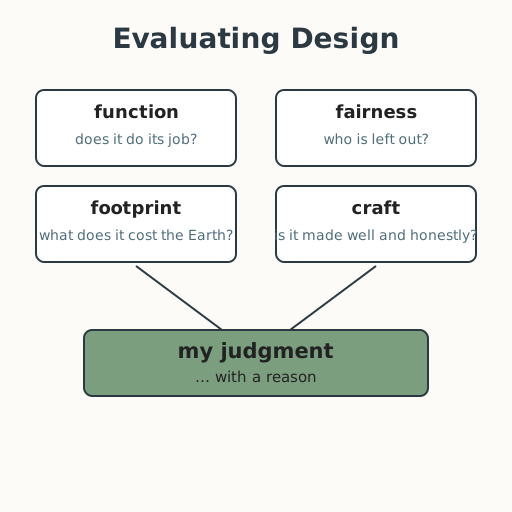
Learners close the unit by evaluating design: a designed thing is judged against four criteria — function, fairness, footprint, and craft — always honoring the tradition it comes from, and always ending in a judgment one can defend. They evaluate two objects from different cultures or eras and write a full claim-evidence-warrant judgment about good design.
Objectives
Objectives
- D07.S4.12.02 Evaluate design across cultures and eras with insight, honoring diverse traditions while forming and defending an independent judgment about good design.
Essential question
How do I evaluate a designed object or place from any culture or era — with insight, honoring its tradition, and forming and defending an independent judgment about good design?
Key vocabulary
Materials
Standard materials
- Design-evaluation sheet · 1 per learner Four criteria — function, fairness, footprint, craft — each with a prompt and a claim-evidence-warrant line
- Design-capstone journal · 1 per learner For recording the worked example and the learner's own evaluation
Low-tech / no-cost
- Any two designed objects or places from different places or times A tool, a vessel, a home, a cloth, a chair — described aloud if not at hand
- Scratch paper For jotting observations against each criterion
Enriched / lab & device
- A curated image or object set spanning two design traditions · 1 per class To evaluate side by side (e.g., a tool from one tradition and a modern mass-produced version) with descriptive notes
Works in different contexts
- large-group Evaluate one object whole-class against the four criteria, then pairs take a second object from a different tradition
- multi-age Younger learners do "function" and "fairness" (does it work, who can use it); older learners add "footprint" and a defended judgment
- self-directed A learner evaluates one object against all four criteria and writes the defended judgment alone
- level-grouped A ready group also weighs the full life cycle and proposes one improvement
- outdoor-only Evaluate a built thing in view — a fence, a path, a shelter, a gate — against the four criteria
Lesson 14 — Evaluating Design Across Cultures and Eras
Summary
Learners close the unit by evaluating design: a designed thing is judged against four criteria — function, fairness, footprint, and craft — always honoring the tradition it comes from, and always ending in a judgment one can defend. They evaluate two objects from different cultures or eras and write a full claim-evidence-warrant judgment about good design.
Objectives
- Evaluate design across cultures and eras with insight, honoring diverse traditions while forming and defending an independent judgment about good design. (D07.S4.12.02)
Connection
You already judge design constantly — a chair that tips, a cup that burns, a bag that tears, a door that is too heavy. Good design is not “looks nice”; it is works well, works for everyone it can, and does not cost the Earth more than it must. Every place and every era has judged its tools, vessels, and homes by these tests, even when the words differed.
Materials
- Design-evaluation sheet
- Design-capstone journal
- Low-tech: two designed objects or places from different places or times; scratch paper
- Enriched: a curated image or object set spanning two design traditions
Preparation
- Copy or draw the design-evaluation sheet (function / fairness / footprint / craft + judgment line).
- Retrieval: from Grade 11 (D07.S4.11.02), evaluating a designed object’s full life cycle and proposing improvements; from Lesson 13, the design cycle and universal-design checks. Today we evaluate design from any culture or era — the unit’s final move.
- Choose two contrasting objects to model (e.g., a handmade vessel from one tradition and a modern mass-produced equivalent) (S-369, S-452).
Facilitator note
This lesson is written to the learner (“you”). The idea to land: a designed thing is evaluated against four criteria — function (does it work), fairness (who can use it, who is left out), footprint (what it costs the Earth, cradle to cradle), and craft (is it made well and honestly) — and every evaluation ends in a judgment one can defend. Teach the four criteria explicitly with a worked example, then let learners evaluate a second object (S-011). Name the danger plainly: judging another culture’s design only by one’s own machine-made standards is flattening, not evaluation.
The ethics lens: to evaluate fairly is to name what a design does and does not do — for people and for the planet — without pretending any design is neutral. The egalitarianism lens: the four criteria are open to anyone who uses and handles things; they need no laboratory, only honest attention and a willingness to ask who is left out (S-369). The global lens: every culture’s tools, vessels, and homes are living design traditions that fit their materials, needs, and climate — to honor with respectful questions, never to grade by a single standard. The technology lens: mass production and digital fabrication change what is possible, but they also change the footprint — a judgment must weigh the whole life cycle, from materials through making, use, and disposal (S-452). The environment lens: this is the criterion that decides whether “good design” is also sustainable design — the unit closes where making meets stewardship. Preview: the capstone portfolio gathers every artifact from this unit into one voice.
Procedure
- Recall (5 min). From Grade 11: what is a “life cycle” — from materials through making, use, and disposal? Today we judge designed things against that full arc.
- Meet the four criteria (8 min). Write them down: function (does it do its job); fairness (who can use it, who is left out, and is it made and sold fairly); footprint (what it costs the Earth across its whole life); craft (is it made well and honestly, and does it honor its tradition). A judgment about good design weighs all four, not just the look.
- Worked example (15 min). Evaluate a handmade woven vessel from a living tradition — say, a tightly coiled basket of local plant fiber. Function: it holds and carries and drains. Fairness: it can be made by many hands with local materials, and its making supports a community rather than a distant factory. Footprint: the fiber is local and renewable, and the basket returns to the earth at the end of its life (S-452). Craft: the coiling is even and strong, a skill passed from hand to hand — a living tradition, honored with questions, not imitated carelessly (S-056). Judgment: this is good design because its function, fairness, footprint, and craft align — a reason, not just “I like it.” Write each criterion on your sheet.
- Name the move (5 min). You did not rank by looks; you weighed. Evaluation honors the design by attending to all four criteria and by knowing that “good” is a judgment you must defend.
- Evaluate a second object (17 min). With a partner, choose a designed thing from a different place or era — a tool, a chair, a shoe, a home, a modern mass-produced version of the vessel. Score it against all four criteria. Then write a full judgment: claim, one piece of evidence per criterion you weigh, and a warrant (“because”). At “fairness,” write at least one respectful question you would ask a living maker of that tradition.
- Share and check (4 min). Exchange judgments with a partner. Check: does the judgment weigh all four criteria, or only looks, and does the warrant connect claim to evidence? Give one specific improvement.
- Close (2 min). Say — or write, sign, gesture, or use AAC to express — the four criteria and the difference between “looks nice” and “good design.”
Differentiation
- Support: Use the evaluation sheet pre-filled for one object; the learner adds one observation to each criterion rather than building the evaluation from scratch.
- Extension: Weigh the full life cycle of a modern mass-produced version against the handmade one, and propose one change that would shrink its footprint or widen its fairness.
- Number access (dyscalculia): No arithmetic is required; “four criteria” is a simple count the sheet already structures with four labeled boxes, and any comparison is made in words rather than numbers. A learner may weigh two criteria and still meet the goal of a reasoned judgment.
- Communication access: Every spoken step — discussing, presenting, sharing, or closing — can be done in writing, sign, gesture, or AAC instead. Learners who are non-speaking, d/Deaf, hard-of-hearing, or who use AAC complete every task in their preferred mode. A learner who is blind or has low vision evaluates by touch, use, and verbal description, judging function, fairness, footprint, and craft through handling and hearing.
Assessment
- Formative (peer + self): Can the learner weigh a design against all four criteria, write one respectful question, and end with a claim-evidence-warrant judgment about good design?
- Portfolio artifact (unit): One completed design-evaluation sheet (four criteria + a defended judgment) on a design from a culture or era different from the learner’s own, opened in the design-capstone journal.
Home connection
Evaluate one designed thing at home against the four criteria — function, fairness, footprint, craft — in one sentence each, and write one improvement you would make and why.
Resources
- On designing with access in mind: The Center for Universal Design — The Principles of Universal Design (S-369).
- On the circular-economy frame for a design’s footprint: Ellen MacArthur Foundation (S-452).
- On honoring living craft traditions: UNESCO Intangible Cultural Heritage (S-056).