Lesson 01 — The Science of Nutrition: What Bodies Need
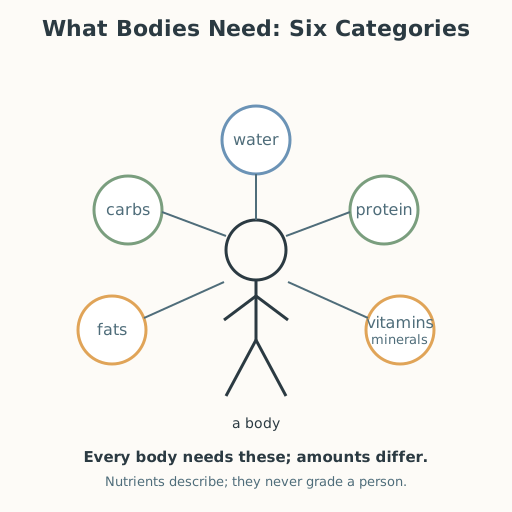
Learners meet nutrition as the study of what bodies need — six broad categories of nutrients (water, carbohydrates, proteins, fats, vitamins, minerals) — rather than a list of "good" and "bad" foods. They sort real foods from their own tables into the categories, learn to tell an evidence-based nutrition claim from a diet-culture fad, and name nutrition as one input — alongside ethics, culture, and environment — into a lifelong food decision.
Objectives
Objectives
- D03.S3.12.01 Synthesize the science of nutrition with ethical, cultural, and environmental considerations to make lifelong food decisions.
Essential question
What does the science of nutrition actually tell me my body needs — and how do I tell that science apart from diet-culture noise?
Key vocabulary
Materials
Standard materials
- What-bodies-need organizer · 1 per learner A six-box chart (water, carbohydrate, protein, fat, vitamins, minerals) with a "role" line and a "one food from my own table" line per box
- Health & care journal · 1 per learner The unit-long notebook for worked examples, reflections, and portfolio artifacts
Low-tech / no-cost
- Paper and any writing tool A hand-drawn six-box chart on scrap paper or slate works exactly as well
- Real or remembered foods Foods learners actually eat or remember from home, named aloud or drawn — no packages or labels needed
Enriched / lab & device
- A small set of food packages or labels · 1 set per small group To read ingredient and nutrition lists and connect them to the six nutrient categories
Works in different contexts
- large-group Model the six-category worked example whole-class, then pairs fill their own chart with foods from their own tables
- multi-age Younger learners name foods and sort them into the six boxes; older learners also write each nutrient's role in a sentence
- self-directed A learner follows the worked example, fills the six boxes from memory, and writes the evidence-vs-fad test in their own words
- level-grouped A ready group also reads a real nutrition label and maps its listed values onto the six categories, noting what the label cannot tell us
- outdoor-only Use a garden, field, market, or remembered foods; name each food and its nutrient category aloud without any paper
Lesson 1 — The Science of Nutrition: What Bodies Need
Summary
Learners meet nutrition as the study of what bodies need — six broad categories of nutrients (water, carbohydrates, proteins, fats, vitamins, minerals) — rather than a list of “good” and “bad” foods. They sort real foods from their own tables into the categories, learn to tell an evidence-based nutrition claim from a diet-culture fad, and name nutrition as one input — alongside ethics, culture, and environment — into a lifelong food decision.
Objectives
- Synthesize the science of nutrition with ethical, cultural, and environmental considerations to make lifelong food decisions, beginning with what bodies actually need. (D03.S3.12.01)
Connection
Food is fuel, and it is also memory: the dish your family makes for a celebration is both a set of nutrients and a piece of who you are. Your body turns what you eat into energy to move and think, into building blocks to grow and repair, and into protection against illness (S-038). Every body needs the same broad categories of nutrients — but no two bodies need the exact same amounts, and no two families eat the same way. That is what makes nutrition a science you can learn and a personal art you already practice.
Materials
- “What-bodies-need” organizer
- Health & care journal
- Low-tech: paper and any writing tool; real or remembered foods
- Enriched: food packages or labels
Preparation
- Copy or draw the six-box organizer (water / carbohydrate / protein / fat / vitamins / minerals, each with a “role” line and a “one food from my own table” line).
- Retrieval: from Grade 10 (D03.S3.10.01), evaluating popular diets with evidence, without shaming any body; from Grade 11 (D03.S3.11.02), building a sustainable personal nutrition plan. Today we build the science underneath those skills.
- Prepare the worked example (six categories with roles) to model first (S-011).
Facilitator note
This lesson is written to the learner (“you”). The idea to land: nutrition is the study of what bodies need — six broad categories of nutrients — not a ranking of “good” and “bad” foods. Teach the six categories explicitly as a worked example, then let learners sort foods from their own lives into them (S-011). Hold one distinction firmly all unit: a factual claim (what a nutrient does) is different from a value claim (that a food or a body is “good” or “bad”). Nutrition science describes; it never grades a person.
The ethics lens: we teach nutrients, not moral verdicts — no food is “clean” or “sinful,” and no body is a score. The egalitarianism lens: every body needs the same six categories; only the amounts differ, and amounts differ by body, activity, and life — never by worth. The global lens: there is no single “correct” diet — the WHO’s healthy-diet guidance is built around variety, and over 100 countries adapt dietary guidance to their own food cultures (S-038, S-118). The technology lens: labels, apps, and laboratory science let us measure nutrients, but measuring is not the same as judging — a label can tell you salt content, never your value. The environment lens: what we eat is connected to land, water, and climate, a thread Lessons 2 and 4 pull. Preview: Lesson 2 weighs the ethics and environment of food choices; Lesson 3 holds food as culture.
Procedure
- Recall (5 min). From Grade 11: name one thing your personal nutrition plan tried to balance. Today we ask the deeper question: what does a body actually need, and how do I know?
- Meet the idea (8 min). Write it down: nutrition is the study of what food provides and what bodies need. The things food provides are nutrients, grouped into six broad categories. A food is not “good” or “bad” — it is a mix of nutrients, and every food can be part of a way of eating that works for someone.
- Worked example — the six categories (15 min). Model each on the organizer: water (the body’s everyday drink and the medium every process runs in, S-049); carbohydrates (the body’s primary energy source, S-038); proteins (building blocks for structure and growth, S-038); fats (stored energy and the material of cells, S-038); vitamins and minerals (needed in tiny amounts to protect and regulate — for example, too little iron causes tiredness, S-193). For each, write one food from your own table that provides it.
- Name the move — evidence vs fad (8 min). A claim about nutrition is evidence-based when it rests on repeated, testable study across many people and places. A fad rests on a single testimonial, a “miracle” promise, or fear — often to sell something. Write the test: “Who benefits if I believe this, and what would prove it wrong?”
- Guided practice (12 min). With a partner, sort a short list of claims into “what bodies need (evidence)” or “diet-culture claim (test it first)”: e.g., “bodies need water,” “protein helps build and repair tissue,” “this one fruit burns fat,” “carbs are poison.” Say — or write, sign, gesture, or use AAC to show — your reason for each.
- Synthesize preview (5 min). Write one sentence: nutrition science tells me what my body needs, but it is only one input — my culture, my ethics, my budget, and the Earth are the others. Keep this in your journal; it is the unit’s through-line.
- Close (2 min). Say — or write, sign, gesture, or use AAC to express — the difference between “a nutrient” and “a good/bad food.”
Differentiation
- Support: Use the organizer pre-filled with the six roles; the learner only adds one food per box and skips the label-reading entirely.
- Extension: Read a real nutrition label and map its listed values onto the six categories, then name one thing a label can tell us and one thing it cannot.
- Number access (dyscalculia): This lesson needs no arithmetic. The “six categories” is a simple count handled by the pre-printed six-box organizer; any amounts are read as more or less, never as calculations, and a learner may name each nutrient’s role in words without writing a single numeral.
- Communication access: Every spoken step — saying, naming, reading aloud, discussing, or closing — can be done in writing, sign, gesture, or AAC instead. Learners who are non-speaking, d/Deaf, hard-of-hearing, or who use AAC complete every task in their preferred mode; no step requires producing or hearing sound. Foods may be shown, drawn, or signed rather than named aloud.
Assessment
- Formative (peer + self): Can the learner name the six categories, place a real food in each, and state the evidence-vs-fad test (“who benefits, what would prove it wrong”)?
- Portfolio artifact (unit): The completed six-box organizer plus the one-sentence “nutrition is one input” through-line, opened in the health & care journal.
Home connection
At home, name one food your family makes often and, with someone there, work out which two or three nutrient categories it mostly provides. Write one sentence — no judgment, just description — about what that food is for in your family.
Resources
- On worked examples and guided practice for a new concept: Kirschner, Sweller & Clark (2006) (S-011).
- On what a healthy diet provides and the value of variety: WHO — Healthy diet fact sheet (S-038); on micronutrients: WHO — Micronutrients (S-193).
- On water as the body’s everyday drink: WHO — Drinking-water fact sheet (S-049).
- On healthy traditional dietary patterns existing in every region: FAO — Food-based dietary guidelines (S-118).