Lesson 02 — Nutrition, Ethics, and the Environment
Learners weigh the ethics and environment of food choices: every meal reaches beyond the plate to land, water, climate, and the people who grow and move it. They trace one meal outward, separate measurable facts (a food's footprint, how much food is wasted) from values (what we owe each other), and commit to choosing with eyes open — never shaming what a person can afford or the food their family holds dear.
Objectives
Objectives
- D03.S3.12.01 Synthesize the science of nutrition with ethical, cultural, and environmental considerations to make lifelong food decisions.
Essential question
What do my food choices cost other people and the living Earth — and how do I weigh that honestly without judging anyone's plate?
Key vocabulary
Materials
Standard materials
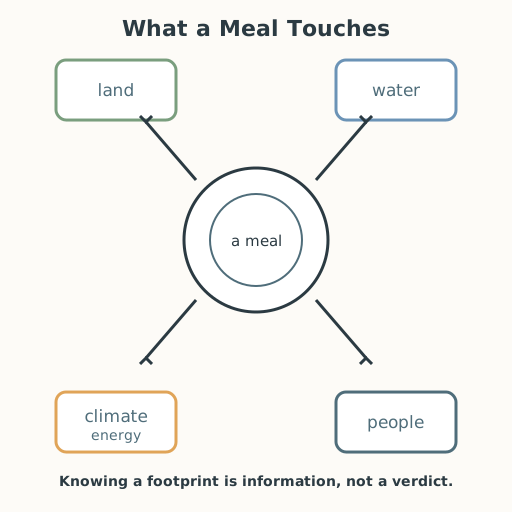
- What-a-meal-touches footprint sheet · 1 per learner A plate at center with four labeled arrows out — land, water, climate/energy, people — each with a blank for one cost and one choice
- Health & care journal · 1 per learner The unit-long notebook for reflections and portfolio artifacts
Low-tech / no-cost
- Paper and any writing tool A hand-drawn plate-with-arrows works identically
- A remembered or real meal One ordinary meal, named or drawn, to trace outward — no data or device needed
Enriched / lab & device
- A food-footprint data source (e.g., Our World in Data, bookmarked) · 1 per pair To compare the relative footprint of a few foods with real numbers (S-006)
Works in different contexts
- large-group Trace one meal's footprint whole-class, then pairs trace a different meal and compare
- multi-age Younger learners trace "where did this food come from and who grew it?"; older learners also weigh a real footprint comparison
- self-directed A learner traces one meal outward across all four arrows and writes the evidence-vs-value split alone
- level-grouped A ready group also separates, in each arrow, what is a measurable fact from what is a value judgment
- outdoor-only Trace a food grown or gathered nearby; walk its journey from soil to hand and name each step's cost
Lesson 2 — Nutrition, Ethics, and the Environment
Summary
Learners weigh the ethics and environment of food choices: every meal reaches beyond the plate to land, water, climate, and the people who grow and move it. They trace one meal outward, separate measurable facts (a food’s environmental footprint, how much food is wasted) from values (what we owe each other), and commit to choosing with eyes open — never shaming what a person can afford or the food their family holds dear.
Objectives
- Synthesize the science of nutrition with ethical and environmental considerations to make lifelong food decisions. (D03.S3.12.01)
Connection
Every meal is a choice that reaches beyond the plate. A mango, a bowl of rice, a piece of bread — each was grown somewhere, used water and soil, produced some greenhouse gas, and passed through the hands of people who were paid for it. Knowing a food’s footprint does not make you guilty; it makes you able to choose with eyes open. And guilt is the wrong tool: what a person eats is shaped by money, access, and culture long before it is shaped by preference.
Materials
- “What-a-meal-touches” footprint sheet
- Health & care journal
- Low-tech: paper and any writing tool; a remembered or real meal
- Enriched: a food-footprint data source (S-006)
Preparation
- Copy or draw the plate-with-four-arrows sheet (land / water / climate-energy / people).
- Retrieval: from Grade 10 (D03.S3.10.02), the environmental footprint of different foods; from Grade 9 (D03.S3.09.02), hunger, food security, and unequal access. Today we weigh ethics and environment together in one decision.
- Prepare the worked example (trace one meal across all four arrows) to model first (S-011).
Facilitator note
This lesson is written to the learner (“you”). The idea to land: food choices carry consequences for other people and the living Earth, and we can weigh those honestly — by separating facts from values — without shaming anyone’s plate. Teach the trace-the-meal worked example explicitly, then let learners trace their own (S-011). This is the unit’s highest-shame-risk lesson; name it out loud: a learner who is poor, food-insecure, or whose family’s food is not “green” must never be made to feel at fault. The footprint belongs to systems, and the responsibility to change them is shared, never loaded onto one plate.
The ethics lens: a food choice has consequences for others — farm workers, animals, future people — and ethics is simply the discipline of asking who is affected and what do I owe them. The egalitarianism lens: the costs of food are unevenly carried — the people who grow and pick food are often the people who can least afford it, and the places least responsible for climate change often feel it worst (S-006, S-005). The global lens: footprints differ by place and method — a food farmed one way in one region has a different footprint than the same food farmed differently elsewhere; there is no single “good” food. The technology lens: fertilizer, irrigation, refrigeration, and long-distance shipping changed footprints dramatically — some raising them, some lowering them. The environment lens: about one-fifth of the food available to consumers worldwide is wasted, wasting the water, land, and energy that made it (S-410). Preview: Lesson 4 traces the whole system from farm to table; Lesson 5 turns this understanding into advocacy.
Procedure
- Recall (5 min). From Grade 10, name one way the same food can have a bigger or smaller environmental footprint. Today we add the ethics side: who and what a meal touches.
- Meet the idea (8 min). Write it down: a food’s environmental footprint is the total effect of producing, moving, and disposing of it — on land, water, climate, and the people in the chain. Every meal has one; knowing it is information, not a verdict.
- Worked example — trace one meal (15 min). Take an ordinary meal (rice and beans, bread and soup, a bowl of fruit). Trace it across the four arrows: land (what was cleared or used to grow it), water (what it took to grow and process it), climate/energy (the greenhouse gases and fuel in growing and moving it), people (who grew, picked, packed, and sold it, and whether they were paid fairly). Write one cost and one choice per arrow.
- Name the move — fact vs value (8 min). Some of what you wrote is fact (measurable — how much water, how much greenhouse gas), some is value (what we ought to owe workers or the Earth). Write one example of each from your own sheet. Both are real; only the first is settled by evidence.
- Guided practice (12 min). With a partner, trace a second meal — one you actually eat — across all four arrows. Then exchange sheets and check each other: did you each separate fact from value? Say — or write, sign, gesture, or use AAC to show — one honest choice you could make and one honest thing that is not in your control.
- Commit without shame (5 min). Write one sentence: I will choose what I can, and I will not turn a system’s cost into a person’s guilt. Keep it in your journal.
- Close (2 min). Say — or write, sign, gesture, or use AAC to express — the difference between a food’s footprint (a fact) and a food’s worth (a value).
Differentiation
- Support: Use the worked-example meal pre-traced on the sheet; the learner adds one cost or choice to a single arrow rather than building the whole trace.
- Extension: Compare the relative footprints of two foods that could fill the same role (e.g., two protein sources) using real data (S-006), and write which difference is largest and why.
- Number access (dyscalculia): This lesson’s numbers (a fifth of food wasted, a footprint figure) are all read as more, less, or about the same, never as arithmetic; provide the plate-with-arrows sheet pre-printed, and allow the whole trace to be done in words and arrows with no numerals at all.
- Communication access: Every spoken step — saying, naming, reading aloud, discussing, or closing — can be done in writing, sign, gesture, or AAC instead. Learners who are non-speaking, d/Deaf, hard-of-hearing, or who use AAC complete every task in their preferred mode; no step requires producing or hearing sound.
Assessment
- Formative (peer + self): Can the learner trace a meal across the four arrows, separate a factual footprint claim from a value claim, and state why guilt is the wrong tool?
- Portfolio artifact (unit): One completed “what a meal touches” sheet with the fact-vs-value split marked, opened in the health & care journal.
Home connection
At home, pick one food your family often buys and, with someone there, work out (roughly, no numbers required) what it touches before it reaches you. Write one sentence naming a fact you learned and one naming a choice you could make.
Resources
- On worked examples and guided practice for a new concept: Kirschner, Sweller & Clark (2006) (S-011).
- On food waste and its environmental cost: UNEP — Food Waste Index Report (S-410).
- On who emits and who is exposed (climate fairness): Our World in Data (S-006); on climate science: IPCC (S-005).
- On food security and unequal access as the backdrop: FAO — SOFI (S-409).