Lesson 03 — My Place in the Long Human Story
Learners locate themselves on the long human story. They see — proportionally — that anatomically modern humans have walked the Earth for roughly 300,000 years, that writing is only about 5,000 years old, and that cities and electricity are younger still, and they place their own one life on that span. The point is not to feel small but to feel *placed*: each of us is a thread in a story no single generation ever finished.
Objectives
Objectives
- D08.S1.12.02 Reflect on their own place in the long, unfinished human story, connecting the past to the present and to possible futures.
Essential question
Where do I sit on a story that began long before any writing and reaches long past me — and why does my place in it matter?
Key vocabulary
Materials
Standard materials
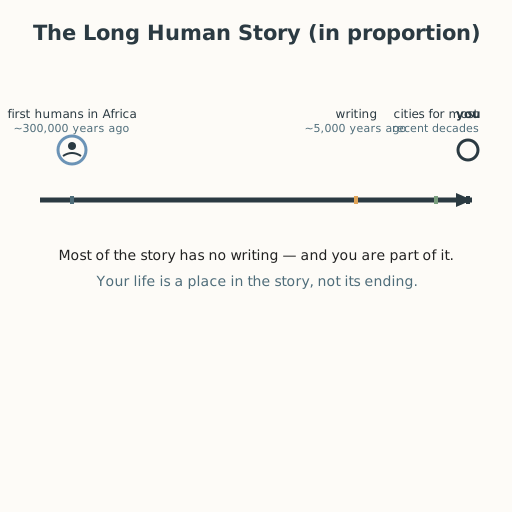
- Long-story timeline (pre-printed) · 1 per learner A non-numeric, proportional strip — human origins, first writing, first cities, my life — with markers, not dates, so no counting is needed
- Capstone history journal · 1 per learner
Low-tech / no-cost
- A long strip of paper, cloth, or smoothed earth To draw or press a long timeline and mark one's own place on it
- Pebbles, seeds, or chalk To mark positions along the strip without numerals
Enriched / lab & device
- A digital timeline tool (e.g., TimelineJS or a shared document) · 1 per learner or pair To build an interactive long-story timeline with text and images
Works in different contexts
- large-group Build one long wall timeline whole-class, each learner adding a marker for an ancestor's story and for themselves
- multi-age Younger learners place themselves and a parent on the strip; older learners add human origins, writing, and cities in proportion
- self-directed A learner draws the strip, places the four markers, and writes one sentence on where they sit
- level-grouped A ready group also marks what came *after* writing — printing, electricity, the internet — to see how recent "modern" is
- outdoor-only Pace the long story out on the ground — from one landmark to another — and stand where writing, cities, and your own life would fall
Lesson 3 — My Place in the Long Human Story
Summary
Learners locate themselves on the long human story. They see — proportionally — that anatomically modern humans have walked the Earth for roughly 300,000 years, that writing is only about 5,000 years old, and that cities and electricity are younger still, and they place their own one life on that span. The point is not to feel small but to feel placed: each of us is a thread in a story no single generation ever finished.
Objectives
- Reflect on their own place in the long, unfinished human story, connecting the past to the present and to possible futures. (D08.S1.12.02)
Connection
Most of what you call “history” — the books, the dates, the named rulers — covers only the last sliver of the human story. Before writing, thousands of generations of people lived, loved, planted, mourned, and made decisions whose consequences reached you, without leaving a single written word. When you place your own life on that longer line, your life stops looking like an endpoint and starts looking like a place — a point from which the story keeps going.
Materials
- Long-story timeline (pre-printed, non-numeric)
- Capstone history journal
- Low-tech: a long strip of paper, cloth, or smoothed earth; pebbles, seeds, or chalk
- Enriched: a digital timeline tool (TimelineJS or a shared document)
Preparation
- Prepare the proportional long-story strip with markers for human origins, first writing, and first cities (no dates required to be computed).
- Retrieval: from Grade 10 (D08.S1.10.01), comparing how societies measured time; from Grade 7 (D08.S1.07.01), why historians divide time into periods. Today we place ourselves on the line.
- Prepare the proportional example to model first (S-011).
Facilitator note
This lesson is written to the learner (“you”). The idea to land: the human story is far longer than written history, and locating yourself on it — in proportion — turns “the past” from a finished list into an unfinished story you are inside. Model the proportional strip explicitly (S-011). Handle the “deep time” numbers with care: humans evolved in Africa roughly 300,000 years ago (S-506); writing is about 5,000 years old (S-264); most people came to live in cities only within recent decades (S-089); electric light within a few generations (S-052). Hold these as proportions, not as a memorization test, and keep the number access scaffold in place.
The ethics lens: knowing the story is longer than the records is a caution against treating the written past — and its winners — as the whole of what mattered. The egalitarianism lens: every person alive is a descendant of that long story, and no line of descent is more “history” than another; the unrecorded billions were not extras — they are the story (S-506). The global lens: this is not any one nation’s origin — all living people share ancestry rooted in Africa, and the story fans out to every continent (S-506). The technology lens: writing, printing, electricity, and the internet each arrived astonishingly recently, which is why “modern” feels breakneck — and why we should not mistake recency for destiny. The environment lens: for almost the whole of the story, humans lived within landscapes that outlived them; only in the last sliver did our tools begin to reshape the whole planet — a change of scale worth sitting with. Preview: Lesson 4 carries the story from the past through the present toward possible futures.
Procedure
- Recall (5 min). From Grade 10 or 7, name one way a society measured time — a calendar, a dynasty list, an oral genealogy. Today we put you on a longer line than any of them.
- Meet deep time (8 min). Write it down: the human story is far longer than the part that got written. People like us have existed for roughly 300,000 years (S-506); writing for about 5,000 (S-264); city life for most people only recently (S-089); electric light for a few generations (S-052). Those are proportions, not a quiz.
- Worked example — the proportional strip (12 min). Look at the pre-printed strip. Notice where “first humans” sits, where “writing” sits, and how tiny the space between “writing” and “now” is. Mark where you sit. The move: place yourself on the line, and see what came before you as living, not just listed.
- Make it your own (18 min). On your strip (paper, cloth, or ground), place four markers: human origins; first writing; first cities; and your own life. Add one marker for something in your family’s story — a move, a trade, a name — wherever you think it falls. Then write or say one sentence: where do I sit, and what does that placement make me notice?
- Share and check (5 min). With a partner, show your strip and read your sentence. Ask: does the placement match the proportions we learned? Give one specific correction or agreement.
- Close (2 min). Say — or write, sign, gesture, or use AAC to express — one thing that changes when you see your life as a place in a story, not an endpoint.
Differentiation
- Support: Use the strip pre-marked with all positions except “you”; the learner places only themselves and one family marker and answers the sentence with a starter (“I sit… and I notice…”).
- Extension: Mark what arrived after writing — printing, electricity, the internet — and write one sentence on what “very recent” means for how we treat our own moment.
- Number access (dyscalculia): The strip is deliberately non-numeric and proportional; no dates are computed, and the few figures (“300,000 years,” “5,000 years”) are offered on the pre-printed strip and read aloud, never required to be reproduced or ordered from memory. All positions are marked by place, not by number.
- Communication access: Every spoken step — naming, reading aloud, sharing, or closing — can be done in writing, sign, gesture, or AAC instead. Learners who are non-speaking, d/Deaf, hard-of-hearing, or who use AAC complete every task in their preferred mode. For learners with low or no vision, the strip can be built as a tactile line (a raised ridge, a string, pressed marks) and the sentence spoken or signed.
Assessment
- Formative (peer + self): Can the learner place human origins, writing, cities, and their own life in proportion, and say one thing their placement makes them notice?
- Portfolio artifact (unit): The marked long-story strip with the one-sentence placement reflection, opened in the capstone history journal.
Home connection
Ask an elder at home for one story from before they were born that reached them — a family move, a craft, a name. Write one sentence placing that story on the long line, and one sentence on how it reached you.
Resources
- On worked examples and guided practice: Kirschner, Sweller & Clark (2006) (S-011).
- On human origins in deep time: Smithsonian National Museum of Natural History, Introduction to Human Evolution (S-506).
- On writing materials and the written record: British Library (S-264).
- On the recency of city life and electric light: Our World in Data, Urbanization (S-089) and Light at Night (S-052).