Lesson 04 — Past, Present, and Possible Futures
Learners connect the long human story to their own agency. They name what they inherit from the past, what is happening in their present, and two or three possible futures they could help make, then write the link between them. The lesson frames the story as unfinished — not a fate to accept but a next step that is partly theirs to take — holding hope and agency against despair.
Objectives
Objectives
- D08.S1.12.02 Reflect on their own place in the long, unfinished human story, connecting the past to the present and to possible futures.
Essential question
How do the past I carry and the present I live in open onto futures I can actually help shape?
Key vocabulary
Materials
Standard materials
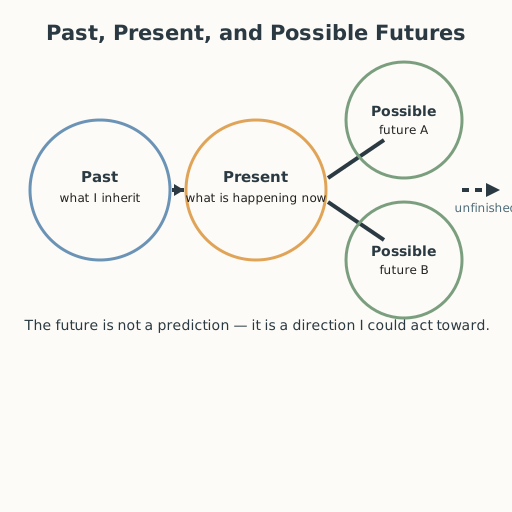
- Past–present–futures sheet · 1 per learner Three linked boxes — what I inherit from the past, what is happening now, and two or three futures I could help make — with a line for the link between them
- Capstone history journal · 1 per learner
Low-tech / no-cost
- Paper and any writing tool To draw the three linked boxes by hand
- A partner-listener To talk the reflection through before writing it
Enriched / lab & device
- A shared document or digital portfolio · 1 per learner To draft and keep the reflection as a capstone artifact
Works in different contexts
- large-group Model the three boxes whole-class, then learners draft individually and share one future with a small group
- multi-age Younger learners name one thing they inherit and one thing they want for the future; older learners link past, present, and several futures
- self-directed A learner fills the three boxes alone and writes the linking sentence
- level-grouped A ready group also marks which future depends on what happens in the present — the lever they can actually pull
- outdoor-only Name one inheritance from the land and one change happening on it now, then say one future you would help make for that place
Lesson 4 — Past, Present, and Possible Futures
Summary
Learners connect the long human story to their own agency. They name what they inherit from the past, what is happening in their present, and two or three possible futures they could help make, then write the link between them. The lesson frames the story as unfinished — not a fate to accept but a next step that is partly theirs to take — holding hope and agency against despair.
Objectives
- Reflect on their own place in the long, unfinished human story, connecting the past to the present and to possible futures. (D08.S1.12.02)
Connection
Every future you have ever imagined stands on something you inherited and something happening right now. A farmer imagines next season’s crop from last season’s soil and this week’s rain; a student imagines a career from a family’s skill and a present opportunity. “Possible futures” is not a dreamy abstraction — it is the ordinary, human way of standing between what was and what could be, and noticing that you get a hand in the “could be.”
Materials
- Past–present–futures sheet
- Capstone history journal
- Low-tech: paper and any writing tool; a partner-listener
- Enriched: a shared document or digital portfolio
Preparation
- Copy or draw the past–present–futures sheet (three linked boxes + linking line).
- Retrieval: from Lesson 3, where the learner sits on the long story. Today we ask what follows from that place.
- Prepare a model reflection to show first (S-011).
Facilitator note
This lesson is written to the learner (“you”). The idea to land: the human story is unfinished, and “possible futures” is a concrete, ordinary act of agency — naming what I inherit, what is happening now, and what I could help make. Teach the three boxes explicitly (S-011). This lesson must carry hope, never nihilism: the “unfinished” framing is empowerment (there is still time, and the next step is partly ours), not dread. Name feelings before facts where the present is heavy, and always connect difficulty to agency (facilitation, holding difficult topics safely).
The ethics lens: imagining futures is a moral act — some futures are more just than others, and we can ask which futures are worth wanting. The egalitarianism lens: “possible selves” are not a privilege of the rich — people everywhere imagine and work toward futures (S-399); the point is that agency belongs to everyone, even when it is unevenly resourced. The global lens: the same inherited past can seed many different futures in different places — a coastline facing the sea, a dry region facing drought — and no single future is the only one. The technology lens: tools narrow and widen futures at once — a phone connects a village to the world while a new dam floods a valley; naming futures is naming which tools serve whom. The environment lens: the Earth itself is the biggest “present” — what we do now narrows or widens which futures remain possible for the living world (S-005). Preview: Lesson 5 turns to the many knowledge traditions that different futures draw on.
Procedure
- Recall (5 min). From Lesson 3, say — or write, sign, gesture, or use AAC to show — where you sit on the long story. Today: what follows from that place?
- Meet the three boxes (8 min). Write them: (1) Past — what I inherit (a family skill, a language, a place, a debt or a gift from history); (2) Present — what is happening now (in my life, my community, the world); (3) Possible futures — two or three I could help make. A possible future is not a prediction; it is a direction you could act toward.
- Worked example (10 min). Read or hear a model: a learner who inherits a farming family, lives through a changing climate now, and names three futures — keep the farm and adapt it, teach others the soil, leave and return with new tools. Notice each box is concrete, and the futures follow from the past and present.
- Fill your sheet (18 min). Write your own three boxes. Then write the linking sentence: what I inherit and what is happening now point toward futures I could help make, and here is the first small step.
- Share and check (5 min). With a partner, share one future and your linking sentence. Ask: does the future actually follow from the past and present you named? Give one specific suggestion.
- Close (2 min). Say — or write, sign, gesture, or use AAC to express — why “unfinished” is a word of hope, not of failure.
Differentiation
- Support: Use the sheet with starters (“I inherit…; right now…; one future I could help make is…”); fill one future rather than three.
- Extension: Mark which future depends on a present choice you can actually make, and write one sentence on the lever — the specific thing you could do this year.
- Number access (dyscalculia): No arithmetic is required; “two or three futures” is a loose count a learner may meet with any number, spoken or shown without numerals. The sheet is pre-structured so no ordering or counting is needed.
- Communication access: Every spoken step — naming, sharing, or closing — can be done in writing, sign, gesture, or AAC instead. Learners who are non-speaking, d/Deaf, hard-of-hearing, or who use AAC complete every task in their preferred mode; no step requires producing or hearing sound.
Assessment
- Formative (peer + self): Can the learner name an inheritance, a present condition, and at least one future that genuinely follows from them, with a linking sentence?
- Portfolio artifact (unit): The completed past–present–futures sheet, opened in the capstone history journal — the strand’s “place in the story” reflection.
Home connection
Ask someone at home what future they once imagined and what they did about it. Write one sentence on how their future grew out of their past and present, and one sentence on what that shows you about your own.
Resources
- On worked examples and guided practice: Kirschner, Sweller & Clark (2006) (S-011).
- On possible selves as a real psychological frame for imagining futures: Markus & Nurius (S-399).
- On climate as a present condition narrowing and widening possible futures: IPCC (S-005).