Lesson 05 — Multiple Knowledge Traditions, Side by Side
Learners practice setting multiple knowledge traditions side by side without ranking one above another. They meet the idea that a knowledge tradition is a coherent, living way of asking and answering questions — herbal medicine, scientific biomedicine, and Indigenous ecological knowledge each ask different questions and offer different strengths — and they chart what each asks and offers, then name how they relate, with dignity for all.
Objectives
Objectives
- D08.S2.12.01 Weigh multiple knowledge traditions side by side and articulate a respectful, non-dogmatic relationship among them.
Essential question
How do I set several ways of knowing — a herbal medicine, a scientific treatment, an elder's ecological knowledge — beside each other and weigh them without ranking any as lesser?
Key vocabulary
Materials
Standard materials
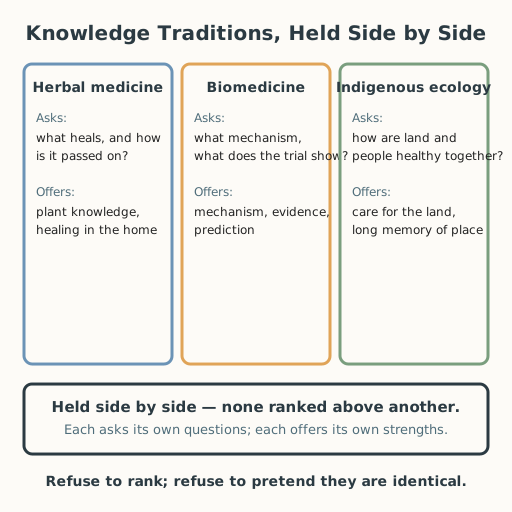
- Side-by-side traditions chart · 1 per learner Two or three equal columns — 'what this tradition asks' and 'what it offers' — with a shared row for how they relate, none ranked above another
- Capstone history journal · 1 per learner
Low-tech / no-cost
- Two or three short written descriptions of knowledge traditions Hand-copied or printed; any local pair works
- Scratch paper To draw the side-by-side chart by hand
Enriched / lab & device
- A short excerpt from Kimmerer's Braiding Sweetgrass or a local elder's account · 1 per class To see two ways of knowing held together in one person's voice
Works in different contexts
- large-group Hold one set of traditions whole-class, then pairs each chart a different set and report one relation
- multi-age Younger learners answer "what does each tradition help people do?"; older learners also name the question each tradition is answering
- self-directed A learner charts two or three traditions and writes how they relate without ranking
- level-grouped A ready group also names a point where two traditions genuinely differ and one where they complement
- outdoor-only Name one living thing or place and tell two ways of knowing it — how it works, and what it means to your people — and hold both
Lesson 5 — Multiple Knowledge Traditions, Side by Side
Summary
Learners practice setting multiple knowledge traditions side by side without ranking one above another. They meet the idea that a knowledge tradition is a coherent, living way of asking and answering questions — herbal medicine, scientific biomedicine, and Indigenous ecological knowledge each ask different questions and offer different strengths — and they chart what each asks and offers, then name how they relate, with dignity for all.
Objectives
- Weigh multiple knowledge traditions side by side and articulate a respectful, non-dogmatic relationship among them. (D08.S2.12.01)
Connection
For a fever, one person brews a plant their grandmother taught them; another takes a medicine a doctor prescribed; a third knows that the fever is one sign in a whole season of a river’s health. All three are knowing — differently. The mature skill is not to declare one “the real knowledge” and the rest superstition, but to set them beside each other and ask, without ranking, what each asks and what each offers.
Materials
- Side-by-side traditions chart
- Capstone history journal
- Low-tech: two or three written descriptions of knowledge traditions; scratch paper
- Enriched: an excerpt from Kimmerer’s Braiding Sweetgrass or a local elder’s account
Preparation
- Copy or draw the side-by-side chart; gather two or three short, respectful descriptions of knowledge traditions (herbal medicine, biomedicine, Indigenous ecological knowledge, or a local set).
- Retrieval: from Grade 11 (D08.S2.11.01), the relationship between dominant and marginalized knowledge traditions. Today we set traditions beside each other, as equals.
- Prepare the worked example (charting one set) to model first (S-011).
Facilitator note
This lesson is written to the learner (“you”). The idea to land: a knowledge tradition is a coherent, living way of asking and answering questions, and the skill is to set several beside each other without ranking — seeing what each asks, what it offers, and how they relate. Teach the chart explicitly (S-011). This is the inquiry-over-creed commitment made concrete (philosophy §11): we do not rank traditions, and we do not pretend they are identical. Frame as wondering together; use written or anonymous questions if speaking up is not safe (contexts, cultural power dynamics).
The ethics lens: ranking one people’s knowledge above another’s has been used to justify suppression; refusing the ranking is an ethical stance, not a claim that nothing can be checked. The egalitarianism lens: traditional medicine is a real, valued, living tradition, recognized worldwide, used alongside — not beneath — other systems (S-145); Indigenous fire stewardship is a long-standing practice documented by national science agencies as knowledge, not folklore (S-320, S-321). The global lens: every named tradition here is a living practice carried by real communities, recognized through living-heritage frameworks (S-056), never a specimen. The technology lens: scientific instruments answer “how” with unmatched power, but they are silent on “what it means” and “how we should live with it” — questions other traditions take up (S-427). The environment lens: Indigenous ecological knowledge — when to burn, when to plant, how to read a landscape — complements scientific ecology rather than contradicting it (S-320, S-321, S-427). Preview: Lesson 6 asks learners to articulate the relationship between traditions explicitly and non-dogmatically.
Procedure
- Recall (5 min). From Grade 11, name one knowledge tradition that was marginalized or suppressed, and one thing it knew. Today we set traditions beside each other, as equals.
- Meet the idea (8 min). Write it down: a knowledge tradition is a coherent way a people ask and answer questions — through plants, instruments, story, apprenticeship, or prayer. Each tradition asks its own questions and offers its own strengths. Side by side means we refuse to rank them: we do not call one “real” and another “lesser.”
- Worked example — three ways of knowing health and land (15 min). Chart three traditions: herbal medicine (asks “what does this plant heal, and how is it passed on?” — S-145); scientific biomedicine (asks “what mechanism causes this, and what does the trial show?”); Indigenous ecological knowledge (asks “how is this land and its people healthy together?” — S-320, S-321, S-427). For each, write what it asks and what it offers. Then the relation: they answer different questions; they can correct, inform, and complete each other — and none is lesser.
- Chart your own set (18 min). With a partner, choose two or three knowledge traditions you can name respectfully — the lesson’s set, a local pair, or another you both know. Fill the chart. Say — or write, sign, gesture, or use AAC to show — one place they complement and one place they genuinely differ.
- Name the relation (7 min). Write one sentence of relation: do they answer different questions? does one carry facts and another carry meaning and duty? Be precise — no ranking, but no pretending they are identical either.
- Close (2 min). Say — or write, sign, gesture, or use AAC to express — what it means to hold several knowledge traditions side by side with dignity for all.
Differentiation
- Support: Chart only “what each tradition offers” before adding “what each asks.”
- Extension: Name a case where two traditions appear to conflict (e.g., about a treatment or a landscape’s history) and write how you would hold both honestly without pretending the difference away.
- Number access (dyscalculia): The chart is qualitative — no arithmetic; provide it pre-printed with the columns labeled so the learner fills phrases and single words, and allow the relation sentence to be spoken or recorded rather than written.
- Communication access: Every spoken step — naming, reading aloud, discussing, or closing — can be done in writing, sign, gesture, or AAC instead. Learners who are non-speaking, d/Deaf, hard-of-hearing, or who use AAC complete every task in their preferred mode; no step requires producing or hearing sound.
Assessment
- Formative (peer + self): Can the learner chart two or three traditions — naming what each asks and offers — and write one precise sentence of relation that neither ranks them nor erases their difference?
- Portfolio artifact (unit): The completed side-by-side chart with the relation sentence, opened in the capstone history journal — a “knowledge traditions” artifact.
Home connection
Ask someone at home for one way they know something — a remedy, a planting rule, a way of reading weather. Write it beside a scientific account you know, and one sentence on how the two stand together.
Resources
- On worked examples and guided practice: Kirschner, Sweller & Clark (2006) (S-011).
- On traditional medicine as a living tradition: WHO, Traditional, complementary and integrative medicine (S-145).
- On Indigenous and scientific knowledge held together: Kimmerer, Braiding Sweetgrass (S-427).
- On Indigenous ecological practice: CSIRO cultural burning (S-320) and Firesticks Alliance (S-321).
- On living heritage and intergenerational knowledge: UNESCO Intangible Cultural Heritage (S-056).