Lesson 06 — A Respectful, Non-Dogmatic Relationship
Learners articulate the *relationship* between knowledge traditions explicitly. They learn that a respectful, non-dogmatic relationship does two things at once: it honors what each tradition offers and refuses to treat any tradition as beyond question. Using the idea of two-eyed seeing, they write a relationship statement — where the traditions complement, where they differ, and what they will keep open rather than force shut.
Objectives
Objectives
- D08.S2.12.01 Weigh multiple knowledge traditions side by side and articulate a respectful, non-dogmatic relationship among them.
Essential question
What does a truly respectful, non-dogmatic relationship between knowledge traditions look like — one that honors each without making any of them unquestionable?
Key vocabulary
Materials
Standard materials
- Relationship statement sheet · 1 per learner A frame for one paragraph — where the traditions complement, where they differ, and the open questions the learner will not force shut
- Capstone history journal · 1 per learner
Low-tech / no-cost
- Paper and any writing tool To draft the relationship statement
- A partner-listener or voice recorder To speak the statement first, then write it down
Enriched / lab & device
- A shared document · 1 per pair To co-write and revise the relationship statement
Works in different contexts
- large-group Model the statement whole-class, then pairs draft and read statements to a small group for one revision
- multi-age Younger learners say one thing the two traditions share and one thing they do differently; older learners write the full statement
- self-directed A learner writes the statement alone and revises one sentence to avoid either ranking or pretending sameness
- level-grouped A ready group also names the dogmatism trap — a tradition treated as beyond question — and how their statement avoids it
- outdoor-only Speak the statement about two ways of knowing a place to a partner before writing it
Lesson 6 — A Respectful, Non-Dogmatic Relationship
Summary
Learners articulate the relationship between knowledge traditions explicitly. They learn that a respectful, non-dogmatic relationship does two things at once: it honors what each tradition offers and refuses to treat any tradition as beyond question. Using the idea of two-eyed seeing, they write a relationship statement — where the traditions complement, where they differ, and what they will keep open rather than force shut.
Objectives
- Weigh multiple knowledge traditions side by side and articulate a respectful, non-dogmatic relationship among them. (D08.S2.12.01)
Connection
Two elders can disagree about the same medicine and still respect each other completely — because respect is not “agree with me,” and disagreement is not “you are wrong about everything.” A non-dogmatic relationship is that same stance, scaled up: I honor your way of knowing, I do not have to adopt it, and I do not treat my own as beyond question either. Both traditions stay open; neither becomes a law.
Materials
- Relationship statement sheet
- Capstone history journal
- Low-tech: paper and any writing tool; a partner-listener or voice recorder
- Enriched: a shared document
Preparation
- Copy or draw the relationship statement frame.
- Retrieval: from Lesson 5, the side-by-side chart and its relation sentence. Today we write the relationship fully — complement, difference, and what stays open.
- Prepare a model relationship statement to show first (S-011).
Facilitator note
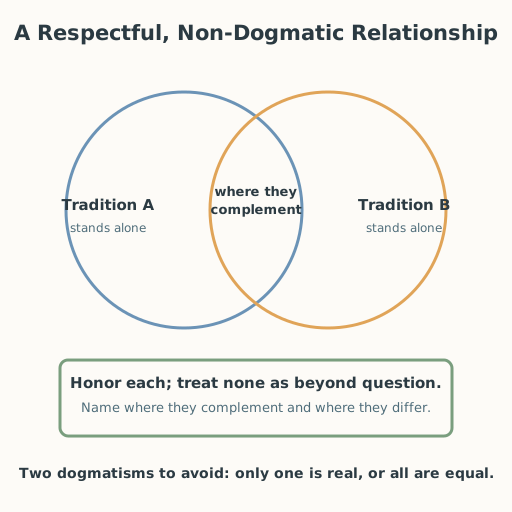
This lesson is written to the learner (“you”). The idea to land: a respectful, non-dogmatic relationship honors each tradition and treats none as beyond question — it names complement, difference, and the open questions it refuses to force shut. Teach the statement explicitly (S-011). Two dogmatisms to avoid, and to name aloud: scientific dogmatism (only one tradition is real knowledge) and relativist dogmatism (all claims are equal, so nothing can be checked). The mature stance refuses both: traditions are held with dignity and claims are weighed with evidence.
The ethics lens: the refusal to rank is not a refusal to judge — we can still ask of any tradition, “does this claim hold up, and does this practice do harm?” The egalitarianism lens: “two-eyed seeing” — seeing with Indigenous and scientific eyes together — is itself a teaching from Mi’kmaq Elder Albert Marshall, carried into science by Indigenous scholars such as Robin Wall Kimmerer (S-427), which is a quiet reversal of the idea that only one tradition gets to define the relationship. The global lens: complement-and-difference relationships exist worldwide — a doctor who is also a herbalist, a fisherman who is also a hydrologist — and each culture words the relation its own way. The technology lens: tools let one tradition borrow from another (a satellite map of a landscape an elder knows by foot), which is relation, not replacement. The environment lens: when fire science and cultural burning work together, the result is better land care than either alone (S-320, S-321) — a working model of the non-dogmatic relationship. Preview: Lesson 7 turns from the relationship to the act of honoring many traditions.
Procedure
- Recall (5 min). From Lesson 5, name one place two knowledge traditions complement and one place they differ. Today we write the whole relationship.
- Meet the stance (8 min). Write it down: non-dogmatic means no tradition — including my own — is treated as beyond question. A respectful relationship therefore says three things: where they complement, where they differ, and what I keep open.
- Worked example (12 min). Read or hear a model relationship statement about fire science and cultural burning: they complement (both keep a landscape healthy), they differ (one measures fuel loads, the other carries law and kinship), and the writer keeps open the question of how a single place can hold both systems of authority at once (S-320, S-321, S-427). Mark the three parts.
- Write your statement (18 min). Using the frame, write your own relationship statement for the traditions you charted in Lesson 5. Name complement, difference, and one open question you will not force shut. Guard against both dogmatisms: do not rank, and do not pretend sameness.
- Revise with a partner (8 min). Read your statement to a partner. Ask: does it honor both traditions, and does it avoid both dogmatisms? Revise one sentence.
- Close (2 min). Say — or write, sign, gesture, or use AAC to express — the three things a respectful, non-dogmatic relationship always says.
Differentiation
- Support: Use the frame with starters (“They complement when…; they differ when…; I will keep open…”); fill the blanks rather than composing free.
- Extension: Name the two dogmatisms (only-one-tradition vs all-claims-equal) and write how your statement steers between them with a concrete example.
- Number access (dyscalculia): No arithmetic is required; the three parts are a list, not a computation. The sheet is pre-numbered so the learner can work one part at a time in any order without counting.
- Communication access: Every spoken step — reading, drafting aloud, discussing, or closing — can be done in writing, sign, gesture, or AAC instead. Learners who are non-speaking, d/Deaf, hard-of-hearing, or who use AAC complete every task in their preferred mode; no step requires producing or hearing sound.
Assessment
- Formative (peer + self): Does the statement name complement, difference, and an open question, while avoiding both ranking and pretending sameness?
- Portfolio artifact (unit): The written relationship statement, paired with the Lesson 5 chart, in the capstone history journal.
Home connection
Write a two-sentence “relationship statement” between a way of knowing you grew up with and one you met at school. Name one place they complement and one open question you will not force shut.
Resources
- On worked examples and guided practice: Kirschner, Sweller & Clark (2006) (S-011).
- On two-eyed seeing and holding traditions together: Kimmerer, Braiding Sweetgrass (S-427).
- On cultural burning as a working complement to fire science: CSIRO (S-320) and Firesticks Alliance (S-321).