Lesson 07 — Honoring Many Traditions
Learners move from *weighing* traditions to *honoring* them. They study short, real cases — West African griot oral history, the Andean khipu, the manuscripts of Timbuktu, and language revitalization — and ask what honoring each actually requires: recognizing it as knowledge, crediting its keepers, protecting it, and helping pass it on. Honoring is distinguished from merely tolerating, and from taking without credit.
Objectives
Objectives
- D08.S2.12.02 Reflect on how honoring many knowledge traditions contributes to a more just and flourishing shared human story.
Essential question
What does it actually mean to *honor* a knowledge tradition — not just tolerate it, but recognize, credit, and help keep it alive?
Key vocabulary
Materials
Standard materials
- Honoring case card set · 1 set per pair Short cases of traditions kept and revived — griot oral history, the khipu, Timbuktu's manuscripts, language revitalization — with a question for each: what does honoring it require?
- Capstone history journal · 1 per learner
Low-tech / no-cost
- Hand-copied case cards on paper The same cases written or drawn by hand
- Scratch paper For the honoring organizer
Enriched / lab & device
- A short film or audio of a living tradition (e.g., a kōhanga reo or a griot performance) · 1 per class To hear honoring in a real voice
Works in different contexts
- large-group Present two cases whole-class, then pairs each take a different case and report what honoring it requires
- multi-age Younger learners say what each tradition makes and who keeps it; older learners name what honoring requires (credit, protection, transmission)
- self-directed A learner reads the cases, chooses one, and writes what honoring it requires
- level-grouped A ready group also weighs the difference between honoring a tradition and taking from it without credit
- outdoor-only Name a local tradition tied to the land and say what keeping it alive requires of the people who carry it
Lesson 7 — Honoring Many Traditions
Summary
Learners move from weighing traditions to honoring them. They study short, real cases — West African griot oral history, the Andean khipu, the manuscripts of Timbuktu, and language revitalization — and ask what honoring each actually requires: recognizing it as knowledge, crediting its keepers, protecting it, and helping pass it on. Honoring is distinguished from merely tolerating, and from taking without credit.
Objectives
- Reflect on how honoring many knowledge traditions contributes to a more just and flourishing shared human story. (D08.S2.12.02)
Connection
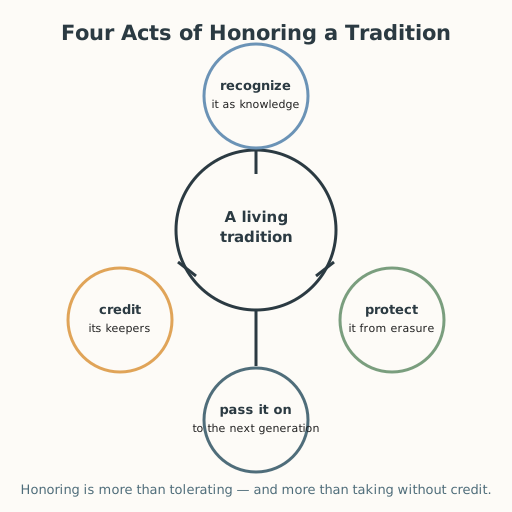
When a recipe is passed to you, honoring it is not just cooking it once — it is learning it right, naming who taught you, and passing it on to the next person, not claiming you invented it. The same is true of a people’s knowledge: to honor a tradition is to recognize it as real knowledge, credit its keepers, protect it from erasure, and help it live into the next generation.
Materials
- Honoring case card set
- Capstone history journal
- Low-tech: hand-copied case cards; scratch paper
- Enriched: a short film or audio of a living tradition (a kōhanga reo, a griot performance)
Preparation
- Copy the case cards (griot, khipu, Timbuktu, language revitalization) and the honoring organizer (recognize / credit / protect / pass on).
- Retrieval: from Grade 11 (D08.S2.11.02), how peoples have maintained and revitalized languages and knowledge. Today we name what honoring requires.
- Prepare the worked example (one case) to model first (S-011).
Facilitator note
This lesson is written to the learner (“you”). The idea to land: honoring a tradition is active — recognize it as knowledge, credit its keepers, protect it, and pass it on — and it is not the same as tolerating, and not the same as taking without credit. Teach the four honoring acts explicitly (S-011). Keep each case accurate and centered on its own people: the griot (jeli/jali) carries genealogies and histories orally across generations in West Africa (S-446); the Andean khipu is a knotted-cord record-keeping system suppressed under colonial rule and now studied and revived (S-473); Timbuktu’s manuscripts preserve centuries of scholarship in Arabic and African languages (S-201, S-268); language revitalization — kōhanga reo, Pūnana Leo, and others — brings languages home (S-428). None is a museum piece; each is living.
The ethics lens: the line between honoring and taking is credit — using a tradition’s knowledge while erasing its keepers is not honoring but extraction. The egalitarianism lens: these are not “minor” traditions of “minor” peoples; they are whole systems of knowledge whose bearers have the same dignity as any scholar (S-056). The global lens: honoring is recognized worldwide through living-heritage and memory-of-the-world frameworks (S-056, S-201) — a shared, cross-cultural practice, not one region’s virtue. The technology lens: digital archives now photograph and index the Timbuktu manuscripts and record endangered languages, so tools can serve honoring — when the keepers, not the tools, decide what is shared. The environment lens: many traditions carry ecological knowledge (when to burn, plant, harvest) whose loss would also harm the land — honoring the tradition and caring for the Earth are one act. Preview: Lesson 8 turns honoring into a claim about a more just, flourishing shared story.
Procedure
- Recall (5 min). From Grade 11, name one tradition that was revived or kept alive under pressure. Today: what does honoring it require?
- Meet the four acts (8 min). Write them down: to honor a knowledge tradition is to (1) recognize it as real knowledge; (2) credit its keepers by name and people; (3) protect it from erasure or misuse; (4) pass it on to the next generation. Honoring is not merely tolerating, and not taking without credit.
- Worked example — the griot (12 min). Read the case: the West African griot carries a people’s genealogies and histories in memory and song, across generations, without a written text (S-446). Walk the four acts: recognize (it is a historian’s discipline), credit (name the griot and the lineage), protect (the right to tell, and to be heard), pass on (apprenticeship to the next griot). Write these on your organizer.
- Work your own case (18 min). With a partner, take one case — the khipu, Timbuktu’s manuscripts, or language revitalization — and fill the four acts. Say — or write, sign, gesture, or use AAC to show — one thing honoring it requires that merely “tolerating” it would miss.
- Share and check (5 min). Report one act to another pair. Ask: did we credit the keepers, or just describe the tradition? Give one correction.
- Close (2 min). Say — or write, sign, gesture, or use AAC to express — the four acts that make honoring more than tolerance.
Differentiation
- Support: Use the organizer pre-filled with one act already done for each case; the learner adds the remaining acts with sentence starters (“To honor this, people must…”).
- Extension: Weigh the difference between honoring a tradition and borrowing from it, and write one sentence on where credit makes the difference.
- Number access (dyscalculia): No arithmetic is required; the four acts are a list, not a computation, and the organizer is pre-numbered so the learner works one act at a time without counting. Dates on the cards are offered as background, never required to be computed or ordered.
- Communication access: Every spoken step — naming, reading aloud, sharing, or closing — can be done in writing, sign, gesture, or AAC instead. Learners who are non-speaking, d/Deaf, hard-of-hearing, or who use AAC complete every task in their preferred mode; no step requires producing or hearing sound.
Assessment
- Formative (peer + self): Can the learner apply the four honoring acts to a case, and name what honoring adds beyond tolerance — especially crediting the keepers?
- Portfolio artifact (unit): The completed honoring organizer for one case, opened in the capstone history journal.
Home connection
Name one thing your family or community knows — a remedy, a craft, a saying — and write who keeps it and how it will reach the next person. One sentence on how it could be honored, and by whom.
Resources
- On worked examples and guided practice: Kirschner, Sweller & Clark (2006) (S-011).
- On the griot: Encyclopaedia Britannica, Griot (S-446).
- On the khipu: Encyclopaedia Britannica, quipu/khipu (S-473).
- On Timbuktu’s manuscripts: UNESCO Memory of the World (S-201) and UNESCO World Heritage (S-268).
- On language revitalization: Hinton (ed.), Bringing Our Languages Home (S-428); UNESCO Intangible Cultural Heritage (S-056).