Lesson 08 — A More Just, Flourishing Shared Story
Learners argue the connection between honoring many knowledge traditions and a more just, flourishing shared story. They learn that a shared story is impoverished when one tradition crowds out the rest — knowledge is lost, and whole peoples are told their knowing does not count — and enriched when many traditions are honored. They write one reasoned claim with an example, and answer the honest counter that a single "most efficient" tradition might be enough.
Objectives
Objectives
- D08.S2.12.02 Reflect on how honoring many knowledge traditions contributes to a more just and flourishing shared human story.
Essential question
How does honoring many knowledge traditions — instead of letting one crowd out the rest — make the shared human story more just and more able to flourish?
Key vocabulary
Materials
Standard materials
- Flourishing claim sheet · 1 per learner A frame for one argued claim — honoring many traditions helps a shared story flourish *because*… with an example and a 'who is left out otherwise' line
- Capstone history journal · 1 per learner
Low-tech / no-cost
- Paper and any writing tool To draft the claim sheet by hand
- A partner-listener To talk the claim through before writing
Enriched / lab & device
- A shared document · 1 per pair To co-write and revise the claim
Works in different contexts
- large-group Model the claim whole-class, then learners draft individually and share claims in small groups
- multi-age Younger learners say one tradition that should not be lost and why; older learners write the full argued claim
- self-directed A learner writes the claim alone and revises one sentence to sharpen the 'because'
- level-grouped A ready group also names a counter-claim ("one tradition is more efficient") and answers it honestly
- outdoor-only Name two ways of knowing the same place and say how keeping both makes the place itself better cared for
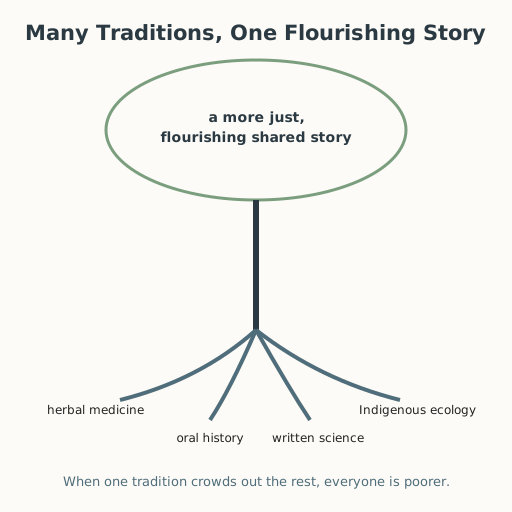
Lesson 8 — A More Just, Flourishing Shared Story
Summary
Learners argue the connection between honoring many knowledge traditions and a more just, flourishing shared story. They learn that a shared story is impoverished when one tradition crowds out the rest — knowledge is lost, and whole peoples are told their knowing does not count — and enriched when many traditions are honored. They write one reasoned claim with an example, and answer the honest counter that a single “most efficient” tradition might be enough.
Objectives
- Reflect on how honoring many knowledge traditions contributes to a more just and flourishing shared human story. (D08.S2.12.02)
Connection
A garden with one crop feeds you; a garden with many crops feeds you and survives a bad season. Human knowledge is like that garden. When many traditions are kept alive — many ways to heal, to farm, to read a river, to remember — the shared story is more just (no one is told their knowing does not count) and more able to flourish (there is more than one answer when one answer fails).
Materials
- Flourishing claim sheet
- Capstone history journal
- Low-tech: paper and any writing tool; a partner-listener
- Enriched: a shared document
Preparation
- Copy or draw the flourishing claim frame (claim + because + example + who is left out otherwise).
- Retrieval: from Lesson 7, the four honoring acts and the cases. Today we argue why honoring matters for the whole shared story.
- Prepare a model claim to show first (S-011).
Facilitator note
This lesson is written to the learner (“you”). The idea to land: honoring many knowledge traditions makes the shared human story more just and more able to flourish — because knowledge is diverse, because telling a people their knowing does not count is an injustice, and because one tradition alone leaves everyone poorer. Teach the claim frame explicitly (S-011). Welcome and answer the honest counter (“wouldn’t one best method be more efficient?”) — the answer is not that efficiency is worthless but that a single tradition is also a single point of failure, and that justice is not measured only by efficiency (S-460). Keep this a reasoned claim, not a slogan: the learner must support it, not merely assert it.
The ethics lens: the claim is a values claim (a shared story should honor many traditions) supported by evidence (diverse knowledge is more resilient) — model the distinction between evidence and values explicitly. The egalitarianism lens: development understood as freedom — people able to live the lives they value, in their own terms — is exactly what honoring many traditions protects (S-460); suppressing a tradition is taking a capability away. The global lens: the claim is universal, not one culture’s — everywhere, when one tradition dominates, others are lost, and everywhere, revival brings them back (S-428, S-056). The technology lens: tools can centralize knowledge (one platform, one standard) or pluralize it (many archives, many voices); the design of tools is a choice about whether the story stays many-voiced. The environment lens: biodiversity and knowledge-diversity rise and fall together — when one crop, one language, one way of burning is lost, the land loses a caretaker too (S-437, S-320). Preview: Lesson 9 turns to the movements of peoples and power that have carried these traditions — and their keepers — across the Earth.
Procedure
- Recall (5 min). From Lesson 7, name one tradition and the four acts that honor it. Today: why does honoring many traditions matter for everyone, not just for that tradition’s people?
- Meet the claim (8 min). Write the frame: Claim — a shared story flourishes when many knowledge traditions are honored; Because — diverse knowledge is more resilient, and telling a people their knowing does not count is an injustice; Example — one concrete tradition and what it adds; Otherwise — who is left out, and what is lost, when one tradition crowds out the rest.
- Worked example (12 min). Read or hear a model: honoring both fire science and cultural burning keeps a landscape healthier than either alone, and refusing the Indigenous knowledge would be an injustice and a practical loss (S-320, S-321). Mark the four parts of the frame.
- Answer the counter (8 min). Someone says: “wouldn’t one best method be simpler?” Write an honest answer: efficiency matters, but one tradition is also one point of failure, and justice is not only efficiency — a people whose knowing is erased loses the freedom to live by it (S-460).
- Write your claim (15 min). Using the frame, write your own argued claim. Support it with a real example; do not merely assert it.
- Close (2 min). Say — or write, sign, gesture, or use AAC to express — one way the shared story becomes more just when many traditions are honored.
Differentiation
- Support: Use the frame with starters (“The shared story is more just and more able to flourish when… because… for example… and otherwise…”); fill the blanks.
- Extension: Add a second example from a different region, and mark which part of your claim is a value and which part is evidence.
- Number access (dyscalculia): No arithmetic is required; the frame is qualitative and pre-structured, so the learner fills phrases and single words, and may speak or record the claim rather than write it.
- Communication access: Every spoken step — reading, drafting aloud, discussing, or closing — can be done in writing, sign, gesture, or AAC instead. Learners who are non-speaking, d/Deaf, hard-of-hearing, or who use AAC complete every task in their preferred mode; no step requires producing or hearing sound.
Assessment
- Formative (peer + self): Does the claim state why honoring many traditions helps the shared story flourish, support it with an example, and answer the counter honestly — while separating value from evidence?
- Portfolio artifact (unit): The written flourishing claim, opened in the capstone history journal — the strand’s “many traditions” reflection.
Home connection
Ask someone at home what would be lost if everyone farmed, cooked, or healed the same single way. Write one sentence on what diversity of knowledge protects, and one sentence on your own part in keeping a tradition alive.
Resources
- On worked examples and guided practice: Kirschner, Sweller & Clark (2006) (S-011).
- On development as freedom (the values frame behind “flourishing”): Sen, Development as Freedom (S-460).
- On the link between biological and cultural diversity: IPBES Global Assessment (S-437).
- On cultural burning and knowledge-diversity: CSIRO (S-320), Firesticks Alliance (S-321); on language revitalization: Hinton (ed.) (S-428); on living heritage: UNESCO (S-056).