Lesson 09 — Movements of Peoples and Power Across Deep Time
Learners trace the movements of peoples — and of power — across deep time. They map the human dispersal out of Africa, the long trade networks of the Silk Roads and Indian Ocean, the forced movement of the transatlantic slave trade, and today's chosen and forced displacement, and they name for each *who moved, why, and who held the power to decide*. The lesson connects deep-time movement to the living fact of migration.
Objectives
Objectives
- D08.S3.12.01 Trace global movements of peoples and power across deep time and synthesize how migration has shaped the human story.
Essential question
How have peoples — and the power to decide where and how people live — moved across the Earth, from the first human dispersals to the forced and free migrations of today?
Key vocabulary
Materials
Standard materials
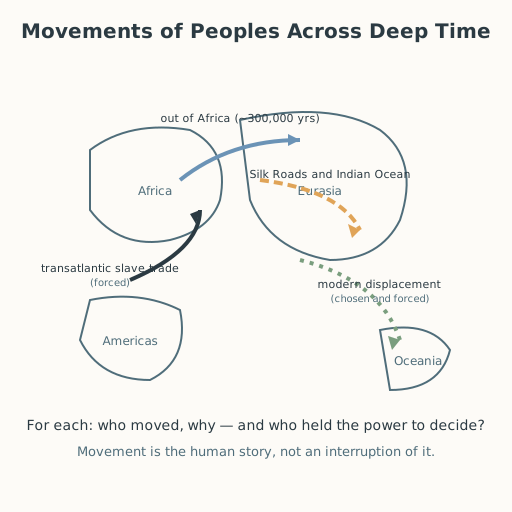
- Movements map-or-timeline (pre-printed) · 1 per learner A non-numeric, arrowed world map or timeline — out of Africa, the Silk Roads and Indian Ocean, the transatlantic slave trade, modern displacement — with arrows and labels, not dates to compute
- Capstone history journal · 1 per learner
Low-tech / no-cost
- A hand-drawn map on paper or smoothed earth To draw the movement arrows by hand and label them in words
- String or pebbles To trace routes across the map without numerals
Enriched / lab & device
- A digital map tool (e.g., Google Earth or a shared map document) · 1 per pair To trace routes interactively and attach notes
Works in different contexts
- large-group Build one large wall map whole-class, each learner tracing one route and naming who moved and why
- multi-age Younger learners trace one route and say who moved; older learners also name whether the movement was chosen or forced and who held power
- self-directed A learner traces the routes and writes which were chosen and which were forced
- level-grouped A ready group also marks where power — not just people — moved (ports, empires, borders)
- outdoor-only Use the ground as the map; pace one route and stand where its endpoints would be, naming who moved and why
Lesson 9 — Movements of Peoples and Power Across Deep Time
Summary
Learners trace the movements of peoples — and of power — across deep time. They map the human dispersal out of Africa, the long trade networks of the Silk Roads and Indian Ocean, the forced movement of the transatlantic slave trade, and today’s chosen and forced displacement, and they name for each who moved, why, and who held the power to decide. The lesson connects deep-time movement to the living fact of migration.
Objectives
- Trace global movements of peoples and power across deep time and synthesize how migration has shaped the human story. (D08.S3.12.01)
Connection
Almost everyone alive is somewhere because someone moved — a great-grandparent who crossed a border, a family that fled, a trade that drew people to a port, or a dispersal so ancient no name survives. Movement is not an interruption of the human story; it is the human story. The question history asks is not whether people moved but who chose to move, who was forced, and who held the power to decide.
Materials
- Movements map-or-timeline (pre-printed)
- Capstone history journal
- Low-tech: a hand-drawn map; string or pebbles
- Enriched: a digital map tool
Preparation
- Prepare the arrowed, non-numeric world map or timeline with the four movements labeled.
- Retrieval: from Grade 10 (D08.S3.10.01/02), colonization’s reshaping of populations and modern displacement; from Grade 8 (D08.S3.08.01), the Silk Roads and Indian Ocean routes. Today we trace the whole arc in one picture.
- Prepare the worked example (tracing one movement) to model first (S-011).
Facilitator note
This lesson is written to the learner (“you”). The idea to land: peoples have moved across the Earth since our species began, and the power to decide where and how people live has moved with them — so migration must be read through the question of who chose and who was forced. Teach the tracing explicitly (S-011). Hold the hard parts with care and accuracy, and never reduce the transatlantic slave trade to a statistic: at least 12 million Africans were forcibly transported, in a trade built on the denial of human dignity (S-322, S-274); today, tens of millions of people are forcibly displaced by conflict, persecution, and violence (S-493). Name these as facts, with the feeling named first, and connect them to the agency of the people who endured and resisted — never to despair.
The ethics lens: the difference between chosen and forced movement is a moral difference, and blurring it hides the harm of forced migration. The egalitarianism lens: the map is not “explorers discovering” — peoples moved and knew these routes before any empire claimed them; the Silk Roads and Indian Ocean were made by many peoples, not by any single power (S-265, S-207). The global lens: this is one human story — our shared ancestry began in Africa (S-506) and fanned out to every continent, so no place and no people is “more native” than another on the scale of deep time. The technology lens: the astrolabe, the sail, the rail line, and the jet each changed how far and how fast people and power could move — and who could afford to (S-379). The environment lens: movement has always been partly driven by environment — drought, flood, and climate shift push people, past and present (S-383). Preview: Lesson 10 synthesizes how this movement shaped the human story.
Procedure
- Recall (5 min). From Grade 8 or 10, name one trade network or one migration you studied and what moved along it. Today we trace the whole arc in one picture.
- Meet the frame (8 min). Write the three questions you will ask of every movement: who moved? why — chosen or forced? who held the power to decide? Movement is the human story; these three questions tell you what kind of story it was.
- Worked example — out of Africa (12 min). Trace the first movement: anatomically modern humans evolved in Africa roughly 300,000 years ago and, over tens of thousands of years, dispersed to every habitable continent (S-506). Ask the three questions: who (all our ancestors), why (climate, following food and land, over generations), who held power (no single ruler — it was gradual, not commanded). Mark it on your map.
- Trace the rest (18 min). With a partner, trace and label three more movements: the Silk Roads and Indian Ocean trade (goods, ideas, beliefs, and people moved both ways — S-265, S-207, S-323); the transatlantic slave trade (forced, not chosen — S-322, S-274); and today’s displacement (chosen and forced, driven by conflict, economy, and climate — S-493, S-383). For each, answer the three questions.
- Share and check (5 min). Show one route to another pair. Ask: did we name who chose and who was forced? Give one correction.
- Close (2 min). Say — or write, sign, gesture, or use AAC to express — the three questions you now ask of any migration, past or present.
Differentiation
- Support: Use the map with routes pre-drawn and labeled; the learner answers only “chosen or forced?” for each with a mark or word.
- Extension: Mark where power itself moved — ports, borders, capitals — and write one sentence on how a route of goods can also be a route of empire.
- Number access (dyscalculia): The map is non-numeric and arrowed; no dates or figures are computed. The few figures (“300,000 years,” “12 million,” “tens of millions”) are offered on the pre-printed map and read aloud, never required to be reproduced, ordered, or compared numerically; a learner may complete the whole task by tracing and labeling with words.
- Communication access: Every spoken step — naming, reading aloud, sharing, or closing — can be done in writing, sign, gesture, or AAC instead. Learners who are non-speaking, d/Deaf, hard-of-hearing, or who use AAC complete every task in their preferred mode. For learners with low or no vision, the map can be a tactile surface (raised routes, string) and the three questions spoken or signed.
Assessment
- Formative (peer + self): Can the learner trace each movement and answer, for each, who moved, whether it was chosen or forced, and who held the power to decide?
- Portfolio artifact (unit): The labeled movements map with the three-questions notes, opened in the capstone history journal — the strand’s “deep-time migration” artifact.
Home connection
Ask someone at home about one move in your family’s past — who moved, why, and whether it was chosen or forced. Write those three answers, and one sentence on what the move set in motion.
Resources
- On worked examples and guided practice: Kirschner, Sweller & Clark (2006) (S-011).
- On human origins and dispersal: Smithsonian, Introduction to Human Evolution (S-506).
- On the Silk Roads and Indian Ocean as shared networks: UNESCO Silk Roads (S-265); UNESCO, The Indian Ocean, a shared heritage (S-207); Britannica, Silk Road/Indian Ocean trade (S-323).
- On the transatlantic slave trade: SlaveVoyages (S-322); UNESCO, Routes of Enslaved Peoples (S-274).
- On modern displacement: UNHCR Global Trends (S-493); IOM climate action (S-383).