Lesson 11 — My Place in the Movement of People and Ideas
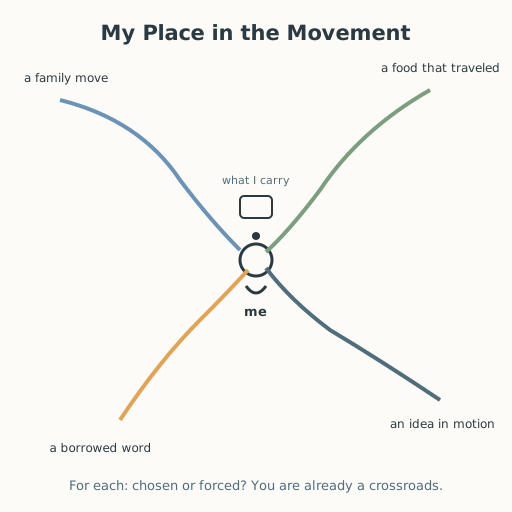
Learners locate themselves in the ongoing movement of people and ideas. They fill a sheet with a family move, a borrowed word they use, a food or idea that reached them from elsewhere, and what they carry forward — and they name, for each, whether the movement was chosen or forced. The lesson makes migration personal and ordinary without flattening its harder forms.
Objectives
Objectives
- D08.S3.12.02 Reflect on their own place in the ongoing movement of people and ideas, and their responsibility to a shared and changing Earth.
Essential question
Where do I sit in the ongoing movement of people and ideas — and what do I carry from it, whether I moved or not?
Key vocabulary
Materials
Standard materials
- My-place-in-movement sheet · 1 per learner A set of lines to fill — a family move, a borrowed word I use, a food or idea that reached me from elsewhere, and one thing I carry forward
- Capstone history journal · 1 per learner
Low-tech / no-cost
- Paper and any writing tool To draw the sheet by hand
- A partner-listener To talk the reflection through before writing
Enriched / lab & device
- A digital map or family-history tool · 1 per learner or pair To trace one route from the learner's own or their community's past
Works in different contexts
- large-group Model the sheet whole-class, then learners fill it individually and share one line in small groups
- multi-age Younger learners name one borrowed word or food; older learners trace a fuller lineage of movement and ideas
- self-directed A learner fills the sheet alone and writes which of their lines is chosen and which was forced
- level-grouped A ready group also names the difference between carrying a tradition willingly and having it assigned to them
- outdoor-only Name one plant, food, or word in your place that arrived from elsewhere, and say what it carried with it
Lesson 11 — My Place in the Movement of People and Ideas
Summary
Learners locate themselves in the ongoing movement of people and ideas. They fill a sheet with a family move, a borrowed word they use, a food or idea that reached them from elsewhere, and what they carry forward — and they name, for each, whether the movement was chosen or forced. The lesson makes migration personal and ordinary without flattening its harder forms.
Objectives
- Reflect on their own place in the ongoing movement of people and ideas, and their responsibility to a shared and changing Earth. (D08.S3.12.02)
Connection
You do not have to have moved to be inside the movement. The word you say for “tea,” the dish on the table, the song you hum, the faith or skill your family keeps — each arrived from somewhere, carried by someone. To find your place in the movement of people and ideas is to notice that your everyday life is already a crossroads, and to ask, honestly, which of those arrivals were chosen and which were forced.
Materials
- My-place-in-movement sheet
- Capstone history journal
- Low-tech: paper and any writing tool; a partner-listener
- Enriched: a digital map or family-history tool
Preparation
- Copy or draw the my-place-in-movement sheet (family move / borrowed word / food or idea / what I carry).
- Retrieval: from Lessons 9–10, the movements and the synthesis. Today we find our own place in that movement.
- Prepare a model reflection to show first (S-011).
Facilitator note
This lesson is written to the learner (“you”). The idea to land: everyone is inside the movement of people and ideas — through family, language, food, and what we carry — and noticing this is the first step to a considered relationship to migration. Teach the sheet explicitly (S-011). Hold two things gently: migration is ordinary (a word, a dish, a move), and some movement is forced — for learners whose families fled or were displaced, this lesson must be a place of dignity, not of being put on display. Offer the option to write about a community rather than a family, and never require anyone to share a painful story. Distinguish chosen from forced movement with care (S-086).
The ethics lens: asking “chosen or forced?” about one’s own history is an ethical honesty — it is how we remember accurately rather than comfortably. The egalitarianism lens: a migrant is not a category of other people — anyone can be one, and nearly everyone descends from one (S-086); the word is descriptive, never a lesser status. The global lens: borrowed words are everywhere — “tea/chai” marks two ancient trade routes, overland and by sea (S-169); our languages are already world maps. The technology lens: today ideas move faster than people — a video crosses a border in an instant — so “the movement of ideas” is no longer tied to the movement of bodies, which changes what belonging means. The environment lens: some movement is toward safety from a changing climate (S-383), and “what I carry” can include a care for the place I came from as much as the place I am. Preview: Lesson 12 turns “my place” into a responsibility to a shared, changing Earth.
Procedure
- Recall (5 min). From Lessons 9–10, name one thing migration spread. Today: find your own place in that movement.
- Meet the sheet (8 min). Write the four lines: (1) a family move I know of (or a community move); (2) a borrowed word I use; (3) a food or idea that reached me from elsewhere; (4) what I carry forward from all of it. For each, mark chosen or forced — or say honestly that you do not know.
- Worked example (10 min). Read or hear a model: a learner whose family moved for work (chosen); who says “tea” (a word that traveled by sea — S-169); who eats rice that crossed oceans; and who carries a grandparent’s recipe and a language half-remembered. Notice each line names the movement and the chosen/forced mark.
- Fill your sheet (18 min). Write your four lines. If a line is painful or private, write about a community instead, or leave it blank — dignity first. Then write one sentence: what does my place in the movement make me notice about migration itself?
- Share and check (5 min). Share one line with a partner (only what you wish). Ask: does it name the movement and the chosen/forced mark? Give one gentle suggestion.
- Close (2 min). Say — or write, sign, gesture, or use AAC to express — one thing you carry that someone else carried to reach you.
Differentiation
- Support: Use the sheet with starters (“My family (or community) moved because…; I use the word … which came from…; the food … reached me from…; I carry…”); fill one line at a time.
- Extension: Trace the route of one borrowed word or food back as far as you can, and write where the idea changed as it moved.
- Number access (dyscalculia): No arithmetic is required; the sheet is a list of four lines, not a computation, and dates are not required. A learner may complete every line in spoken or signed words without any numerals.
- Communication access: Every spoken step — naming, sharing, or closing — can be done in writing, sign, gesture, or AAC instead. Learners who are non-speaking, d/Deaf, hard-of-hearing, or who use AAC complete every task in their preferred mode; no step requires producing or hearing sound. Sharing is always optional.
Assessment
- Formative (peer + self): Can the learner name a family or community move, a borrowed word, a food or idea, and what they carry — marking each as chosen or forced (or honestly unknown)?
- Portfolio artifact (unit): The completed my-place-in-movement sheet, opened in the capstone history journal — the strand’s “place in movement” reflection.
Home connection
Ask someone at home for one word, food, or song in your household that came from somewhere else. Write one sentence on where it came from, and one on what it carried with it.
Resources
- On worked examples and guided practice: Kirschner, Sweller & Clark (2006) (S-011).
- On who counts as a migrant: International Organization for Migration, “Who is a migrant?” (S-086).
- On “tea/chai” marking two routes: WALS, Dahl, “Tea” (S-169).
- On climate as a driver of movement: IOM, Climate Action (S-383).