Lesson 10 — How Migration Shaped the Human Story
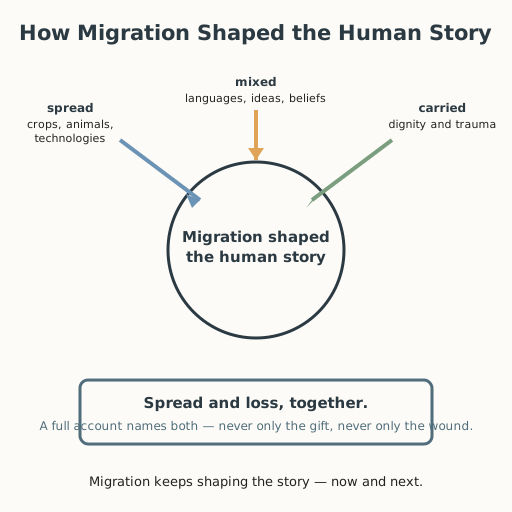
Learners synthesize how migration shaped the human story. They build one reasoned claim and support it with three kinds of evidence: the spread of crops, animals, and technologies; the mixing of languages, ideas, and beliefs; and the carrying of human dignity and trauma through forced movement. The synthesis holds both spread and loss — never reducing migration to only its gifts or only its wounds.
Objectives
Objectives
- D08.S3.12.01 Trace global movements of peoples and power across deep time and synthesize how migration has shaped the human story.
Essential question
When I pull the movements of Lesson 9 together, what is the one big claim I can make about how migration shaped the human story — and what is the evidence for it?
Key vocabulary
Materials
Standard materials
- Migration-synthesis sheet · 1 per learner A frame — claim, three pieces of evidence (crops and animals, languages and ideas, and human dignity and trauma), and one sentence on what migration keeps doing
- Capstone history journal · 1 per learner
Low-tech / no-cost
- Scratch paper and the Lesson 9 map To draft the synthesis from the traced routes
- A partner-listener To speak the synthesis first
Enriched / lab & device
- A shared document · 1 per pair To co-write and revise the synthesis
Works in different contexts
- large-group Model the synthesis whole-class, then learners draft individually and share in small groups
- multi-age Younger learners name one thing migration spread (a crop, a word); older learners write the full synthesis
- self-directed A learner writes the synthesis alone and revises one sentence for precision
- level-grouped A ready group also weighs what migration *destroyed* alongside what it created
- outdoor-only Name a plant, animal, or word in your place that came from elsewhere, and say how it got there
Lesson 10 — How Migration Shaped the Human Story
Summary
Learners synthesize how migration shaped the human story. They build one reasoned claim and support it with three kinds of evidence: the spread of crops, animals, and technologies; the mixing of languages, ideas, and beliefs; and the carrying of human dignity and trauma through forced movement. The synthesis holds both spread and loss — never reducing migration to only its gifts or only its wounds.
Objectives
- Trace global movements of peoples and power across deep time and synthesize how migration has shaped the human story. (D08.S3.12.01)
Connection
The rice in one bowl, the word for tea in another language, a song that crossed an ocean, a family name that traveled a thousand miles — these are migration’s fingerprints. Migration shaped the human story not once but continuously: it moved the food we eat, the words we speak, and the people we come from. A full account must say both what movement gave the world and what forced movement took from the people it moved.
Materials
- Migration-synthesis sheet
- Capstone history journal
- Low-tech: scratch paper and the Lesson 9 map; a partner-listener
- Enriched: a shared document
Preparation
- Copy or draw the migration-synthesis frame (claim + three kinds of evidence + “what migration keeps doing” line).
- Retrieval: from Lesson 9, the traced routes and the three questions. Today we assemble them into one synthesis.
- Prepare a model synthesis to show first (S-011).
Facilitator note
This lesson is written to the learner (“you”). The idea to land: migration shaped the human story by spreading crops, animals, technologies, languages, and ideas — and by carrying both dignity and trauma through forced movement; a full synthesis holds the spread and the loss together. Teach the frame explicitly (S-011). Guard against the one-sided tellings: neither “migration is only a gift of exchange” nor “migration is only a wound.” The mature synthesis says both, with evidence, and centers the experience of the people moved.
The ethics lens: the same movement that spread a crop also carried enslaved people — naming the trauma alongside the gift is an ethical requirement, not a mood. The egalitarianism lens: the Columbian Exchange is often told from the colonizer’s side; told from the side of the peoples and lands it transformed, it is a story of both new foods and devastation (S-273) — and the enslaved who carried a crop’s knowledge across the ocean are authors of the story, not background (S-322, S-274). The global lens: no region is untouched — the potato traveled from the Andes to become a staple on other continents (S-054), and the exchanges went in every direction, not one. The technology lens: what moved was not only people but know-how — weaving, metalwork, navigation — which is why a migration is also a transfer of technology. The environment lens: moving crops and animals between continents remade whole landscapes, for good and ill (S-273) — the human story and the Earth’s story are one migration. Preview: Lesson 11 turns from the story of peoples to your own place in the movement of people and ideas.
Procedure
- Recall (5 min). From Lesson 9, name the movements you traced. Today: what is the one big claim they add up to?
- Meet the synthesis (8 min). Write the frame: Claim — migration shaped the human story; Evidence 1 — it spread crops, animals, and technologies; Evidence 2 — it mixed languages, ideas, and beliefs; Evidence 3 — it carried dignity and trauma, especially through forced movement; So — migration keeps shaping the story, now and next.
- Worked example (12 min). Read or hear a model: the potato left the Andes and fed other continents (S-054); the exchanges of the Columbian era moved plants, animals, and people across the Atlantic in both directions, with gifts and devastation (S-273); the transatlantic slave trade carried at least 12 million people by force, and their knowledge and resilience with them (S-322). Mark the three kinds of evidence.
- Write your synthesis (18 min). Using the frame, write your own synthesis from your Lesson 9 map. Name the spread and the loss, and say one thing migration keeps doing today (S-493, S-383).
- Revise with a partner (8 min). Read your synthesis to a partner. Ask: does it hold spread and loss together, with evidence for each? Revise one sentence.
- Close (2 min). Say — or write, sign, gesture, or use AAC to express — why a full account of migration must name both what it gave and what it took.
Differentiation
- Support: Use the frame with starters (“Migration shaped the human story by…; it spread…; it mixed…; it also carried…”); fill the blanks with one example each.
- Extension: Add a fourth kind of evidence — the resistance and resilience of people under forced movement — and name one specific example.
- Number access (dyscalculia): The synthesis is qualitative — no arithmetic; the frame is pre-structured so the learner fills phrases, and the few figures (“12 million”) are offered as background and may be spoken or shown without numerals. No counting or ordering is required.
- Communication access: Every spoken step — reading, drafting aloud, discussing, or closing — can be done in writing, sign, gesture, or AAC instead. Learners who are non-speaking, d/Deaf, hard-of-hearing, or who use AAC complete every task in their preferred mode; no step requires producing or hearing sound.
Assessment
- Formative (peer + self): Does the synthesis state a claim, support it with the spread and the loss, and name what migration keeps doing — while centering the people moved, not just the goods?
- Portfolio artifact (unit): The written migration synthesis, paired with the Lesson 9 map, in the capstone history journal.
Home connection
Name one thing in your home or neighborhood that came from somewhere else — a food, a word, a tool, a person. Write one sentence on how it got there, and one sentence on what else came with it.
Resources
- On worked examples and guided practice: Kirschner, Sweller & Clark (2006) (S-011).
- On the Columbian Exchange: Crosby, The Columbian Exchange (S-273).
- On the potato’s Andean origin and spread: International Potato Center (S-054).
- On the transatlantic slave trade: SlaveVoyages (S-322); UNESCO, Routes of Enslaved Peoples (S-274).
- On migration today: UNHCR Global Trends (S-493); IOM climate action (S-383).