Lesson 11 — My Role in Public Life
Learners reflect on their role in public life by mapping the many pathways into it — voting, organizing, testifying, creating, witnessing, caring, protesting, running, teaching, reporting — and by noticing that power is unevenly distributed and must be held accountable. They mark the pathways they are most likely to take, and where they have a voice and where they do not, crafting the first sketch of a considered public self.
Objectives
Objectives
- D09.S3.12.02 Reflect on their own role in public life and craft a considered vision of how they will participate to build a more just and sustainable world.
Essential question
What is my role in public life — among the many ways to participate, and given that power is unevenly distributed and must be held accountable?
Key vocabulary
Materials
Standard materials
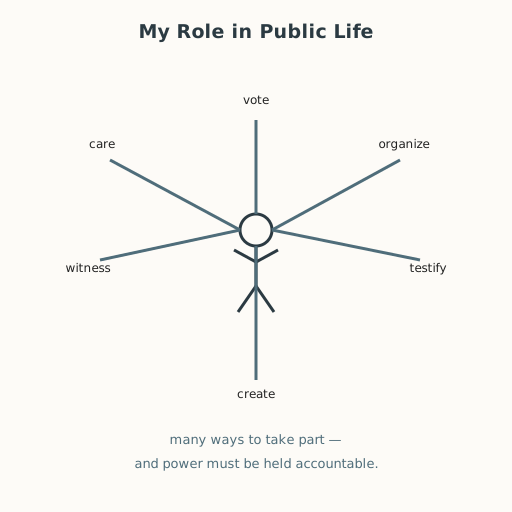
- Pathways-into-public-life sheet · 1 per learner A constellation of participation pathways (vote, organize, testify, create, witness, care, protest, run, teach, report) arranged around 'me at the center'
- Capstone ethics & civic journal · 1 per learner
Low-tech / no-cost
- Blank paper To draw the constellation by hand
- A list of local ways to participate Meetings, councils, groups, and events near the learner
Enriched / lab & device
- A democracy-and-participation data page · 1 per pair V-Dem or similar, to see how participation varies across societies
Works in different contexts
- large-group Brainstorm pathways whole-class, then each learner marks the two they are most likely to take and why
- multi-age Younger learners name one way to take part near home; older learners map pathways and weigh how power is distributed
- self-directed A learner maps the pathways, marks their own likely entries, and writes where they have voice and where they do not
- level-grouped A ready group also names one pathway where power is concentrated and one way citizens hold it accountable
- outdoor-only Walk to where public decisions are made near you (a meeting place, a council building, a notice board) and name one way to take part there
Lesson 11 — My Role in Public Life
Summary
Learners reflect on their role in public life by mapping the many pathways into it — voting, organizing, testifying, creating, witnessing, caring, protesting, running, teaching, reporting — and by noticing that power is unevenly distributed and must be held accountable. They mark the pathways they are most likely to take, and where they have a voice and where they do not, crafting the first sketch of a considered public self.
Objectives
- Reflect on their own role in public life and craft a considered vision of how they will participate to build a more just and sustainable world. (D09.S3.12.02)
Connection
Public life is not only elections and politicians. It is the meeting where a street is decided, the person who speaks up for a neighbor, the artist who makes a problem visible, the volunteer who keeps a shared place alive, the witness who records what happened. Everyone already has a small place in public life; the question is whether we take it up on purpose. Mapping the ways in — and noticing where power sits — is the first step to choosing, rather than drifting into, a public role.
Materials
- Pathways-into-public-life sheet
- Capstone ethics & civic journal
- Low-tech: blank paper; a list of local ways to participate
- Enriched: a democracy-and-participation data page
Preparation
- Copy or draw the constellation sheet; prepare the local list of ways to participate.
- Retrieval: from Lesson 10, acting collectively. Today we widen the frame from one action to a role in public life.
- Frame participation as many pathways, none ranked above the others; every pathway is real, and learners differ in which are open to them.
Facilitator note
This lesson is written to the learner (“you”). The idea to land: public life has many pathways — voting, organizing, testifying, creating, witnessing, caring, protesting, running, teaching, reporting — and no single one is the “real” form of citizenship. Power is unevenly distributed and must be held accountable, and the learner’s role begins by noticing which pathways are open to them and where their own voice is strong or weak. Hold the facts lightly: participation in public decisions is uneven across and within societies (S-461); the Universal Declaration affirms a right to take part in government, directly or through freely chosen representatives (S-149, Article 21); peace, justice, and accountable institutions are a shared global goal (S-463). Do not prescribe any political path or party; the lesson is about how to enter public life, not which cause to serve.
The ethics lens: a public role is a set of responsibilities — to be truthful, to be fair, to listen — and the lesson treats taking up a role as taking up those duties. The egalitarianism lens: power is not only force; it is also the ability to set the agenda and to be heard (S-275), so the lesson asks each learner to notice where their own voice is loud and where it is quiet — and what that means for who else’s voice needs lifting. The global lens: the pathways exist across societies, but they look different everywhere — participation is uneven worldwide (S-461), and no single country’s way is the model; the right to take part is a shared, universal claim (S-149). The technology lens: digital tools have opened new pathways (organizing, witnessing, reporting) while also concentrating who gets seen and who is silenced — and the same tools spread both truth and falsehood, so a public role now includes the duty to check and to be checkable (S-481, S-482, S-278, S-217, S-063). The environment lens: public life includes care for the shared, living world — the person who speaks for a river or a green space is taking part in public life as surely as the person who votes. Preview: Lesson 12 turns the role into a vision of a more just, sustainable world.
Procedure
- Recall (5 min). From Lesson 10, one collective action. Today we widen the frame: from one action to a role in public life.
- Meet the pathways (10 min). Write them around yourself on the sheet: vote, organize, testify, create, witness, care, protest, run, teach, report. Public life is all of these, not only one. No pathway is the “real” one; they are different doors into the same shared life.
- Notice the power (8 min). Write: power is the ability to decide — and to be heard (S-275). In public life, power is uneven: some people’s voices are loud, others are quiet. A role in public life includes asking whose voice is missing here?
- Mark your entries (15 min). Circle the two pathways you are most likely to take, and write one reason for each. Then write honestly: where do I already have a voice, and where is my voice weak or missing? (S-461, S-149)
- Name one duty (10 min). For the pathway you circled first, write one duty it brings — a thing you would owe others if you took it up (truthfulness, fairness, listening, care). A role is not a costume; it is a set of responsibilities.
- Close (7 min). Say — or write, sign, gesture, or use AAC to express — one way you will take part in public life in the next year, and why that one.
Differentiation
- Support: Use a sheet with the pathways pre-printed; the learner circles two and answers with a starter (“I am most likely to… because…; a voice I would need to listen for is…”).
- Extension: Name one pathway where power is concentrated and one concrete way ordinary people hold it accountable, and write which you would take up and why.
- Number access (dyscalculia): This lesson requires no arithmetic. Participation data is offloaded to a pre-printed sheet and read aloud; nothing must be counted, computed, or ordered. The constellation is spatial and word-based, doable in speech, writing, sign, or gesture.
- Communication access: Every spoken step — naming, reading aloud, discussing, or closing — can be done in writing, sign, gesture, or AAC instead. Learners who are non-speaking, d/Deaf, hard-of-hearing, or who use AAC complete every task in their preferred mode; no step requires producing or hearing sound.
Assessment
- Formative (peer + self): Can the learner map the pathways into public life, notice where power and voice are uneven, mark their own likely entries, and name a duty each brings (in speech, writing, sign, or AAC)?
- Portfolio artifact (unit): The completed constellation sheet, opened in the capstone ethics & civic journal — the strand’s “public role” artifact.
Home connection
Ask someone at home: “What is one way you have taken part in public life — a meeting, a vote, a protest, a kindness that changed a shared thing?” Write their answer and yours — one line each.
Resources
- On participation and power across societies: V-Dem — Varieties of Democracy (S-461); Lukes — Power: A Radical View (S-275).
- On the right to take part in government: UN — Universal Declaration of Human Rights, Article 21 (S-149). On peace, justice, and accountable institutions as a shared goal: UN — SDG 16 (S-463).
- On digital public life: Britannica — Social media (S-481); Pariser — The Filter Bubble (S-482); Center for News Literacy (S-278); UNESCO — Media and Information Literacy (S-217); Common Sense Education — News & Media Literacy (S-063).