Lesson 10 — Acting Collectively for a Fairer Common Life
Learners design and carry out a small collective action for a fairer common life: a goal, allies, concrete steps, a clear-eyed look at the likely effects on people and place, and a way to know if it helped. They draw on mutual-aid and cooperative traditions from across cultures (harambee, gotong royong, mink'a, barn-raising, cooperatives) as living evidence that people have always improved the common good by acting together — and they plan one real step they can actually take.
Objectives
Objectives
- D09.S3.12.01 Practice the habits of an engaged citizen by researching an issue, building coalitions, listening across disagreement, and acting collectively toward a fairer common life.
Essential question
How do I design and carry out a small collective action — with goals, allies, steps, and a clear-eyed look at its likely effects — for a fairer common life?
Key vocabulary
Materials
Standard materials
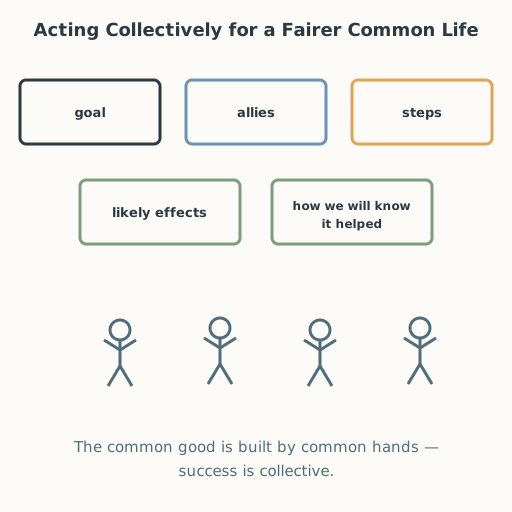
- Collective-action design sheet · 1 per learner Five boxes — the goal, the allies, the steps, the likely effects (for people and place), and how we will know if it helped
- Capstone ethics & civic journal · 1 per learner
Low-tech / no-cost
- Blank paper To draw the design sheet by hand
- A shared local resource to improve A common space, a shared supply, a notice board — something the group can actually act on
Enriched / lab & device
- A planning tool or shared document · 1 per group To coordinate roles, steps, and a check-back
Works in different contexts
- large-group Design one action whole-class for a shared space, then small groups each take one step and report its effect
- multi-age Younger learners name the goal and one step; older learners plan allies, effects, and how to know if it helped
- self-directed A learner designs an action they can carry out with a few others and records its actual effects
- level-grouped A ready group also anticipates one unintended effect and one way to check for it honestly
- outdoor-only Design the action around a real shared place — a path, a water source, a gathering spot — and carry out one step together
Lesson 10 — Acting Collectively for a Fairer Common Life
Summary
Learners design and carry out a small collective action for a fairer common life: a goal, allies, concrete steps, a clear-eyed look at the likely effects on people and place, and a way to know if it helped. They draw on mutual-aid and cooperative traditions from across cultures (harambee, gotong royong, mink’a, barn-raising, cooperatives) as living evidence that people have always improved the common good by acting together — and they plan one real step they can actually take.
Objectives
- Practice the habits of an engaged citizen by researching an issue, building coalitions, listening across disagreement, and acting collectively toward a fairer common life. (D09.S3.12.01)
Connection
Everywhere people live, there is a common life to tend — a shared path, a water source, a market, a school, a neighborhood. And everywhere, people have found the same way to improve it: do it together. When a family in Kenya calls harambee (“all pull together”) to build a school, when neighbors in Indonesia join in gotong royong to raise a hall, when Andean communities work a field by mink’a, they are practicing something universal: the common good is built by common hands. Designing a collective action is just giving that old practice a plan.
Materials
- Collective-action design sheet
- Capstone ethics & civic journal
- Low-tech: blank paper; a shared local resource to improve
- Enriched: a planning tool or shared document
Preparation
- Copy or draw the design sheet; identify a shared local resource the group could actually improve (a common space, a shared supply, a notice board).
- Retrieval: from Lesson 9, the three habits. Today we combine them into one designed action.
- Prepare the mutual-aid examples accurately: harambee (Kenyan self-help), gotong royong (Indonesian mutual assistance), mink’a/minga (Andean communal work), and barn-raising are real, documented traditions of communal work (S-164); cooperatives are a worldwide form of shared ownership (S-486).
Facilitator note
This lesson is written to the learner (“you”). The idea to land: a collective action for a fairer common life is designed, not improvised — a goal, allies, concrete steps, a clear-eyed look at the likely effects on people and place, and a way to know if it helped. People have always built the common good by acting together (mutual-aid traditions and cooperatives), and the learner’s small action joins that old, worldwide pattern. Keep the action real and small enough to actually do; the learning is in the doing and the honest look at effects, not in the scale. Emphasize cooperation over competition (S-147, S-233): success is collective.
The ethics lens: acting for the common good is the strand’s central moral move — from judging what is fair to making something fairer, and then checking honestly whether it worked. The egalitarianism lens: mutual aid is not charity — it is people meeting needs together, as equals, sharing both the giving and the deciding (S-345); the lesson designs actions that build power together rather than handing it down. The global lens: the mutual-aid traditions named — harambee, gotong royong, mink’a, barn-raising — are real and worldwide (S-164), and cooperatives span the globe as shared ownership (S-486, S-487); the learner’s action is one local instance of a human universal. The technology lens: tools (a shared document, a group chat) can coordinate an action across distance, but they can also exclude people who are not online — design must ask who is left out of the tool. The environment lens: the most tangible common goods are often environmental — a clean common space, a shared water supply, a green corner — where acting collectively for fairness and for the Earth are the same act (S-416). Preview: Lesson 11 reflects on the learner’s own role in public life.
Procedure
- Recall (5 min). From Lesson 9, the three habits. Today we combine them into one designed action.
- Meet the pattern (8 min). Write it: people everywhere improve the common good by acting together — harambee in Kenya, gotong royong in Indonesia, mink’a in the Andes, barn-raising, and cooperatives the world over (S-164, S-486). The common good is built by common hands.
- Name the goal (8 min). On the design sheet, choose one small, real improvement to a shared thing — a common space, a shared supply, a rule that could be fairer. Write the goal as a single clear sentence.
- List the allies (8 min). Write who will do it with you — the people who use or care about that common thing, and any group already working there. Name the one shared thing everyone can agree on, even if they differ on much else.
- Plan the steps and the effects (12 min). Write the concrete steps in order. Then look clearly at the likely effects — on people and on the place — including any effect you did not intend. Honesty about effects is part of the action, not a reason to skip it.
- Decide how you will know (8 min). Write one simple way to tell whether it helped — what you will look at afterward, and when.
- Close (6 min). Say — or write, sign, gesture, or use AAC to express — one step you could actually take this week with at least one other person.
Differentiation
- Support: Use a design sheet with the five boxes and starters (“Our goal is…; our allies are…; our first step is…; it might also affect…; we will know it helped if…”).
- Extension: Anticipate one unintended effect and write how you will check for it honestly, and what you would adjust if it appears.
- Number access (dyscalculia): This lesson requires no arithmetic. Ordering the steps is a sequence of words, not numerals; nothing must be counted or computed. The sheet is a word organizer, doable in speech, writing, sign, or gesture.
- Communication access: Every spoken step — naming, reading aloud, planning, discussing, or closing — can be done in writing, sign, gesture, or AAC instead. Learners who are non-speaking, d/Deaf, hard-of-hearing, or who use AAC complete every task in their preferred mode; no step requires producing or hearing sound.
Assessment
- Formative (peer + self): Can the learner design a small collective action — goal, allies, steps, likely effects, and a way to know if it helped — and name one step they can actually take with others (in speech, writing, sign, or AAC)?
- Portfolio artifact (unit): The completed design sheet, added to the capstone ethics & civic journal.
Home connection
With one or two people at home or nearby, do one small thing together for a shared space this week, and write two lines afterward: what you did, and how you could tell whether it helped.
Resources
- On mutual-aid traditions: Communal-work traditions — harambee, gotong royong, mink’a (S-164). On cooperatives: International Cooperative Alliance (S-486); Mondragón Corporation (S-487).
- On mutual aid vs. charity: Spade — Mutual Aid (S-345). On cooperation over competition: Slavin — Cooperative Learning (S-147); Johnson & Johnson — social interdependence (S-233). On governing a commons: Ostrom — Governing the Commons (S-416).