Lesson 13 — Listening, Taking Responsibility, Repairing
Learners practice the habits of a peacemaker — listening to the person harmed, taking responsibility for harm, and repairing it — using a restorative-practice frame of three questions: what happened, who was harmed and how, and what will make it right. They distinguish conflict (disagreement) from violence, and accountability from punishment, and role-play a real or role-played harm in a circle, learning that repair is a practice of listening and responsibility, never retaliation or coercion.
Objectives
Objectives
- D09.S4.12.01 Practice the habits of peacemaking by listening across deep disagreement, taking responsibility for harm, and repairing relationships and communities.
Essential question
When there has been real harm, how do I practice the habits of a peacemaker — listening to the person harmed, taking responsibility for the harm, and repairing it — rather than retaliating or coercing?
Key vocabulary
Materials
Standard materials
- Restorative practice card · 1 per learner Three questions — what happened, who was harmed and how, and what will make it right — with a reminder that the process is repair, never retaliation
- Capstone ethics & civic journal · 1 per learner
Low-tech / no-cost
- A talking object (stone, stick) To pass in the circle so each voice is heard in turn
- Chairs or stones in a circle The circle is the structure; the talking object is the turn
Enriched / lab & device
- A short restorative-justice case summary · 1 per pair A real or role-played harm and how a restorative process addressed it
Works in different contexts
- large-group Model the three questions whole-class on a worked example, then small circles role-play a harm and its repair
- multi-age Younger learners name who was harmed and what would make it right; older learners practice the full listening-taking-responsibility-repairing sequence
- self-directed A learner works the three questions on a real or remembered harm (their own or witnessed), writing what repair would require
- level-grouped A ready group also distinguishes *accountability* (owning the harm) from *punishment*, and reflects on why the process is restorative
- outdoor-only Hold the circle outdoors around a fire or a shared place, and work a real or role-played harm with the talking object
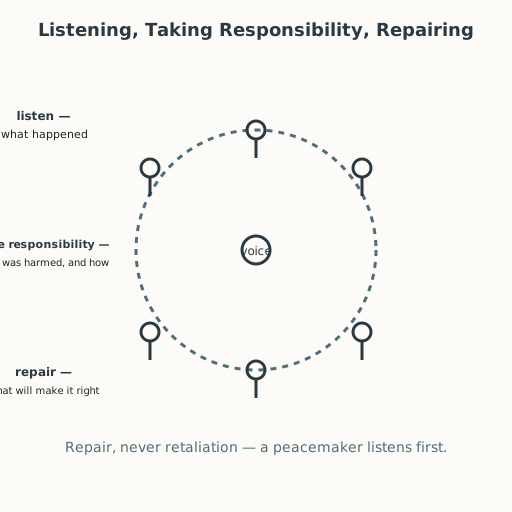
Lesson 13 — Listening, Taking Responsibility, Repairing
Summary
Learners practice the habits of a peacemaker — listening to the person harmed, taking responsibility for harm, and repairing it — using a restorative-practice frame of three questions: what happened, who was harmed and how, and what will make it right. They distinguish conflict (disagreement) from violence, and accountability from punishment, and role-play a real or role-played harm in a circle, learning that repair is a practice of listening and responsibility, never retaliation or coercion.
Objectives
- Practice the habits of peacemaking by listening across deep disagreement, taking responsibility for harm, and repairing relationships and communities. (D09.S4.12.01)
Connection
When harm happens, the easy reflexes are blame and payback — but payback usually leaves the wound open and adds a new one. A peacemaker does something harder: first listen to the person harmed, then own the part that is yours, then work out what would actually make it right. This is not weakness; it is a discipline. It is how a friendship, a family, or a neighborhood mends instead of breaking further — and it is a set of skills anyone can practice, starting in the small harms of everyday life.
Materials
- Restorative practice card
- Capstone ethics & civic journal
- Low-tech: a talking object; chairs or stones in a circle
- Enriched: a short restorative-justice case summary
Preparation
- Copy the restorative practice card; set chairs (or stones) in a circle; prepare the talking object.
- Retrieval: from Grade 11 (D09.S4.11.01), analyzing conflict from multiple perspectives; from earlier grades, active listening, “I” statements, and repair over punishment. Today we practice the full peacemaking sequence.
- Hold the frame accurately: restorative practice responds to harm by repairing it and restoring relationships rather than only punishing (S-022, S-161); conflict (disagreement) is distinct from violence (S-462).
Facilitator note
This lesson is written to the learner (“you”). The idea to land: peacemaking is a discipline of three moves — listen to the person harmed, take responsibility for the harm, and repair it — and it is practiced in a circle with a talking object, through three questions: what happened, who was harmed and how, and what will make it right. Repair is never retaliation and never coercion; accountability (owning the harm) is different from punishment. Model the three questions on a small, low-stakes worked example first (S-011); then let learners role-play a role-played or mildly remembered harm — never a serious or traumatic one, and never one that would re-harm a learner in the room. Hold the circle as a safe structure; the talking object guarantees turn and quiet.
The ethics lens: taking responsibility for harm is the strand’s central moral act — owning what is yours, without being forced — and the lesson treats accountability as a gift one offers, not a penalty one suffers. The egalitarianism lens: the circle equalizes — every voice gets the same turn, the same talking object, the same standing, so the person with the most power cannot simply out-talk the person who was harmed (S-022). The global lens: restorative practice has deep roots in Indigenous peacemaking traditions — circles that aim to restore balance and harmony rather than merely punish — which the field itself acknowledges (S-161); the lesson honors that lineage rather than presenting repair as one culture’s invention. The technology lens: much harm today happens through screens — a cruel post, a leaked image — and repair must ask what “making it right” means when the harm is digital and the wound is public; the same three questions still apply, but the repair may mean taking something down, not just saying something. The environment lens: harm to a shared place — a fouled water source, a damaged common space — is harm to a relationship with the land and the people who use it, and repair can mean restoring the place, not just apologizing to the people. Preview: Lesson 14 reflects on contributing to peace and repair with honesty and hope.
Procedure
- Recall (5 min). From earlier grades, active listening and “I” statements. Today we put them into a peacemaker’s full sequence: listen, take responsibility, repair.
- Meet the three questions (10 min). Write the restorative frame: what happened? who was harmed, and how? what will make it right? (S-022, S-161). Note what it is not: not “who is to blame and how do we pay them back.” Repair, not retaliation.
- Separate two pairs of ideas (8 min). Write them: conflict (disagreement) is not violence — disagreements can be healthy when handled well (S-462). And accountability (owning what you did) is not punishment (making someone suffer). The peacemaker works in the first of each pair.
- Worked example (10 min). Listen to a small, low-stakes example of harm (a broken promise, a cruel word, a shared thing broken). Run the three questions on it aloud: what happened? who was harmed and how? what would make it right?
- Practice in a circle (15 min). In your circle, take a role-played or mildly remembered harm — never a serious or traumatic one. Pass the talking object. Each person, in turn, speaks to the three questions. The person harmed speaks first, and is heard; the person responsible owns their part without being forced; together you name what repair would require.
- Close (7 min). Say — or write, sign, gesture, or use AAC to express — one thing the restorative frame did that blame-and-payback does not.
Differentiation
- Support: Use a pre-written role-play with the three questions printed as starters (“What happened was…; the person harmed was…; what would make it right is…”); the learner fills one line each.
- Extension: Distinguish accountability from punishment in your own words, and write one reason a restorative process can sometimes work better than punishment alone — and one place it is genuinely hard.
- Number access (dyscalculia): This lesson requires no arithmetic. The three questions and the circle are word- and turn-based; nothing must be counted, computed, or ordered. Every step can be done in speech, writing, sign, or gesture.
- Communication access: Every spoken step — naming, reading aloud, speaking in the circle, or closing — can be done in writing, sign, gesture, or AAC instead. Learners who are non-speaking, d/Deaf, hard-of-hearing, or who use AAC complete every task in their preferred mode; the talking object may be passed to a written or signed turn, and no step requires producing or hearing sound.
Assessment
- Formative (peer + self): Can the learner work the three restorative questions — listening to who was harmed, taking responsibility, and naming repair — while distinguishing conflict from violence and accountability from punishment (in speech, writing, sign, or AAC)?
- Portfolio artifact (unit): A short reflection on the practiced repair, opened in the capstone ethics & civic journal — the strand’s “peacemaking practice” artifact.
Home connection
The next time a small harm happens at home or nearby, try the three questions once — what happened, who was harmed and how, what would make it right — and write two lines on what changed.
Resources
- On restorative practice: International Institute for Restorative Practices (S-022); Zehr — Changing Lenses (S-161).
- On nonviolent, needs-based communication: Rosenberg — Nonviolent Communication (S-148).
- On the distinction between conflict and violence: Galtung — Violence, Peace, and Peace Research (S-462). On accountable discussion: Michaels & O’Connor — Accountable Talk (S-238).