Lesson 14 — Contributing to Peace and Repair with Honesty and Hope
Learners close the unit by reflecting on how they can contribute to peace and repair in a divided world — locally and globally — holding *honesty* about what is broken and hard to repair together with *hope* grounded in real agency. They study one real attempt at reconciliation (South Africa's Truth and Reconciliation Commission, which traded some punishment for truth, disclosure, and repair) and write their own contribution, gathering the unit's artifacts into the capstone journal as a record of a person who can disagree, repair, and build — with inquiry, not creed, as their guide.
Objectives
Objectives
- D09.S4.12.02 Reflect on how they can contribute to peace and repair in a divided world, locally and globally, with both honesty and hope.
Essential question
In a divided world, how do I contribute to peace and repair — locally and globally — holding honesty about the harm and the difficulty together with hope, rather than despair or empty optimism?
Key vocabulary
Materials
Standard materials
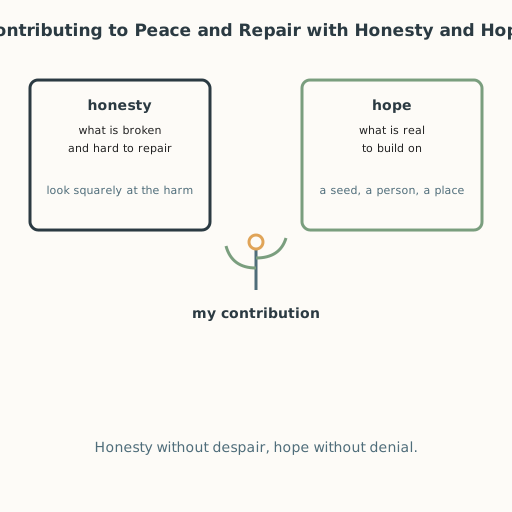
- Honesty-and-hope sheet · 1 per learner Two columns — 'honesty' (what is broken and hard to repair) and 'hope' (what is real to build on) — meeting in a center space for 'my contribution, locally and globally'
- Capstone ethics & civic journal · 1 per learner
Low-tech / no-cost
- Blank paper To draw the two columns by hand
- A small seed or sapling A tangible sign that small beginnings are real and can grow
Enriched / lab & device
- One short account of reconciliation after serious harm · 1 per pair A real case, such as South Africa's Truth and Reconciliation Commission, to see honesty and repair attempted together
Works in different contexts
- large-group Share one honest thing and one hopeful thing whole-class, then each learner writes their own contribution and one person reads theirs aloud
- multi-age Younger learners name one honest and one hopeful thing; older learners write the full contribution locally and globally
- self-directed A learner writes the honesty column, the hope column, and their contribution, then closes the capstone journal
- level-grouped A ready group also names one place honesty and hope seem to conflict, and argues how to hold both without collapsing into either
- outdoor-only Plant a seed or tend a small thing as the lesson's sign of hope, and write the contribution beside it
Lesson 14 — Contributing to Peace and Repair with Honesty and Hope
Summary
Learners close the unit by reflecting on how they can contribute to peace and repair in a divided world — locally and globally — holding honesty about what is broken and hard to repair together with hope grounded in real agency. They study one real attempt at reconciliation (South Africa’s Truth and Reconciliation Commission, which traded some punishment for truth, disclosure, and repair) and write their own contribution, gathering the unit’s artifacts into the capstone journal as a record of a person who can disagree, repair, and build — with inquiry, not creed, as their guide.
Objectives
- Reflect on how they can contribute to peace and repair in a divided world, locally and globally, with both honesty and hope. (D09.S4.12.02)
Connection
It is easy to fall into two opposite traps about a divided world: despair, which says nothing can be fixed, and denial, which says nothing is broken. Neither is honest, and neither is helpful. The harder, truer stance holds both at once — here is what is broken, and here is what is real to build on. That is what peacemakers do: they look squarely at the harm, and they still plant something. Hope is not pretending; hope is seeing a real seed and watering it.
Materials
- Honesty-and-hope sheet
- Capstone ethics & civic journal
- Low-tech: blank paper; a small seed or sapling
- Enriched: a short account of reconciliation after serious harm
Preparation
- Copy or draw the two-column sheet; prepare the reconciliation account.
- Retrieval: from Lesson 13, the three restorative questions; from across the unit, reasoning, weighing, acting, and repairing. Today we close the capstone.
- Hold the case accurately: South Africa’s Truth and Reconciliation Commission (1996–1998), after apartheid, invited public testimony about past abuses and, in defined cases, offered amnesty in exchange for full disclosure, alongside reparations — a real, documented, and contested attempt to trade some punishment for truth and repair (S-392).
Facilitator note
This lesson is written to the learner (“you”). The idea to land: contributing to peace and repair in a divided world means holding honesty (what is broken and hard to repair) together with hope (what is real to build on) — never despair, and never empty optimism. The learner names a concrete contribution, locally and globally, and the unit’s artifacts are gathered as a record of a person who can disagree, repair, and build — with inquiry, not creed, as their guide. Hold the case accurately and with care (S-392); present it as one real, contested attempt, not a perfect model. Do not prescribe what any learner’s contribution must be; the skill is that it is honest and hopeful at once.
The ethics lens: honesty about harm is itself a moral commitment — reconciliation begins with the truth of what happened, and the TRC’s trade of punishment for disclosure is a real ethical choice with real strengths and limits (S-392), held as a question, not a verdict. The egalitarianism lens: peace that papers over the imbalance between the powerful and the harmed is not peace — repair must center the people who were harmed, and a contribution that ignores power is only a wish. The global lens: reconciliation and repair are attempted worldwide — the TRC is one documented case, and humanitarian neutrality (the Red Cross and Red Crescent movement) is another real, global form of serving people in conflict regardless of side (S-329, S-392); neither is a universal template, and both are held as examples to learn from. The technology lens: in a connected world, both harm and repair now travel instantly — a lie can go global in seconds, and so can a truth or a gesture of repair — so a contribution must consider the tools it uses and who they reach (S-481, S-482). The environment lens: peace with one another is incomplete without peace with the living world — repairing a divided Earth is part of repairing a divided humanity, and a hopeful contribution can be as small and real as tending one place. Close: gather the unit’s artifacts into the capstone journal.
Procedure
- Recall (5 min). From Lesson 13, the three restorative questions. Today we ask the final question: how do I contribute — with honesty and hope?
- Meet the two traps (8 min). Write them: despair (nothing can be fixed) and denial (nothing is broken). Both are escapes. The peacemaker’s stance holds both truths at once: here is what is broken, and here is what is real to build on.
- Study one real attempt (12 min). Read about South Africa’s Truth and Reconciliation Commission: after apartheid, it invited public testimony about past abuses and, in defined cases, offered amnesty in exchange for full disclosure, alongside reparations (S-392). Notice the honesty (naming the harm in public) and the hope (building a shared future). Notice too that it was contested — some said too little punishment, others too little repair. Hold it as a question, not a perfect model.
- Write the two columns (12 min). On your sheet, write one honest thing (what is broken and hard to repair, in your world or the wider one) and one hopeful thing (what is real to build on — a person, a group, a practice, a place). Keep both true; do not let either erase the other.
- Name your contribution (12 min). In the center space, write your contribution — one thing, local and one thing, global — that you can actually offer to peace and repair. Make it as concrete as you can, and let it grow from both columns.
- Gather the capstone (6 min). Open your journal. Look back over the unit’s artifacts — the dilemma, the defended position, the values map, the action, the vision, the repair. Write one closing line: the kind of citizen you intend to be.
- Close (0 min). Say — or write, sign, gesture, or use AAC to express — one honest and one hopeful thing, and the contribution that joins them.
Differentiation
- Support: Use a sheet with starters (“One honest thing is…; one hopeful thing is…; my contribution locally is…, and globally is…”).
- Extension: Name one place honesty and hope seem to conflict (for example, telling a hard truth that might discourage people), and argue how you would hold both without collapsing into despair or denial.
- Number access (dyscalculia): This lesson requires no arithmetic. The dates (1996–1998) are pre-printed and read aloud; nothing must be counted, computed, or ordered. The two-column sheet is word-based, doable in speech, writing, sign, or gesture.
- Communication access: Every spoken step — naming, reading aloud, discussing, or closing — can be done in writing, sign, gesture, or AAC instead. Learners who are non-speaking, d/Deaf, hard-of-hearing, or who use AAC complete every task in their preferred mode; no step requires producing or hearing sound. The case may be provided in print, braille, or audio description.
Assessment
- Formative (peer + self): Can the learner name an honest and a hopeful truth, and write a concrete contribution to peace and repair locally and globally, without collapsing into despair or denial (in speech, writing, sign, or AAC)?
- Portfolio artifact (unit capstone): The completed honesty-and-hope sheet and the closing reflection, gathered with the unit’s other artifacts into the capstone ethics & civic journal.
Home connection
Ask someone at home: “What is one thing that gives you hope for a more peaceful world, and one thing that still needs repair?” Write both, and add one line on what you could do about the second.
Resources
- On reconciliation after serious harm: Encyclopaedia Britannica — Truth and Reconciliation Commission, South Africa (S-392).
- On humanitarian service across conflict: IFRC — Red Cross and Red Crescent Movement (S-329).
- On peace, justice, and strong institutions as a shared goal: UN — SDG 16 (S-463). On the roots of conflict and the meaning of peace: Galtung — Violence, Peace, and Peace Research (S-462). On restorative justice: Zehr — Changing Lenses (S-161).