Lesson 03 — What Technology Gives and Costs
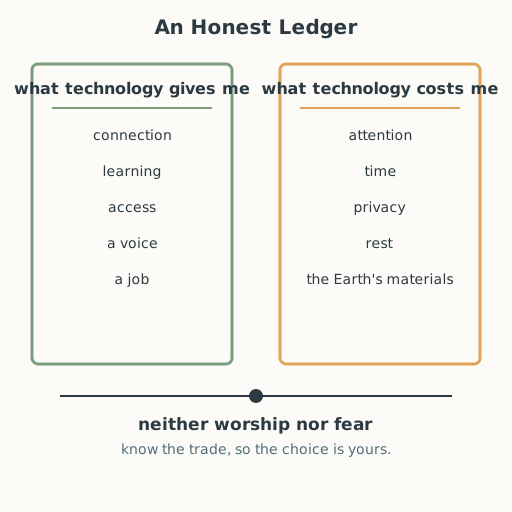
Learners turn the systems lens on their own lives, building an honest two-column ledger of what technology gives them (connection, learning, access) and what it costs them (attention, time, privacy, rest, and — for the Earth — materials and waste). They learn the idea of opportunity cost and practice looking at their own relationship with technology without worship and without fear, as the first step toward choosing stewardship in Lesson 4.
Objectives
Objectives
- D10.S1.12.02 Reflect on their own relationship with technology — what it gives and what it costs — and how they will use it as a steward rather than a consumer.
Essential question
What does my relationship with technology actually give me, and what does it cost me — and how do I look at both honestly, without worship or fear?
Key vocabulary
Materials
Standard materials
- Gives-and-costs ledger · 1 per learner Two columns — 'what technology gives me' and 'what technology costs me' — with rows for connection, learning, attention, time, privacy, and rest
- Capstone technology & Earth journal · 1 per learner
Low-tech / no-cost
- Blank paper To draw the two-column ledger by hand
- A one-day memory of your own device use The learner's own honest recollection, no app required
Enriched / lab & device
- A screen-time or attention-tracking tool · 1 per learner Optional, to add data to the honest ledger
Works in different contexts
- large-group Build a shared ledger on the board first, then each learner makes their own private ledger
- multi-age Younger learners name one give and one cost; older learners weigh attention, privacy, and opportunity cost
- self-directed A learner completes a private ledger and writes one honest reflection on a cost they had not named
- level-grouped A ready group also identifies the *opportunity cost* of one habitual use — what else that time could have been
- outdoor-only Compare a device-based hour with an hour outdoors, and name what each gives and costs
Lesson 3 — What Technology Gives and Costs
Summary
Learners turn the systems lens on their own lives, building an honest two-column ledger of what technology gives them (connection, learning, access) and what it costs them (attention, time, privacy, rest, and — for the Earth — materials and waste). They learn the idea of opportunity cost and practice looking at their own relationship with technology without worship and without fear, as the first step toward choosing stewardship in Lesson 4.
Objectives
- Reflect on their own relationship with technology — what it gives and what it costs — and how they will use it as a steward rather than a consumer. (D10.S1.12.02)
Connection
You already keep a running account of this relationship, even if you have never written it down. The phone that lets you reach a faraway friend also eats an hour you meant to sleep. The app that teaches you a new language also harvests your attention and your data. An honest look at both columns is not about guilt and not about worship — it is about knowing what you are actually trading, so the choice is yours rather than the machine’s.
Materials
- Gives-and-costs ledger
- Capstone technology & Earth journal
- Low-tech: blank paper; your own memory of one day’s device use
- Enriched: a screen-time or attention-tracking tool
Preparation
- Copy or draw the two-column ledger.
- Retrieval: from Lessons 1–2, technology as a system and the argument for a direction. Today the system under the lens is your own relationship.
- Frame the goal as honesty, not shame: naming a cost is information, never a verdict.
Facilitator note
This lesson is written to the learner (“you”). The idea to land: my relationship with technology has real gifts and real costs, and I can name both honestly — attention, time, privacy, rest, and the Earth’s materials — so that my use is a choice, not a reflex. Keep the “neither worship nor fear” stance: the point is a clear-eyed ledger, not a guilt trip and not a love letter. Respect privacy — learners record only what they choose to share.
The ethics lens: the cost side of the ledger is where unnoticed trade-offs live, and ethics is partly the discipline of noticing what we are giving up before we consent to give it. The egalitarianism lens: the ledger looks different by circumstance — a person who needs a screen for school or for accessibility gives and receives differently from one who uses it only for leisure — so no one’s ledger is judged against another’s (S-281). The global lens: the “cost” column extends beyond the user to people far away — the miner of cobalt, the worker at the recycling yard — whose lives carry costs the user’s screen does not show (S-398, S-397). The technology lens: some costs are designed — feeds ranked for engagement hold attention on purpose, and personalization can quietly narrow what a person sees (S-481, S-482). The environment lens: the cost column has an Earth-sized line — every device is made of mined materials and becomes e-waste — so a full ledger includes what the planet pays (S-397). Preview: Lesson 4 turns the honest ledger into a choice — steward, not consumer.
Procedure
- Recall (5 min). From Lessons 1–2, what you learned about technology as a system. Today the system you will map is your own relationship with technology.
- Draw the ledger (8 min). Make two columns: what technology gives me and what technology costs me. Leave rows for connection, learning, access, attention, time, privacy, and rest.
- Fill the gifts (10 min). In the left column, write what you genuinely receive — reaching people far away, learning a skill, finding information, a job, a voice. Be specific and honest; these are real.
- Fill the costs (12 min). In the right column, write what you genuinely pay — attention pulled away, sleep lost, time not spent elsewhere, data given up, the pull to compare, the quiet narrowing of what you see (S-482). Add one cost the Earth pays: the materials and the e-waste behind the device (S-397).
- Name an opportunity cost (10 min). Choose one habitual use and write what else that time could have been — reading, sleeping, talking, walking, making. An opportunity cost is the next-best thing you gave up.
- Pair-check (8 min). With a partner, share only what you choose. Ask: is the ledger honest on both sides — no worship, no fear? Give one reflection, not a grade.
- Close (2 min). Say — or write, sign, gesture, or use AAC to express — one thing you learned about your own relationship that you did not see before.
Differentiation
- Support: Use a pre-drawn ledger with the seven rows labeled, and fill one phrase per cell; gifts and costs may be named aloud, written, or gestured.
- Extension: Write one design question about a cost you found — “why is this feature so hard to put down?” — and connect it to Lesson 2’s argument about direction.
- Number access (dyscalculia): The lesson requires no arithmetic; the ledger is a word organizer. Time and attention are described in words (“an hour,” “a lot,” “a little”), not measured or calculated.
- Communication access: Every spoken step — saying, reading aloud, discussing, or closing — can be done in writing, sign, gesture, or AAC instead. Learners who are non-speaking, d/Deaf, hard-of-hearing, or who use AAC complete every task in their preferred mode; no step requires producing or hearing sound.
Assessment
- Formative (self + peer): Can the learner name real gifts and real costs of their own technology use — including attention, time, privacy, and the Earth’s materials — without worship and without fear?
- Portfolio artifact (unit): The completed gives-and-costs ledger, opened in the capstone technology & Earth journal.
Home connection
For one evening, leave one device in another room for an hour and notice what you do with the time. Write one sentence about what you noticed.
Resources
- On feeds designed for engagement and personalization: Encyclopaedia Britannica — Social media (S-481); Pariser — The Filter Bubble (S-482).
- On the hidden costs in the supply chain: Amnesty International — cobalt (S-398); WHO e-waste fact sheet (S-397).
- On unequal access: World Bank WDR 2016 — Digital Dividends (S-281); on media’s effects on development: Common Sense Media Research Program (S-226).