Lesson 04 — Steward, Not Consumer
Learners distinguish a consumer — who takes, uses, and discards — from a steward, who chooses carefully, uses mindfully, repairs, shares, and cares so that others, present and future, can also use and live well. They apply the distinction to technology itself, deciding how they will use tools in service of people and the living Earth, and write one concrete personal commitment.
Objectives
Objectives
- D10.S1.12.02 Reflect on their own relationship with technology — what it gives and what it costs — and how they will use it as a steward rather than a consumer.
Essential question
How do I move from consuming technology to stewarding it — choosing, using, repairing, and caring for tools so that they serve people and the living Earth, now and later?
Key vocabulary
Materials
Standard materials
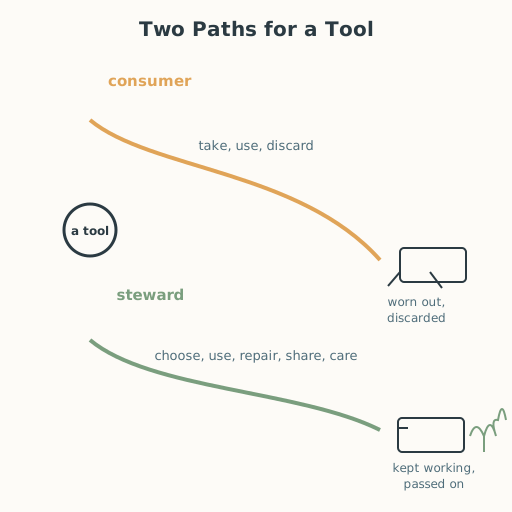
- Steward-or-consumer choice sheet · 1 per learner Two paths: a consumer path (take, use, discard) and a steward path (choose, use, repair, share, care) with a place for one personal commitment
- Capstone technology & Earth journal · 1 per learner
Low-tech / no-cost
- Blank paper To draw the two paths by hand
- A broken or worn object Any object that could be repaired rather than replaced
Enriched / lab & device
- A repair guide or a local repair café listing · 1 per pair To see repair as a real, practiced alternative to replacement
Works in different contexts
- large-group Sort shared examples into the two paths whole-class, then each learner writes one personal commitment
- multi-age Younger learners name one thing they can repair or share; older learners add the "commons" and "care" reasoning
- self-directed A learner chooses one technology in their life and writes one concrete steward commitment
- level-grouped A ready group also designs one small rule or habit for a shared resource (a device, a tool library, a water supply)
- outdoor-only Choose a shared outdoor resource — a well, a garden, a path — and name one steward act for it
Lesson 4 — Steward, Not Consumer
Summary
Learners distinguish a consumer — who takes, uses, and discards — from a steward, who chooses carefully, uses mindfully, repairs, shares, and cares so that others, present and future, can also use and live well. They apply the distinction to technology itself, deciding how they will use tools in service of people and the living Earth, and write one concrete personal commitment.
Objectives
- Reflect on their own relationship with technology — what it gives and what it costs — and how they will use it as a steward rather than a consumer. (D10.S1.12.02)
Connection
Two people can own the same tool. One uses it up and throws it away the moment it slows down; the other mends it, shares it, and leaves it working for the next person. The tool is the same; the relationship is different. A consumer treats a thing as something to be spent; a steward treats it as something to be kept. The difference is a choice you make, not a price you pay.
Materials
- Steward-or-consumer choice sheet
- Capstone technology & Earth journal
- Low-tech: blank paper; a broken or worn object
- Enriched: a repair guide or a local repair café listing
Preparation
- Copy or draw the two-path sheet.
- Retrieval: from Lesson 3, your gives-and-costs ledger. Today we choose a relationship.
- Frame stewardship as care, not sacrifice: a steward keeps more of what they value, longer.
Facilitator note
This lesson is written to the learner (“you”). The idea to land: a consumer uses things up; a steward keeps them working and passing them on — and stewardship of technology means choosing, repairing, sharing, and caring so tools serve people and the living Earth now and later. This is the strand’s turn from reflection to commitment. Do not grade the size of the commitment; a small, real act of care is worth more than a grand vow.
The ethics lens: stewardship is an ethics of relationship — a thing, a tool, or a resource is treated as something owed care, not something owed to me alone. The egalitarianism lens: consumption in one place is often subsidized by labor and land elsewhere — the miner, the recycling yard — and stewardship asks whose cost I am quietly spending (S-398, S-397). The global lens: stewardship is not one culture’s idea — communities worldwide have long managed shared resources by common rules so they last (the commons), a pattern documented across societies (S-416). The technology lens: tools can be designed for stewardship — repair, reuse, and returning materials to the loop rather than disposal — which is what a circular economy means (S-452, S-371). The environment lens: the steward path is the one that matches the Earth’s limits — using things so that what is taken today does not rob tomorrow, the core idea of sustainable development (S-395). Preview: Lesson 5 shifts from tools to media — creating it responsibly.
Procedure
- Recall (5 min). From Lesson 3, one cost you named in your ledger. Today we choose what to do about it.
- Learn the two paths (10 min). A consumer takes, uses, and discards. A steward chooses carefully, uses mindfully, repairs, shares, and cares. Say — or write, sign, gesture, or use AAC to show — the difference in your own words.
- Sort examples (10 min). With a partner, sort everyday acts into the two paths: buying a new phone the moment one is released versus repairing a cracked screen; discarding a broken kettle versus mending it or lending a working one. Ask: which path keeps more for more people, for longer?
- Apply to technology (15 min). Choose one technology from your own life. Write one steward act for it — choose a durable option, use it with a limit, repair before replacing, share it, or choose a tool that helps people and the living Earth. Name one rule of a commons: a shared resource (a tool library, a device, a water supply) kept by common rules so it lasts (S-416).
- Write the commitment (10 min). Write one concrete, doable commitment as a verb with a when: “I will repair… before replacing it”; “I will set… as a limit”; “I will share… with…”.
- Close (5 min). Say — or write, sign, gesture, or use AAC to express — one sentence: “I will use technology as a steward by…” and finish it.
Differentiation
- Support: Use the two-path sheet with pre-labeled boxes and starters (“I will repair…; I will share…; I will set a limit of…”); the learner fills one line.
- Extension: Design one small rule for a real shared resource (a device, a tool library, a water supply) that would keep it fair and lasting, and say how the rule could be changed if it stops working.
- Number access (dyscalculia): The lesson requires no arithmetic. The two-path sheet is a word organizer, doable in speech, writing, sign, or gesture; no step requires counting, ordering, or calculating.
- Communication access: Every spoken step — saying, reading aloud, discussing, or closing — can be done in writing, sign, gesture, or AAC instead. Learners who are non-speaking, d/Deaf, hard-of-hearing, or who use AAC complete every task in their preferred mode; no step requires producing or hearing sound.
Assessment
- Formative (self + peer): Can the learner distinguish consumer from steward and write one concrete, doable stewardship commitment for a technology in their own life?
- Portfolio artifact (unit): The completed two-path sheet with the personal commitment, opened in the capstone technology & Earth journal.
Home connection
Find one thing at home that is worn or broken but could be repaired or shared. Ask a family member how it could be kept in use. Write one sentence about what you decided.
Resources
- On sustainable development and not robbing the future: Brundtland Report — Our Common Future (S-395); on caring for the Earth through education: UNESCO — Education for Sustainable Development (S-004).
- On the commons and shared rules: Ostrom — Governing the Commons (S-416); on the circular economy: Ellen MacArthur Foundation (S-452); on a product’s life cycle: EPA — Sustainable Materials Management (S-371).
- On the hidden costs of consumption: Amnesty International — cobalt (S-398); WHO e-waste (S-397).