Lesson 05 — Responsible Media Creation
Learners begin to create media responsibly. They learn three tests for a message they make — accuracy, fairness, and honesty about sources — and the five core questions of media literacy (who created it, what techniques attract attention, what is omitted, who benefits, and for what purpose). They plan and draft one real message about a real issue, then check it against the tests, preparing to deepen the craft in Lesson 6.
Objectives
Objectives
- D10.S2.12.01 Practice responsible media creation by making and sharing a message that is accurate, fair, and honest about its sources.
Essential question
How do I make and share a message that is accurate, fair, and honest about its sources — so that what I put into the world informs rather than misleads?
Key vocabulary
Materials
Standard materials
- Responsible-message checklist · 1 per learner Three tests — accurate? fair? honest about sources? — plus the five core questions (who created it, what techniques, what is omitted, who benefits)
- Capstone technology & Earth journal · 1 per learner
Low-tech / no-cost
- Blank paper and markers To draft a poster or a hand-written message
- A real local issue Something the learner can describe accurately and fairly
Enriched / lab & device
- A device for drafting and sharing · 1 per pair To draft a short post, a caption, or a news summary
Works in different contexts
- large-group Draft one shared message whole-class, then each learner drafts their own and pairs check with the three tests
- multi-age Younger learners make one accurate claim with a source; older learners add fairness across perspectives and full attribution
- self-directed A learner drafts a message and checks it against the three tests and five questions
- level-grouped A ready group also identifies one thing their message *omits* and whether that omission is honest
- outdoor-only Create a message about a real local place or resource, drawn or written by hand
Lesson 5 — Responsible Media Creation
Summary
Learners begin to create media responsibly. They learn three tests for a message they make — accuracy, fairness, and honesty about sources — and the five core questions of media literacy (who created it, what techniques attract attention, what is omitted, who benefits, and for what purpose). They plan and draft one real message about a real issue, then check it against the tests, preparing to deepen the craft in Lesson 6.
Objectives
- Practice responsible media creation by making and sharing a message that is accurate, fair, and honest about its sources. (D10.S2.12.01)
Connection
Every message you send — a post, a poster, a text, a photo caption — becomes part of what other people know and feel. A message that is accurate, fair, and honest about its sources adds light; a careless one adds fog. Being a creator carries the same responsibility as being a reader: you are helping build the shared picture of the world, so the picture should be true.
Materials
- Responsible-message checklist
- Capstone technology & Earth journal
- Low-tech: blank paper and markers; a real local issue
- Enriched: a device for drafting and sharing
Preparation
- Copy or draw the checklist (three tests + five questions).
- Retrieval: from Grade 11 (D10.S2.11.01), propaganda and manipulation; from D10.S2.11.02, the responsibilities of creators when information spreads harm. Today we practice the creator’s side.
- Prepare a short example message to test together (S-011).
Facilitator note
This lesson is written to the learner (“you”). The idea to land: responsible media creation means three tests — accurate, fair, honest about sources — guided by five questions: who created it, what techniques attract attention, what is omitted, who benefits, and for what purpose. Model checking a message against the tests, then let learners draft their own (S-011). Frame this as craft and ethics, not censorship: the goal is truthfulness, not self-silencing.
The ethics lens: the creator’s ethics is honesty — saying only what is true, showing the other side fairly, and telling readers where the information came from, so they can check it for themselves. The egalitarianism lens: fairness means not flattening anyone into a caricature — a message that shows only one story of a person or a place risks the “single story” that narrows how they are seen (S-417). The global lens: responsible creation is a global skill — UNESCO’s media and information literacy frames the right and duty to create and share information critically and ethically across cultures (S-217). The technology lens: the tools that let anyone publish also let a message spread far and fast, which raises the stakes of the three tests rather than lowering them (S-481). The environment lens: media is how people learn about the living Earth — an accurate, fair message about a river or a forest can move people to care, while a false one can do real harm to the place and the people who depend on it (S-004). Preview: Lesson 6 turns the three tests into careful practice — verifying facts, representing others fairly, and attributing sources precisely.
Procedure
- Recall (5 min). From Grade 11, one way information manipulation works. Today you are on the making side, and the task is to inform, not manipulate.
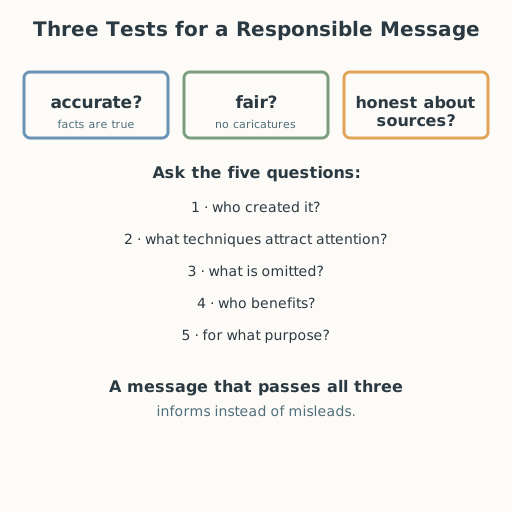
- Learn the three tests (10 min). A responsible message is accurate (facts are true), fair (it represents people and views honestly, not as caricatures), and honest about its sources (it says where its information came from). Say — or write, sign, gesture, or use AAC to show — the three tests in your own words.
- Learn the five questions (10 min). For any message, ask: who created it? what techniques attract attention? what is omitted? who benefits? for what purpose? These questions work for the messages you read and the ones you make (S-442).
- Draft a message (20 min). Choose a real issue you care about — a local one if you can. Decide your purpose and audience, then draft a short message: a poster, a caption, a post, or a news summary. Keep it accurate, represent any other side fairly, and note where your facts came from.
- Self-check (10 min). Run your draft through the three tests and five questions. Fix anything that is inaccurate, unfair, or missing its source.
Differentiation
- Support: Use a template with the three tests as checkboxes and starters (“This message says…; the facts came from…; the other side is…”); the learner fills one line each.
- Extension: Identify one thing your message omits, decide whether the omission is honest or misleading, and either include it or say why you left it out.
- Number access (dyscalculia): The lesson requires no arithmetic; any figures used in a message may be written in words (“many,” “a small number”) or quoted exactly from a source, with no computation required.
- Communication access: Every spoken step — saying, reading aloud, discussing, or self-checking — can be done in writing, sign, gesture, or AAC instead. Learners who are non-speaking, d/Deaf, hard-of-hearing, or who use AAC complete every task in their preferred mode; no step requires producing or hearing sound.
Assessment
- Formative (self + peer): Can the learner draft a message that is accurate, fair, and honest about its sources, and can they name who created it, what is omitted, and who benefits?
- Portfolio artifact (unit): The drafted message with its three-test self-check, opened in the capstone technology & Earth journal.
Home connection
Show your draft to someone at home and ask: is it accurate? is it fair? would you trust it? Note one change they suggest.
Resources
- On the five core questions: Center for Media Literacy — Five Core Concepts (S-442); on fact vs. opinion and bias vs. fairness: Center for News Literacy (S-278).
- On media and information literacy as a global framework: UNESCO — MIL (S-217); on media literacy for learners: Common Sense Education (S-063).
- On the danger of a single story: Adichie (S-417); on worked examples: Kirschner, Sweller & Clark (2006) (S-011).