Lesson 06 — Accurate, Fair, Honest About Sources
Learners deepen Lesson 5's draft into a genuinely responsible message. They verify each fact against a second, independent source; represent any opposing view fairly rather than as a straw figure; and attribute every claim precisely (who said it, where, and when). They revise and peer-check, learning that accuracy, fairness, and honest sourcing are habits of craft, not one-time gestures.
Objectives
Objectives
- D10.S2.12.01 Practice responsible media creation by making and sharing a message that is accurate, fair, and honest about its sources.
Essential question
How do I make my message truly accurate, truly fair, and truly honest about its sources — verifying facts, representing others fairly, and attributing precisely?
Key vocabulary
Materials
Standard materials
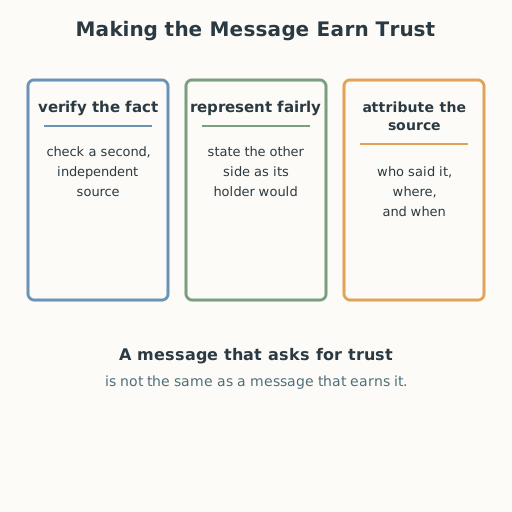
- Verification-and-attribution sheet · 1 per learner Three columns — verify the fact, represent the other side fairly, attribute the source (who, where, when) — for revising the Lesson 5 draft
- Capstone technology & Earth journal · 1 per learner
Low-tech / no-cost
- Blank paper To revise the draft by hand
- Two real sources Any two independent sources (a book, a person, a notice, a broadcast) on the same issue
Enriched / lab & device
- A device with an internet browser · 1 per pair To trace a claim to its original source and check a second, independent source
Works in different contexts
- large-group Revise one shared message whole-class, then each learner revises their own and pairs verify
- multi-age Younger learners verify one fact against a second source; older learners add fairness and precise attribution
- self-directed A learner revises their draft, verifies each fact against a second source, and attributes every claim
- level-grouped A ready group also rewrites one line that was a straw figure into a fair statement of the actual view
- outdoor-only Verify a claim about a local place by checking it against a second source — a person, a sign, a record
Lesson 6 — Accurate, Fair, Honest About Sources
Summary
Learners deepen Lesson 5’s draft into a genuinely responsible message. They verify each fact against a second, independent source; represent any opposing view fairly rather than as a straw figure; and attribute every claim precisely (who said it, where, and when). They revise and peer-check, learning that accuracy, fairness, and honest sourcing are habits of craft, not one-time gestures.
Objectives
- Practice responsible media creation by making and sharing a message that is accurate, fair, and honest about its sources. (D10.S2.12.01)
Connection
Two messages can say the same thing and be different in honesty. One says “studies show…” and stops there; the other says which study, who ran it, and where to find it. One describes an opponent as “obviously wrong”; the other states what the opponent actually argues, fairly, before answering it. Accuracy, fairness, and honest sourcing are the difference between a message that asks for trust and a message that earns it.
Materials
- Verification-and-attribution sheet
- Capstone technology & Earth journal
- Low-tech: blank paper; two real sources
- Enriched: a device with an internet browser
Preparation
- Copy or draw the three-column revision sheet.
- Retrieval: from Lesson 5, your draft message and its self-check. Today we make it truly accurate, fair, and sourced.
- Prepare a worked example of one revision (verify, represent, attribute) to model first (S-011).
Facilitator note
This lesson is written to the learner (“you”). The idea to land: accuracy means verifying a fact against a second, independent source; fairness means representing another view as its holder would, not as a straw figure; honesty about sources means attributing — who said it, where, and when. Model one revision explicitly, then let learners revise their own (S-011). Frame verification as a habit, not a perfection — no one catches everything, which is exactly why checking matters.
The ethics lens: honesty about sources is a respect for the reader’s freedom — it lets them follow your evidence and decide for themselves, rather than taking your word. The egalitarianism lens: fairness is an equal-respect test — you describe the view you disagree with as carefully as the one you hold, because the people who hold it deserve the same care you want for yours (S-278). The global lens: the verification habit — tracing a claim to its origin and checking independent reporting — is the same discipline fact-checkers use across languages and countries (S-394). The technology lens: altered and synthetic media (such as deepfakes) make verification harder, so the habits of tracing and checking become more important, not less (S-393). The environment lens: environmental claims are among the most shared and the most distorted online, so an accurate, well-sourced message about a real place or resource is a genuine act of stewardship (S-004). Preview: Lesson 7 turns from making media to staying informed in the flood.
Procedure
- Recall (5 min). From Lesson 5, your draft message and the three tests. Today we make each test rigorous.
- Verify the facts (15 min). Take each factual claim in your draft and check it against a second, independent source (S-394). If two sources agree, keep it; if they disagree or you cannot find a second, soften or remove it. Say — or write, sign, gesture, or use AAC to show — one fact you verified and how.
- Represent fairly (15 min). Find any place your message describes an opposing view or person. Rewrite it so the holder of that view would agree with your description — no straw figures. State their strongest point, not the weakest, then answer it.
- Attribute the source (10 min). For every claim, write who said it, where it appeared, and when. A precise attribution is the mark of honest sourcing.
- Peer-check (10 min). Trade revised drafts. Ask: is each fact verifiable against a second source? is the other side stated fairly? is every claim attributed? Give one specific suggestion.
Differentiation
- Support: Use the three-column sheet with starters (“The fact is…; my second source is…; the other side says…; the source is (who, where, when)…”); the learner fills one line each.
- Extension: For one contested claim, find two sources that disagree, say what each gets right, and state what you can and cannot conclude from the disagreement.
- Number access (dyscalculia): The lesson requires no arithmetic; any figures are quoted exactly from a source or described in words. Provide a pre-printed attribution table so the learner fills in who/where/when without computing or ordering numbers.
- Communication access: Every spoken step — saying, reading aloud, discussing, or peer-checking — can be done in writing, sign, gesture, or AAC instead. Learners who are non-speaking, d/Deaf, hard-of-hearing, or who use AAC complete every task in their preferred mode; no step requires producing or hearing sound.
Assessment
- Formative (self + peer): Can the learner verify a fact against a second source, represent an opposing view fairly, and attribute a claim precisely (who, where, when)?
- Portfolio artifact (unit): The revised message with verified facts and attributions, opened in the capstone technology & Earth journal.
Home connection
Take one claim from your message and show a family member both your first and second source. Ask them if the claim now feels earned. Write one sentence about what they said.
Resources
- On verification habits: First Draft — Verifying Online Information (S-394); on synthetic media: WITNESS — Prepare, Don’t Panic (S-393).
- On bias vs. fairness in news: Center for News Literacy (S-278); on media and information literacy: UNESCO — MIL (S-217); on the five core questions: Center for Media Literacy (S-442).
- On worked examples: Kirschner, Sweller & Clark (2006) (S-011).