Lesson 07 — Staying Informed in a Flood of Information
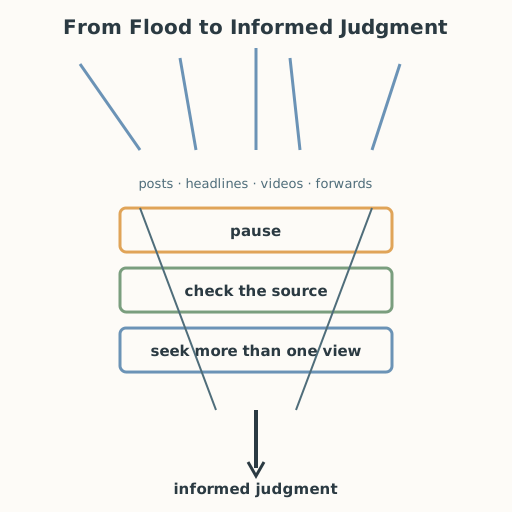
Learners reflect on how to stay informed without drowning or being manipulated. They learn how algorithmic feeds can narrow what they see (the filter bubble), distinguish misinformation (false by mistake) from disinformation (false on purpose), and design a personal media diet: pause before sharing, check the source, seek more than one view, and choose a balanced mix.
Objectives
Objectives
- D10.S2.12.02 Reflect on how they will stay informed in a flood of information, holding claims open to evidence rather than settling into certainty.
Essential question
How do I stay informed in a flood of information — without drowning in it, being narrowed by it, or spreading what is false?
Key vocabulary
Materials
Standard materials
- My-media-diet plan · 1 per learner A plan: pause before sharing, check the source, seek more than one view, and choose a balanced mix of sources
- Capstone technology & Earth journal · 1 per learner
Low-tech / no-cost
- Blank paper To write the media-diet plan by hand
- A list of local and wider sources Broadcasts, papers, community notices, and people with direct knowledge
Enriched / lab & device
- A device with an internet browser · 1 per pair To practice checking a claim against independent reporting
Works in different contexts
- large-group Build one shared media-diet plan whole-class, then each learner drafts their own and pairs check it
- multi-age Younger learners practice one habit (pause before sharing); older learners add source-checking and diversification
- self-directed A learner writes a personal media-diet plan with a pause-check-diversify routine
- level-grouped A ready group also distinguishes misinformation (a mistake) from disinformation (deliberate), with an example of each
- outdoor-only Contrast a screen's flood with direct observation of a local place, and name what each tells you
Lesson 7 — Staying Informed in a Flood of Information
Summary
Learners reflect on how to stay informed without drowning or being manipulated. They learn how algorithmic feeds can narrow what they see (the filter bubble), distinguish misinformation (false by mistake) from disinformation (false on purpose), and design a personal media diet: pause before sharing, check the source, seek more than one view, and choose a balanced mix.
Objectives
- Reflect on how they will stay informed in a flood of information, holding claims open to evidence rather than settling into certainty. (D10.S2.12.02)
Connection
You are not a passive receiver of “the news” — you are a curator. Every day a flood of posts, headlines, videos, and forwarded messages pours past you, and the mix you end up seeing is shaped partly by the apps and partly by your own choices. Staying informed is not about consuming everything; it is about choosing, checking, and pausing, so that what reaches your mind is true and varied rather than just loud and familiar.
Materials
- My-media-diet plan
- Capstone technology & Earth journal
- Low-tech: blank paper; a list of local and wider sources
- Enriched: a device with an internet browser
Preparation
- Copy or draw the media-diet plan.
- Retrieval: from Lessons 5–6, the three tests and the verification habit. Today we apply them to staying informed, not just making media.
- Frame the goal as balance, not paranoia: the aim is a media diet you can keep, not a world you fear.
Facilitator note
This lesson is written to the learner (“you”). The idea to land: staying informed in a flood means a personal media diet — pause before sharing, check the source, seek more than one view, and choose a balanced mix — and it means knowing that feeds can narrow what you see (the filter bubble) and that false information can be a mistake (misinformation) or deliberate (disinformation). Hold the “no cynicism, no nihilism” line: the response to a flood is not to trust nothing, but to check and diversify. Keep partisan framing out — the skills are the same in every direction.
The ethics lens: sharing before checking makes you an unwitting carrier of what is false, so pausing is a small ethical act you can do every day. The egalitarianism lens: the flood does not hit everyone equally — people with less time, less access, or fewer sources are more exposed to what is loudest, so a good media diet is also a question of who gets to be informed (S-281). The global lens: the same habits — trace the claim, check independent reporting — are taught by news-literacy programs around the world, because the flood is global (S-217, S-278). The technology lens: feeds ranked for engagement and personalized recommendations can quietly surround you with what you already believe — the filter bubble, a real effect whose strength is still debated (S-481, S-482). The environment lens: environmental information is especially flooded with rumor, so the media diet directly affects whether people can act on the real state of the living Earth (S-004). Preview: Lesson 8 goes deeper — holding claims open to evidence rather than settling into certainty.
Procedure
- Recall (5 min). From Lessons 5–6, one verification habit you practiced. Today we apply those habits to the stream of information you live in.
- See the narrowing (10 min). Learn how a feed works: it ranks what you see, often for engagement, and personalization can leave you inside a filter bubble — mostly hearing what you already believe (S-481, S-482). Say — or write, sign, gesture, or use AAC to show — what “narrowed” means for what you know.
- Know the two falses (10 min). Misinformation is false by mistake; disinformation is false on purpose. Give one example of each, or invent a careful one. Knowing the difference matters for how you respond: correct the first, do not spread the second.
- Design your media diet (20 min). Write a plan you can actually keep: pause before sharing; check the source (who, where, when); seek more than one view (read across disagreement, not around it); and choose a balanced mix of sources — local and wider, official and independent, voices that differ from yours.
- Peer-check (10 min). With a partner, ask: is the plan doable? does it include more than one kind of source? does it work when you are tired or in a hurry? Give one concrete improvement.
Differentiation
- Support: Use a four-box plan sheet (pause, check, seek, mix) with starters (“Before I share, I will…; to check, I will…; to hear another view, I will…; my mix includes…”).
- Extension: Distinguish misinformation from disinformation in one real example you have seen, and explain why the difference changes how you would respond to it.
- Number access (dyscalculia): The lesson requires no arithmetic. The media-diet plan is a word organizer, doable in speech, writing, sign, or gesture; no step requires counting, ordering, or calculating.
- Communication access: Every spoken step — saying, reading aloud, discussing, or peer-checking — can be done in writing, sign, gesture, or AAC instead. Learners who are non-speaking, d/Deaf, hard-of-hearing, or who use AAC complete every task in their preferred mode; no step requires producing or hearing sound.
Assessment
- Formative (self + peer): Can the learner explain how feeds narrow what they see, distinguish misinformation from disinformation, and write a doable media diet (pause, check, seek more than one view, balanced mix)?
- Portfolio artifact (unit): The completed media-diet plan, opened in the capstone technology & Earth journal.
Home connection
Ask someone at home where they get their information, and compare your mix with theirs. Write one sentence about one source you each trust differently and why.
Resources
- On algorithmic feeds and the filter bubble: Encyclopaedia Britannica — Social media (S-481); Pariser — The Filter Bubble (S-482).
- On news literacy: Center for News Literacy (S-278); on media and information literacy globally: UNESCO — MIL (S-217); on unequal access: World Bank WDR 2016 (S-281).