Lesson 08 — Holding Claims Open to Evidence
Learners practice epistemic humility: confidence in a belief should track the evidence, and a person should be able to say what would change their mind. They learn how science itself corrects — a striking result (the 2011 faster-than-light neutrino claim) that was later withdrawn after it failed replication — and apply the discipline to one belief of their own, steering between the two traps of dogmatism (my side is certainly right) and cynicism (nothing can be known).
Objectives
Objectives
- D10.S2.12.02 Reflect on how they will stay informed in a flood of information, holding claims open to evidence rather than settling into certainty.
Essential question
How do I hold what I believe open to evidence — letting my confidence track the evidence, and updating when it changes — instead of settling into certainty?
Key vocabulary
Materials
Standard materials
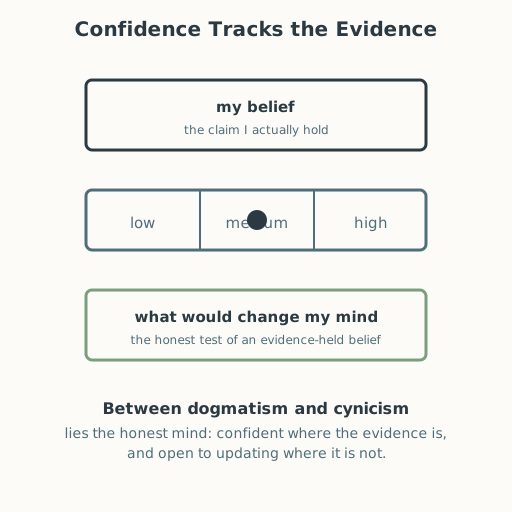
- Confidence-tracks-evidence sheet · 1 per learner For one belief: state the claim, rate confidence (low/medium/high), list the evidence for and against, and write what would change your mind
- Capstone technology & Earth journal · 1 per learner
Low-tech / no-cost
- Blank paper To write the confidence sheet by hand
- One belief of your own A claim the learner actually holds, about anything
Enriched / lab & device
- A device with an internet browser · 1 per pair To look up one piece of evidence for and against a chosen claim
Works in different contexts
- large-group Work one shared claim whole-class first, then each learner works on a personal belief and pairs check
- multi-age Younger learners rate confidence and give one reason; older learners list evidence for and against and what would change their mind
- self-directed A learner completes the confidence sheet for one belief and writes what would change their mind
- level-grouped A ready group also connects the lesson to a real case of science updating itself (the OPERA neutrino result)
- outdoor-only Hold a claim about a local place or weather pattern open, and name one observation that would change it
Lesson 8 — Holding Claims Open to Evidence
Summary
Learners practice epistemic humility: confidence in a belief should track the evidence, and a person should be able to say what would change their mind. They learn how science itself corrects — a striking result (the 2011 faster-than-light neutrino claim) that was later withdrawn after it failed replication — and apply the discipline to one belief of their own, steering between the two traps of dogmatism (my side is certainly right) and cynicism (nothing can be known).
Objectives
- Reflect on how they will stay informed in a flood of information, holding claims open to evidence rather than settling into certainty. (D10.S2.12.02)
Connection
You already hold hundreds of beliefs with different levels of confidence: you are nearly certain the sun will rise, fairly sure of a fact you half-remember, and only tentatively convinced by a claim you read once. The honest mind keeps that difference visible — it says “I am very confident about this, less about that, and here is what would change my mind.” Certainty is not a sign of strength; matching your confidence to your evidence is.
Materials
- Confidence-tracks-evidence sheet
- Capstone technology & Earth journal
- Low-tech: blank paper; one belief of your own
- Enriched: a device with an internet browser
Preparation
- Copy or draw the confidence sheet.
- Retrieval: from Lesson 7, your media diet. Today we go one level deeper — not just checking claims but holding our own beliefs open.
- Prepare the worked example (the OPERA neutrino result) to model first (S-011).
Facilitator note
This lesson is written to the learner (“you”). The idea to land: confidence should track the evidence — I can say how sure I am and what would change my mind — and this is the middle path between dogmatism and cynicism. Model the confidence sheet and the OPERA example explicitly (S-011). This is the unit’s deepest “evidence not certainty” move; teach it as a habit of honesty, never as doubt for its own sake, and never as a weapon against a learner’s values — beliefs held as values are treated with respect, while factual claims are held open to evidence.
The ethics lens: intellectual honesty is an ethical virtue — the willingness to update a belief is respect for the truth over the comfort of being right. The egalitarianism lens: holding claims open is a leveler — it protects ordinary people from being certain into error by the loudest voices, because anyone can ask “what would change your mind?” (S-278). The global lens: the self-correcting habit is universal to science worldwide — peer review and replication are how a community, not any one authority, converges on what is true (S-489). The technology lens: the flood and the filter bubble reward certainty, because confident, simple claims travel fastest — which is exactly why the discipline of tracking evidence is a counterweight (S-481). The environment lens: on the living Earth, overconfidence about a risky claim can do lasting harm, while honest uncertainty lets people act carefully as evidence grows (S-005). Preview: Lesson 9 turns to the Earth itself as one interconnected system.
Procedure
- Recall (5 min). From Lesson 7, one habit of your media diet. Today we apply the same honesty to our own beliefs.
- Learn the discipline (10 min). Confidence should track the evidence: state a claim, rate your confidence (low, medium, high), list evidence for and against, and — most important — write what would change your mind. A belief you cannot imagine changing is held as faith, not as evidence. Say — or write, sign, gesture, or use AAC to show — why “what would change my mind” matters.
- Worked example — science correcting itself (15 min). In 2011, an experiment reported neutrinos apparently traveling faster than light — a result that would overturn a pillar of physics. Instead of celebrating, scientists asked for replication; the result failed to hold and was traced to a measurement error, and was withdrawn (S-488). This is not a failure of science — it is science working: claims are held open, checked, and updated (S-489).
- Apply it to a belief of your own (15 min). Choose one factual belief you hold. Fill the confidence sheet: the claim, your confidence, the evidence for and against, and what would change your mind.
- Peer-check (10 min). With a partner, share only what you choose. Ask: does the confidence match the evidence? is “what would change my mind” specific and honest? Give one reflection.
Differentiation
- Support: Use a pre-drawn sheet with starters (“The claim is…; I am (low/medium/high) confident because…; something that would change my mind is…”); the learner fills one line each.
- Extension: Name one belief you value (not a factual claim) and one factual belief, and say how the two are held differently — values with conviction, facts open to evidence.
- Number access (dyscalculia): The lesson requires no arithmetic. Confidence is rated with words (low/medium/high), not numbers; provide a pre-printed sheet so nothing must be counted, ordered, or computed.
- Communication access: Every spoken step — saying, reading aloud, discussing, or peer-checking — can be done in writing, sign, gesture, or AAC instead. Learners who are non-speaking, d/Deaf, hard-of-hearing, or who use AAC complete every task in their preferred mode; no step requires producing or hearing sound.
Assessment
- Formative (self + peer): Can the learner state a belief, rate their confidence so it tracks the evidence, list evidence for and against, and name what would change their mind?
- Portfolio artifact (unit): The completed confidence sheet, opened in the capstone technology & Earth journal.
Home connection
Ask someone at home what they are very confident about, and then — gently, with respect — ask what would change their mind. Notice how the question lands. Write one sentence about it.
Resources
- On science’s self-correction: Understanding Science — peer review and replication (S-489); on the OPERA neutrino result: Wikipedia — 2011 faster-than-light neutrino anomaly (S-488).
- On bias in science: Understanding Science — what is science? (S-250); on spurious correlation: Vigen — Spurious Correlations (S-307); on worked examples: Kirschner, Sweller & Clark (2006) (S-011).