Lesson 09 — Earth as One Interconnected System
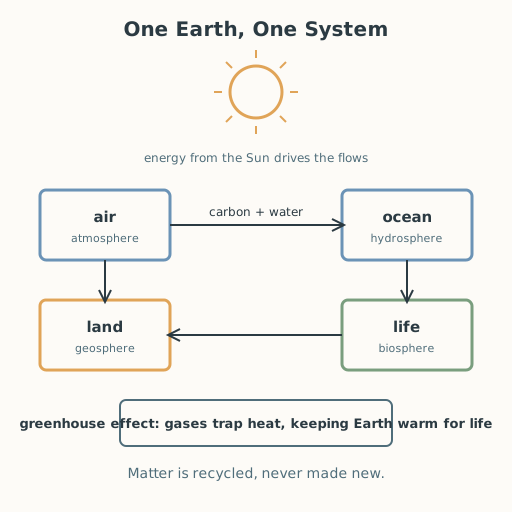
Learners explain Earth as one interconnected system: the atmosphere, hydrosphere, geosphere, and biosphere coupled through cycles of matter (carbon, water) and flows of energy from the Sun. They trace the carbon and water cycles, learn the greenhouse effect that keeps Earth warm enough for life, and name how human activity is now altering these cycles — the bridge to the planetary boundaries of Lesson 10.
Objectives
Objectives
- D10.S3.12.01 Explain Earth as one interconnected system and how human activity is pushing against the planetary boundaries that sustain all life.
Essential question
How do I explain Earth as one interconnected system — atmosphere, water, land, and life — coupled through cycles of matter and energy that human activity is now changing?
Key vocabulary
Materials
Standard materials
- Earth-system cycle sheet · 1 per learner A circle with reservoirs — air, ocean, land, life — and arrows to label how carbon and water move among them
- Capstone technology & Earth journal · 1 per learner
Low-tech / no-cost
- Blank paper To draw the cycle by hand
- A local example of a cycle Rain falling, a river, a plant breathing, a fire — anything that moves matter or energy
Enriched / lab & device
- A short diagram or animation of the carbon or water cycle · 1 per class To see the cycle move end to end
Works in different contexts
- large-group Trace the carbon cycle whole-class, then pairs each trace one local flow (rain, a river, a plant) and report
- multi-age Younger learners draw "where the rain goes"; older learners label reservoirs and fluxes and the greenhouse effect
- self-directed A learner draws the carbon and water cycles with labeled reservoirs and fluxes, and names one human alteration
- level-grouped A ready group also identifies one feedback loop where a human change speeds up further change
- outdoor-only Trace one real cycle in view — rain, runoff, a plant, evaporation — and name where it connects to the wider system
Lesson 9 — Earth as One Interconnected System
Summary
Learners explain Earth as one interconnected system: the atmosphere, hydrosphere, geosphere, and biosphere coupled through cycles of matter (carbon, water) and flows of energy from the Sun. They trace the carbon and water cycles, learn the greenhouse effect that keeps Earth warm enough for life, and name how human activity is now altering these cycles — the bridge to the planetary boundaries of Lesson 10.
Objectives
- Explain Earth as one interconnected system and how human activity is pushing against the planetary boundaries that sustain all life. (D10.S3.12.01)
Connection
The breath you just took in is air that has circled the planet; the water in your glass has been cloud, rain, river, and sea before; the carbon in your body has been a tree, a fish, and a rock. Nothing on Earth is made fresh — matter is recycled through one connected system, and energy from the Sun drives the whole thing. You are not a visitor to this system; you are one of its moving parts.
Materials
- Earth-system cycle sheet
- Capstone technology & Earth journal
- Low-tech: blank paper; a local example of a cycle
- Enriched: a short diagram or animation of the carbon or water cycle
Preparation
- Copy or draw the cycle sheet.
- Retrieval: from Grade 11 (D10.S3.11.01), trace a global cycle and how human activity has altered it; from D10.S3.11.02, the more-than-human world. Today we pull the cycles into one system.
- Prepare the worked example (the carbon cycle) to model first (S-011).
Facilitator note
This lesson is written to the learner (“you”). The idea to land: Earth is one system — atmosphere, water, land, and life — coupled through cycles of matter and energy from the Sun, and human activity is now altering those cycles. Model the carbon cycle explicitly, then let learners trace water and a local flow (S-011). Keep evidence and values distinct: that the system is coupled and that humans are altering it are factual, cited claims (S-253, S-212, S-005); what we ought to do about it is argued in later lessons.
The ethics lens: seeing the whole system makes the consequences of a choice travel — the carbon burned here warms the air everywhere — so the system view is an ethical demand to notice what reaches others. The egalitarianism lens: a changed cycle does not fall evenly — the people who contributed least to altering it often feel it first and worst (S-005, S-006). The global lens: the cycles are planetary by nature, so they cannot be understood or fixed one country at a time — the ocean, the wind, and the carbon all cross every border (S-214). The technology lens: technology both reveals the system (satellites and data that show the whole planet) and alters it (the burning that loads the atmosphere with carbon) — the same tools that measure are also part of the story (S-006). The environment lens: the greenhouse effect is a natural, life-giving process that human emissions are strengthening, and the biosphere is losing species because of it and of other drivers (S-438, S-437). Preview: Lesson 10 names the planetary boundaries this system is pressing against.
Procedure
- Recall (5 min). From Grade 11, one global cycle you traced — carbon, nitrogen, or water. Today we see the cycles as one system.
- Name the spheres (8 min). Earth’s system is usually described as four coupled parts: the atmosphere (air), the hydrosphere (water), the geosphere (rock and soil), and the biosphere (life). Say — or write, sign, gesture, or use AAC to show — one thing that moves between two of them.
- Worked example — the carbon cycle (15 min). Carbon moves among air, ocean, land, and life: plants pull it from the air, living things release it, the ocean and rocks store it, and burning fossil fuels sends long-buried carbon back into the air. Because Earth is a closed system for matter, carbon is reused, never made new (S-253). Trace the loop on your sheet.
- The water cycle and the greenhouse (10 min). Water cycles too — the Sun lifts it, gravity brings it down, and the ocean holds most of it (S-212, S-214). And a blanket of gases keeps Earth warm enough for life — the greenhouse effect — which added carbon is now strengthening (S-438).
- Name a human alteration (12 min). Write one way human activity changes these cycles — the carbon added by burning, the water diverted, the land cleared. With a partner, trace where that change travels next in the system.
- Close (5 min). Say — or write, sign, gesture, or use AAC to express — one complete sentence: “Earth is one system because…” and finish it in your own words.
Differentiation
- Support: Use a pre-drawn cycle sheet with the four reservoirs labeled and the arrows ready to label; the learner writes one word per arrow.
- Extension: Identify one feedback loop — a change that returns to speed itself up, such as warming melting ice that reflects less sunlight — and trace it one full turn.
- Number access (dyscalculia): The lesson is diagram-based and requires no arithmetic. Provide the cycle sheet pre-drawn so the learner labels arrows rather than measuring or counting, and allow every flow to be stated in words with no numeric work.
- Communication access: Every spoken step — saying, reading aloud, discussing, or closing — can be done in writing, sign, gesture, or AAC instead. Learners who are non-speaking, d/Deaf, hard-of-hearing, or who use AAC complete every task in their preferred mode; no step requires producing or hearing sound.
Assessment
- Formative (peer + self): Can the learner name the four spheres, trace the carbon and water cycles through reservoirs and fluxes, explain the greenhouse effect, and name one human alteration?
- Portfolio artifact (unit): The labeled Earth-system cycle sheet with one written human alteration, opened in the capstone technology & Earth journal.
Home connection
Trace one thing you used today — a cup of water, a piece of food, a breath of air — back one step in its cycle. Write two sentences about where it came from and where it goes next.
Resources
- On the carbon cycle: National Geographic Education — The Carbon Cycle (S-253); on the water cycle: USGS Water Science School (S-212) and the ocean’s share: NOAA (S-214).
- On the greenhouse effect: NASA (S-438); on the coupled climate system: IPCC (S-005); on biodiversity loss: IPBES Global Assessment (S-437).
- On worked examples: Kirschner, Sweller & Clark (2006) (S-011); on global data: Our World in Data (S-006).