Lesson 10 — Planetary Boundaries
Learners meet the planetary boundaries framework: nine Earth-system processes that define the "safe operating space" — the stable Holocene conditions in which human civilizations grew — and the finding that human activity has now crossed several of them. They learn it with words, not figures, and anchor each boundary to a real local sign of strain, so the honest fact of ecological pressure is met with understanding and agency rather than despair.
Objectives
Objectives
- D10.S3.12.01 Explain Earth as one interconnected system and how human activity is pushing against the planetary boundaries that sustain all life.
Essential question
How do I explain the planetary boundaries — the safe operating space that has let humanity flourish — and the honest fact that human activity is now pushing past several of them, without falling into despair?
Key vocabulary
Materials
Standard materials
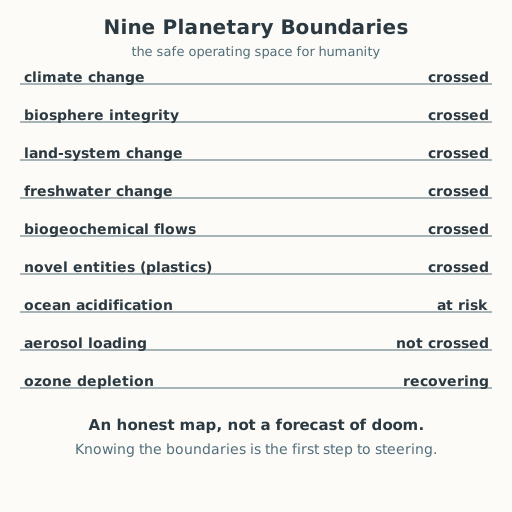
- Planetary-boundaries organizer (pre-printed) · 1 per learner Nine boundaries listed with a simple three-state mark (safe / at risk / crossed) already shown as words, not numbers — climate change, biosphere integrity, land-system change, freshwater change, biogeochemical flows, ocean acidification, aerosol loading, ozone depletion, novel entities
- Capstone technology & Earth journal · 1 per learner
Low-tech / no-cost
- Blank paper To copy the nine boundaries as a word list with marks, not figures
- A local sign of strain A dry well, a flood, a hotter season, a vanished species — one real, local example to anchor the abstract
Enriched / lab & device
- The Stockholm Resilience Centre planetary-boundaries page · 1 per class To see the nine boundaries and their current status as a diagram
Works in different contexts
- large-group Walk the nine boundaries whole-class, then pairs each take one boundary and name a local sign of strain
- multi-age Younger learners name one boundary in words and one local sign; older learners add which are crossed and why that matters
- self-directed A learner copies the nine boundaries as a word list, marks each safe/at-risk/crossed, and writes one local sign of strain
- level-grouped A ready group also explains a tipping point — a threshold past which change can become hard to reverse — with one example
- outdoor-only Anchor the boundaries to one real local system — water, soil, or air — and name the boundary it presses against
Lesson 10 — Planetary Boundaries
Summary
Learners meet the planetary boundaries framework: nine Earth-system processes that define the “safe operating space” — the stable Holocene conditions in which human civilizations grew — and the finding that human activity has now crossed several of them. They learn it with words, not figures, and anchor each boundary to a real local sign of strain, so the honest fact of ecological pressure is met with understanding and agency rather than despair.
Objectives
- Explain Earth as one interconnected system and how human activity is pushing against the planetary boundaries that sustain all life. (D10.S3.12.01)
Connection
For most of the last ten thousand years, the Earth’s conditions stayed steady enough for farms, cities, and civilizations to grow — the climate, the water, the soils, the web of life all held. That steady window is called a “safe operating space.” Scientists now measure that space and find that human activity is pressing past several of its edges. This is not a forecast of doom; it is a map — and a map is the first thing you need if you intend to steer.
Materials
- Planetary-boundaries organizer (pre-printed)
- Capstone technology & Earth journal
- Low-tech: blank paper; a local sign of strain
- Enriched: the Stockholm Resilience Centre planetary-boundaries page
Preparation
- Copy or draw the nine-boundary organizer with states as words (safe / at risk / crossed), not numbers.
- Retrieval: from Lesson 9, Earth as one system and the greenhouse effect. Today we name the edges of the system.
- Prepare to hold the honesty-and-agency balance: name the strain truthfully, then always ask “what can be done, individually and with others.”
Facilitator note
This lesson is written to the learner (“you”). The idea to land: nine planetary boundaries define the safe operating space of the Holocene, and human activity has crossed several of them — an honest, evidence-based finding that must be met with agency, not despair. Teach the boundaries with words, not figures, and pre-print the organizer to offload the numbers (see Differentiation). This is the unit’s hardest truth; hold it carefully (development.md §9–12): name the strain truthfully, never dump despair, and always return to “here is what people are doing and what you can do.”
The ethics lens: crossing a boundary harms people and other species who did not cause it, so knowing the boundaries is an ethical demand to act, not just to know. The egalitarianism lens: the burdens of crossed boundaries fall unevenly — those who contributed least often feel them first and worst — so the boundaries are a question of justice, not only of science (S-005, S-006). The global lens: boundaries are planetary by definition — the atmosphere, the ocean, and the nitrogen cycle do not respect borders, so the response must be shared across the world (S-005). The technology lens: technology is part of both sides — it powered the overshoot, and it also measures the boundaries and can help bring human activity back inside them — which is why the unit treats technology as neither savior nor villain (S-006). The environment lens: the framework is the unit’s core environmental fact — climate change, biodiversity loss, and the other crossed boundaries are documented by the IPCC and IPBES, not speculation (S-005, S-437, S-507). Preview: Lesson 11 turns inward — your own place in this living world.
Procedure
- Recall (5 min). From Lesson 9, one way human activity changes the carbon or water cycle. Today we name the edges of the system those changes press against.
- Meet the idea (10 min). A planetary boundary is a limit on an Earth-system process — climate, water, soils, the web of life — that, if crossed, risks leaving the stable conditions of the last ten thousand years (the Holocene) that civilizations depend on (S-507). Say — or write, sign, gesture, or use AAC to show — what “safe operating space” means in your own words.
- Walk the nine boundaries (15 min). Read the nine: climate change, biosphere integrity (the loss of species), land-system change, freshwater change, biogeochemical flows (too much nitrogen and phosphorus), ocean acidification, aerosol loading, ozone depletion, and novel entities (chemical pollution and plastics) (S-507). Mark each with a word — safe, at risk, or crossed — using the pre-printed organizer. Several are now crossed, including climate and the loss of species (S-507, S-005, S-437).
- Anchor to the local (15 min). Choose two boundaries and name one real, local sign of strain for each — a hotter season, a dry well, a flood, a vanished species, a plastic-choked shore. This is not a quiz; it is the map made real.
- Meet the tipping point (5 min). A tipping point is a threshold past which a change can feed on itself and become hard to reverse — the reason boundaries matter before they are crossed (S-309).
- Close (5 min). Say — or write, sign, gesture, or use AAC to express — one honest sentence about the strain and one thing people can do about it. Never one without the other.
Differentiation
- Support: Use the pre-printed organizer with the nine boundaries already listed and the states shown as words; the learner circles one state per boundary and names one local sign of strain.
- Extension: For one crossed boundary, explain why crossing it is hard to reverse (a tipping point or a slow-to-recover process), and name one action — individual or collective — that addresses it.
- Number access (dyscalculia): This lesson is deliberately number-free. The nine boundaries are presented as a word list with three word-states (safe / at risk / crossed); no thresholds, quantities, or figures need to be read, ordered, or compared. Provide the pre-printed organizer so nothing is transcribed or computed.
- Communication access: Every spoken step — saying, reading aloud, discussing, or closing — can be done in writing, sign, gesture, or AAC instead. Learners who are non-speaking, d/Deaf, hard-of-hearing, or who use AAC complete every task in their preferred mode; no step requires producing or hearing sound.
Assessment
- Formative (peer + self): Can the learner name the safe operating space, list the nine boundaries in words, mark several as crossed, and anchor two boundaries to a real local sign of strain — pairing honesty about the strain with something people can do?
- Portfolio artifact (unit): The completed boundary organizer with two local anchors and one “what people can do” line, opened in the capstone technology & Earth journal.
Home connection
Ask someone at home what they have noticed change in the local weather, water, or wildlife over their lifetime. Write two sentences connecting their observation to one planetary boundary.
Resources
- On the planetary boundaries framework: Stockholm Resilience Centre / Rockström et al. (S-507); on the climate boundary: IPCC (S-005); on the biosphere boundary: IPBES Global Assessment (S-437).
- On climate and tipping points: NOAA Climate (S-309); on global emissions data: Our World in Data (S-006).