Lesson 11 — My Place in the Living World
Learners place themselves within the living world, mapping the web of life they are already part of — the food, water, air, soil, sun, and other species they depend on, and that depend on them. They meet the idea of reciprocity from Indigenous and place-based traditions, and the more-than-human world, and begin to see interdependence not as an abstract fact but as their own address in the world.
Objectives
Objectives
- D10.S3.12.02 Reflect on their place within the living world and how understanding interdependence shapes how they choose to live.
Essential question
What is my place within the living world — how am I a living being among living beings, bound to them by the same air, water, soil, and sun?
Key vocabulary
Materials
Standard materials
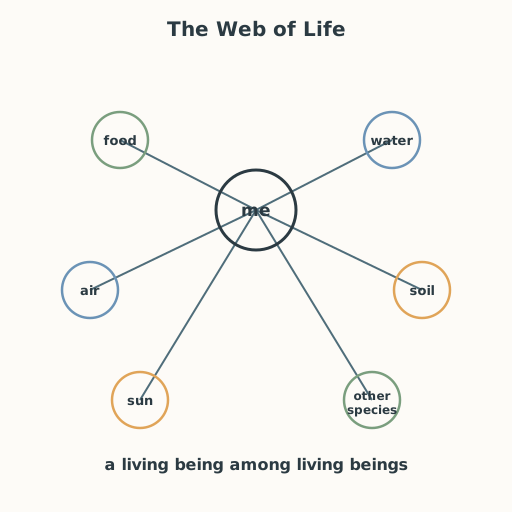
- Web-of-life sheet · 1 per learner A circle with 'me' at the center and lines outward to the living and nonliving things the learner depends on — food, water, air, soil, sun, and other species
- Capstone technology & Earth journal · 1 per learner
Low-tech / no-cost
- Blank paper To draw the web of life by hand
- One plant, animal, or place you actually depend on A real, named living thing or place from the learner's own life
Enriched / lab & device
- A short reading from an Indigenous or place-based account of reciprocity · 1 per class A living tradition's way of naming kinship with land, water, and other species
Works in different contexts
- large-group Build one web whole-class with strings between learners, then each learner draws their own web and shares one line
- multi-age Younger learners name one living thing they depend on; older learners add reciprocity and the more-than-human idea
- self-directed A learner draws a web-of-life with lines to what they depend on and writes one reciprocity sentence
- level-grouped A ready group also names one ecosystem service — pollination, clean water, soil — and the living thing that provides it
- outdoor-only Sit near a real living thing and draw the web from it outward, then place yourself on one of its lines
Lesson 11 — My Place in the Living World
Summary
Learners place themselves within the living world, mapping the web of life they are already part of — the food, water, air, soil, sun, and other species they depend on, and that depend on them. They meet the idea of reciprocity from Indigenous and place-based traditions, and the more-than-human world, and begin to see interdependence not as an abstract fact but as their own address in the world.
Objectives
- Reflect on their place within the living world and how understanding interdependence shapes how they choose to live. (D10.S3.12.02)
Connection
You do not stand outside nature looking at it. The oxygen in your lungs came from a plant; the water in your body was once cloud and river; the food on your plate grew in soil made by countless small lives. Other beings — a pollinating bee, a filtering wetland, a deep taproot — are quietly doing work you depend on every day. Your place in the living world is not a location on a map; it is a web of relationships you are already woven into.
Materials
- Web-of-life sheet
- Capstone technology & Earth journal
- Low-tech: blank paper; one plant, animal, or place you depend on
- Enriched: a short reading from an Indigenous or place-based account of reciprocity
Preparation
- Copy or draw the web-of-life sheet.
- Retrieval: from Lessons 9–10, Earth as one system and the planetary boundaries. Today we locate yourself inside that system.
- Frame this as belonging, not burden: the web is what keeps you alive, and it is worth knowing.
Facilitator note
This lesson is written to the learner (“you”). The idea to land: I am a living being among living beings, bound to them by the same air, water, soil, and sun — my place is a web of relationships, and I can name the beings I depend on and that depend on me. Keep the tone of belonging and wonder, not guilt. Treat Indigenous and place-based traditions with respect — each is a distinct, living tradition, offered here as an example, never reduced to a single concept or ranked against science.
The ethics lens: naming what you depend on is the seed of care — you tend what you know you owe your life to. The egalitarianism lens: the web includes every being, not only the ones useful to humans, and this is a leveling idea — a beetle and a person are both threads, though different threads (S-437). The global lens: cultures around the world have long named this kinship — many Indigenous and place-based traditions treat land, water, and other species as relatives owed care, a way of seeing the unit holds alongside science, not beneath it (S-427, S-320). The technology lens: some traditions and some tools both reveal the web — a botanist’s lens and an elder’s plant-knowledge each name real relationships, and both matter (S-427). The environment lens: the web is not metaphor but fact — species are declining because the threads are being cut, and ecosystem services like pollination and clean water are the web doing its work (S-437, S-176). Preview: Lesson 12 turns the web into choices — how knowing you are interdependent changes how you live.
Procedure
- Recall (5 min). From Lesson 10, one planetary boundary. Today we step inside the system — and find you there.
- Draw your web (15 min). Put “me” at the center. Draw lines outward to what keeps you alive: food, water, air, soil, sun, and other species — the plant that made your oxygen, the animal that pollinated your food, the wetland that filtered your water. Name at least one of them specifically (a real tree, a real river, a real bee). Say — or write, sign, gesture, or use AAC to show — one thread you had never noticed.
- Turn the web around (10 min). Now ask the reverse: what depends on you? The soil you walk on, the animal whose home your choices touch, the people downstream. Add those arrows.
- Meet reciprocity (10 min). Some traditions call this reciprocity: because the living world gives to you, you give back — you take only what you need, and you give in return, so all flourishing is mutual (S-427). Write one reciprocity sentence: “Because… gives me…, I will…”.
- Name an ecosystem service (10 min). Pick one thread of your web and name the service it provides — pollination, clean water, fertile soil, breathable air (S-437). Notice: the web is doing real work for you every day.
- Close (5 min). Say — or write, sign, gesture, or use AAC to express — one sentence: “My place in the living world is…” and finish it.
Differentiation
- Support: Use a pre-drawn web with “me” and six labeled nodes; the learner draws and labels one line at a time and names one specific living thing.
- Extension: For one thread, explain what would happen to you and to others if that thread were cut, and name one thing you could do to keep it whole.
- Number access (dyscalculia): The lesson is diagram-based and requires no arithmetic. The web is drawn and labeled with words; nothing must be counted, ordered, or computed.
- Communication access: Every spoken step — saying, reading aloud, discussing, or closing — can be done in writing, sign, gesture, or AAC instead. Learners who are non-speaking, d/Deaf, hard-of-hearing, or who use AAC complete every task in their preferred mode; no step requires producing or hearing sound.
Assessment
- Formative (self + peer): Can the learner draw a web of life from themselves to the food, water, air, soil, sun, and species they depend on, name one specific living thing, and write one reciprocity sentence?
- Portfolio artifact (unit): The labeled web of life with one reciprocity sentence, opened in the capstone technology & Earth journal.
Home connection
Choose one living thing near your home — a tree, a bird, a garden plant — and spend two quiet minutes noticing what it gives and what it needs. Write one sentence about what you noticed.
Resources
- On reciprocity and kinship with the living world: Kimmerer — Braiding Sweetgrass (S-427); on cultural burning as living stewardship: CSIRO (S-320) and Firesticks Alliance (S-321).
- On biodiversity and ecosystem services: IPBES Global Assessment (S-437); on keystone species: National Geographic Education (S-176); on biodiversity’s value: Convention on Biological Diversity (S-279).