Lesson 12 — How Interdependence Shapes How I Live
Learners turn the web of life from an insight into a practice. They trace the ripples of one everyday choice — a meal, a trip, a purchase, a use of water or energy — outward to themselves, other people, other species, future generations, and the Earth, weigh the trade-offs, and write one change they will actually make. The stance is care, not guilt: knowing you are interdependent is a reason to choose well, not a reason to feel bad.
Objectives
Objectives
- D10.S3.12.02 Reflect on their place within the living world and how understanding interdependence shapes how they choose to live.
Essential question
How does understanding that I am interdependent with the living world change what I choose — what I eat, buy, travel, use, and value?
Key vocabulary
Materials
Standard materials
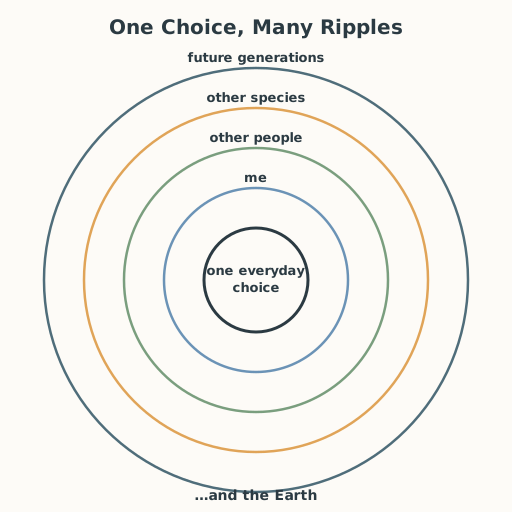
- Choices-and-ripples sheet · 1 per learner One everyday choice at the center, with ripples outward to self, other people, other species, future generations, and the Earth
- Capstone technology & Earth journal · 1 per learner
Low-tech / no-cost
- Blank paper To draw the choices-and-ripples map by hand
- One real choice from your own week A meal, a trip, a purchase, a use of water or energy
Enriched / lab & device
- A footprint or impact tool · 1 per pair Optional, to add data to one ripple
Works in different contexts
- large-group Trace one shared choice's ripples whole-class, then each learner traces a choice of their own and pairs compare
- multi-age Younger learners name one ripple (self → Earth); older learners add trade-offs and collective action
- self-directed A learner traces one everyday choice's ripples and writes one change they will make
- level-grouped A ready group also weighs a trade-off — a choice good for one ripple but costly for another — and argues it
- outdoor-only Trace a choice tied to the outdoors — water, fuel, or food — with the real consequence in view
Lesson 12 — How Interdependence Shapes How I Live
Summary
Learners turn the web of life from an insight into a practice. They trace the ripples of one everyday choice — a meal, a trip, a purchase, a use of water or energy — outward to themselves, other people, other species, future generations, and the Earth, weigh the trade-offs, and write one change they will actually make. The stance is care, not guilt: knowing you are interdependent is a reason to choose well, not a reason to feel bad.
Objectives
- Reflect on their place within the living world and how understanding interdependence shapes how they choose to live. (D10.S3.12.02)
Connection
Every choice you make already has ripples — the food you buy grew somewhere, using water and soil and someone’s work; the trip you take burned something; the thing you bought will one day be waste. Knowing you are part of the web does not make these choices easy or clean; it makes them visible. And a visible choice is one you can make on purpose, weighing what it gives you against what it asks of everyone else, present and future.
Materials
- Choices-and-ripples sheet
- Capstone technology & Earth journal
- Low-tech: blank paper; one real choice from your own week
- Enriched: a footprint or impact tool
Preparation
- Copy or draw the choices-and-ripples sheet (choice at center; ripples of self, other people, other species, future generations, Earth).
- Retrieval: from Lesson 11, your web of life. Today we follow one thread of the web through your own choices.
- Frame this as care, not guilt: the goal is one honest change, not shame.
Facilitator note
This lesson is written to the learner (“you”). The idea to land: knowing I am interdependent turns my everyday choices visible — each one ripples to myself, other people, other species, future generations, and the Earth — so I can choose with care, weighing trade-offs honestly and changing one thing at a time. Never rank learners by the size or purity of their change; a small, kept choice is worth more than a grand, abandoned one. Distinguish evidence from values: a choice’s effects are measurable (a footprint), but which trade-offs are worth accepting is a values question for the learner to argue (S-277, S-395).
The ethics lens: the ripple is an ethics of consequences made concrete — what happens to everyone affected by a choice, including those not yet born. The egalitarianism lens: some choices cost more elsewhere than where they are made — the water and labor embedded in a product are often borne far from the buyer — so choosing with care is partly a matter of justice (S-006, S-437). The global lens: what counts as a good choice differs by place — walking, sharing, growing, and mending look different in a city, a village, and a farm — so the lesson adapts rather than prescribing one “right” lifestyle (S-006). The technology lens: tools can make the ripple visible (a footprint estimator) and can also widen it (a supply chain that hides where things come from) — the same technology serves both, depending on how it is used (S-006, S-371). The environment lens: the footprint idea — how much nature a life uses — is a real measurement, and ordinary people acting together (a movement that planted millions of trees) shows that individual choices compound into collective change (S-277, S-059). Preview: Lesson 13 turns these choices into a designed stewardship plan for a real place or resource.
Procedure
- Recall (5 min). From Lesson 11, one thread of your web of life. Today we follow that thread through a choice.
- Choose one real choice (8 min). Pick one choice you actually made this week — a meal, a trip, a purchase, a use of water or energy. Put it at the center of your sheet.
- Trace the ripples (15 min). Draw the ripples outward and label each: me (what it gave you), other people (whose work or health it touched, near or far), other species (whose home or life it affected), future generations (what it leaves for them), and the Earth (the water, soil, and air it used) (S-277). Say — or write, sign, gesture, or use AAC to show — the ripple that surprised you most.
- Weigh a trade-off (10 min). Every choice is a trade-off: it gives you something and asks something of others. Write one trade-off honestly — what you gained, and what it cost the wider web.
- Choose one change (12 min). Write one change you will actually make, as a verb with a when (“I will walk… when…”; “I will buy… less often”; “I will repair… before replacing”). Make it small enough to keep.
- Close (5 min). Say — or write, sign, gesture, or use AAC to express — one sentence: “Because I am part of the web, I will…” and finish it.
Differentiation
- Support: Use a pre-drawn ripple sheet with the five rings labeled; the learner fills one phrase per ring and chooses one change from a short menu.
- Extension: Weigh one trade-off where two ripples conflict (a choice good for people but costly for the Earth, or vice versa), and argue which consideration should win and why.
- Number access (dyscalculia): The lesson requires no arithmetic; any footprint figures are described in words (“more,” “less,” “a lot”), and the ripple map is a word organizer. Provide the sheet pre-drawn so nothing is measured, counted, or computed.
- Communication access: Every spoken step — saying, reading aloud, discussing, or closing — can be done in writing, sign, gesture, or AAC instead. Learners who are non-speaking, d/Deaf, hard-of-hearing, or who use AAC complete every task in their preferred mode; no step requires producing or hearing sound.
Assessment
- Formative (self + peer): Can the learner trace one everyday choice’s ripples to self, other people, other species, future generations, and the Earth, weigh a trade-off, and write one doable change?
- Portfolio artifact (unit): The completed choices-and-ripples map with one written change, opened in the capstone technology & Earth journal.
Home connection
Tell someone at home the one change you chose, and ask them to do it with you for one week. Write one sentence about what was easy and what was hard.
Resources
- On the ecological footprint: Global Footprint Network (S-277); on sustainable development and future generations: Brundtland Report (S-395).
- On global patterns of who uses and who is affected: Our World in Data (S-006); on biodiversity and the living world: IPBES Global Assessment (S-437); on a product’s hidden life cycle: EPA — Sustainable Materials Management (S-371).
- On collective action: Nobel Prize — Wangari Maathai (S-059).